
Bootstrapping a startup with AI automation is the most cost-effective way for non-technical founders to launch and grow a business without a large team or outside capital. An AI agent stack costing $300–$500 per month now replaces functions that once required $80,000–$120,000 monthly in human payroll. That single shift in startup economics makes solo founding viable at a scale that was impossible five years ago. Astarlabshub's Agentica platform takes this further by deploying specialized autonomous agents across CEO, Marketing, and Engineer roles so founders can focus on vision while AI handles execution.
What AI tools are essential for a bootstrap startup using AI automation?
The right AI tool stack is the foundation of any lean, automated startup. Founders who try to automate before choosing the right tools waste time and money on systems that don't connect. The goal is to cover five core functions: coding assistance, content creation, customer support, design, and workflow automation.
These functions map directly to the roles you would otherwise hire for. A solo founder running an AI-powered stack can operate 24/7 customer outreach and lead coordination for as little as $100 per month. That cost is not a rounding error. It represents a structural change in what one person can build and run alone.

| AI tool category | Role it replaces | Example function |
|---|---|---|
| Coding assistant | Junior developer | Write, debug, and refactor code |
| Content generation | Copywriter | Blog posts, emails, ad copy |
| Customer support agent | Support rep | Ticket triage, FAQ responses |
| Design assistant | Graphic designer | Landing pages, social assets |
| Workflow automation | Operations manager | Connect apps, trigger actions |
Three types of tools exist in this space. Standalone AI tools handle one job well. AI-enhanced SaaS products add AI features to existing platforms. Autonomous agent frameworks, like Agentica, coordinate multiple AI roles in a single system. Most bootstrapped founders start with standalone tools and graduate to agent frameworks as complexity grows.
Pro Tip: Focus on context engineering, not just prompt engineering. The quality of the background information you give an AI agent determines the quality of its output far more than clever phrasing.
How do you identify the highest-impact workflows to automate first?
Workflow selection is where most founders make their first mistake. They automate what feels annoying rather than what drives the most value. The correct principle: identify workflows where AI can improve unit economics by 10x, then rebuild that process with AI at the center.
A 10x improvement means the task either costs 10 times less, runs 10 times faster, or produces 10 times more output per hour of founder time. Marginal improvements are not worth the setup cost. Target the workflows that are high volume, low judgment, and repetitive.
Common automatable workflows in an early-stage startup include:
- Email responses: AI drafts replies to common inquiries using your tone and knowledge base.
- Lead qualification: AI scores inbound leads based on criteria you define, so you only talk to the right prospects.
- Customer support triage: AI routes tickets, answers FAQs, and escalates only complex issues.
- Content drafts: AI generates first drafts for blog posts, social media, and newsletters.
- Invoice and contract processing: AI extracts data and flags exceptions for human review.
- Meeting summaries: AI transcribes calls and produces action items automatically.
Document every workflow before you automate it. Automation tools cannot fix a broken or poorly defined process. Write out the trigger, the sequence of steps, the decision rules, and what happens when something goes wrong. That specification document becomes your automation blueprint.
"Simple scripts or manual processes often outperform complex automations for low-volume tasks." Overbuilding is the most common and costly mistake bootstrapped founders make.
Pro Tip: Add a human-in-the-loop checkpoint for any action that cannot be undone, such as sending bulk emails, deleting records, or publishing content publicly. One bad automated run can damage relationships that took months to build.
Step-by-step: building AI automation in your bootstrap startup
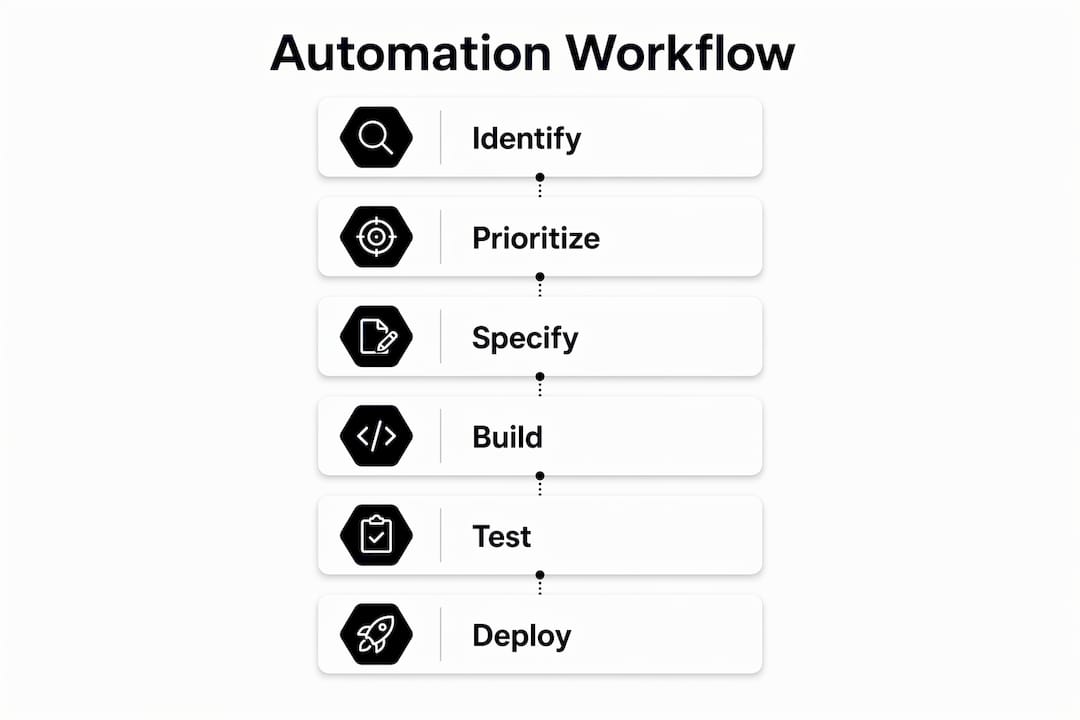
Non-technical founders do not need to write code to deploy working automation. The process follows a clear sequence that any founder can execute with the right tools.
- Choose one workflow. Pick the single highest-volume, lowest-judgment task in your operation. Do not try to automate everything at once.
- Write the specification. Define the trigger event, every step in the sequence, the decision rules at each branch, and the fallback action if the AI fails. Triggers and decision rules must be explicit before you touch any tool.
- Select your tools. Zapier or Make handle workflow connections between apps. Claude or GPT-4o handle language tasks like drafting, summarizing, and classifying. Combine them based on your specification.
- Build and test with live data. Run the automation on real inputs before going live at scale. Synthetic test data hides edge cases that real data exposes immediately.
- Monitor for silent failures. Set up alerts for when an automation runs zero times in a period it should have run. Silent failures are the most dangerous because nothing breaks visibly.
- Refine and expand. Once the first workflow runs reliably for two weeks, apply the same process to the next highest-impact task.
| Step | Key action | Time estimate | Cost estimate |
|---|---|---|---|
| Specification | Document workflow in writing | 2–4 hours | $0 |
| Tool setup | Connect apps in Zapier or Make | 3–6 hours | $20–$50/mo |
| AI integration | Add Claude or GPT-4o to tasks | 2–4 hours | $20–$100/mo |
| Testing | Run on live data, fix errors | 2–3 hours | $0 |
| Monitoring | Set failure alerts | 1 hour | $0–$10/mo |
Astarlabshub's Agentica platform compresses this entire process. Its autonomous agents handle specification, execution, and monitoring inside a single system. Founders who used Agentica reported 340% growth in 30 days by removing the manual setup work from each step above.
Pro Tip: Build your first automation to be reversible. If the output is wrong, you want to be able to undo it in minutes. Lock in permanence only after the system has proven reliable.
What are the cost and risk considerations when bootstrapping with AI?
Monthly AI tool costs for a bootstrapped startup typically fall between $100 and $500. That range covers frontier AI models, workflow automation platforms, and basic monitoring. The ROI is clear when you compare it to the payroll it replaces, but the risks are real and worth managing from day one.
Security controls are mandatory for any autonomous AI agent touching your startup's systems. Every agent should operate with the minimum access it needs. Secrets like API keys must be stored in a dedicated secrets manager, not in plain text. Every action an agent takes should be logged so you can audit what happened and when.
The four risks founders most often underestimate are:
- Technical debt from overbuilding: Complex automation pipelines break in unexpected ways and cost more to maintain than they save. Minimal viable automation beats elaborate systems every time for early-stage startups.
- Vendor lock-in: Building deep integrations with a single AI provider creates fragility if that provider changes pricing or deprecates a feature.
- Silent failures: Automations that stop working without alerting anyone cause compounding damage before anyone notices.
- Over-automation of judgment tasks: AI handles repetitive tasks well. Decisions that require nuance, ethics, or relationship context still need a human.
Keep automation reversible for as long as possible. Write documentation for every workflow so a new person, or future you, can understand and modify it without starting from scratch. Scale automation only after a workflow has proven stable, not before.
Key takeaways
A bootstrap startup using AI automation succeeds by selecting high-impact workflows, building minimal viable automations, and maintaining human oversight for irreversible actions.
| Point | Details |
|---|---|
| AI stacks replace payroll | A $300–$500/mo AI stack covers functions that cost $80k–$120k/mo in human labor. |
| Automate for 10x gains | Target workflows where AI improves unit economics by 10x, not just marginally. |
| Specify before you build | Document triggers, steps, and fallbacks before touching any automation tool. |
| Security is non-negotiable | Limit agent access, log every action, and require human approval for irreversible tasks. |
| Distribution beats features | Building an AI product is cheap. Getting it in front of customers is the real work. |
Why I think most founders automate in the wrong order
Founders get excited about AI tools and start automating the tasks they personally find tedious. I understand the impulse. But tedious for you is not the same as high-value for your business. The founders I have watched build real traction with AI automation all started with one question: where does my business lose the most money or time per week? The answer is almost never "writing my own emails."
The other trap I see constantly is building automation before the underlying process works manually. If your lead qualification process is broken when a human does it, an AI agent will break it faster and at higher volume. Fix the process first. Then automate it.
Distribution remains the key competitive factor over AI feature richness. Every founder I respect in this space says the same thing: building the product is now the easy part. Getting people to use it is where the real work lives. Your AI stack should free up your time for customer conversations, not replace them.
Start small, prove the system works, then expand. The founders who try to automate everything in month one spend month two fixing broken pipelines. The founders who automate one workflow well in month one have a reliable system and a clear template for the next one. That compounding effect is where the real advantage lives.
— Carlos
How Astarlabshub's Agentica fits a bootstrap budget
Non-technical founders who want to skip the manual setup process have a direct path with Astarlabshub's Agentica platform.
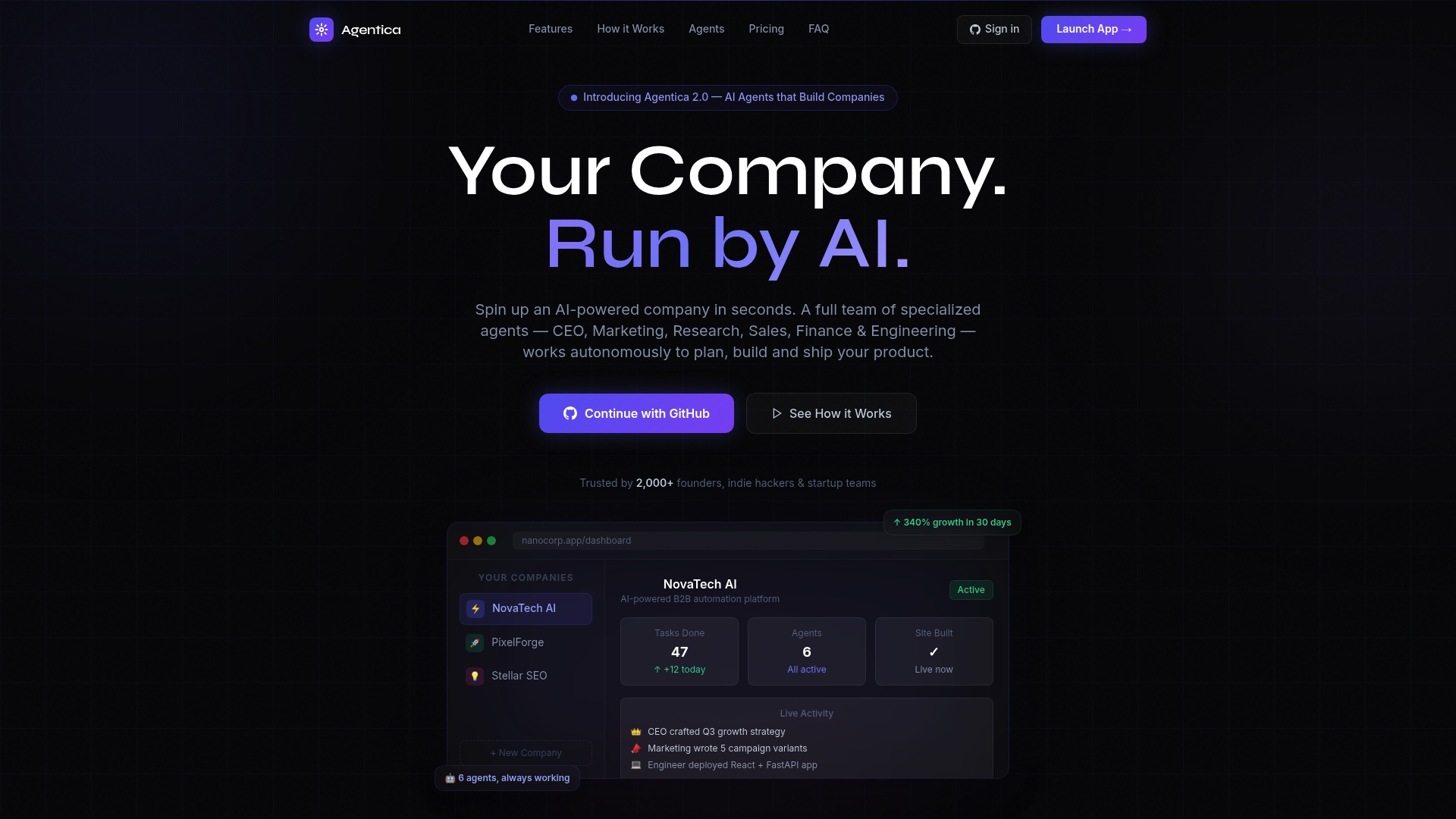
Agentica deploys a coordinated team of autonomous AI agents covering CEO, Marketing, and Engineer functions inside a single platform. Founders do not need to connect tools manually or write specifications from scratch. The agents handle strategy, coding, and deployment while you set the direction. Pricing tiers are built for bootstrap budgets, making enterprise-grade automation accessible without venture capital. Astarlabshub clients have reported 340% growth in 30 days using the autonomous mode, with full real-time visibility into every action the agents take.
FAQ
What does bootstrapping a startup with AI automation mean?
Bootstrapping with AI automation means building and running a startup using AI tools to replace functions you would otherwise hire people for, without outside investment. The goal is to keep costs low while maintaining full operational capacity.
How much does an AI tool stack cost per month for a solo founder?
A functional AI stack for a bootstrapped startup costs between $100 and $500 per month. That covers coding, content, and support automation using frontier AI models and workflow platforms.
Which workflows should a bootstrapped founder automate first?
Automate the workflows with the highest volume and lowest judgment requirements first. Email triage, lead qualification, and customer support ticket routing are the most common starting points because they are repetitive and well-defined.
Is AI automation safe for a startup with sensitive customer data?
AI automation is safe when you apply proper security controls: limit agent access to only what it needs, store credentials in a secrets manager, log every action, and require human approval before any irreversible operation runs.
Can a non-technical founder build AI automation without coding?
Yes. Platforms like Zapier and Make connect apps without code. Autonomous agent platforms like Agentica handle the full build and deployment process, so non-technical founders can launch AI-powered operations without writing a single line of code.