
AI is defined as the application of machine learning, natural language processing, generative AI, predictive analytics, and computer vision to automate routine work and improve decision-making across business functions. The role of AI in daily business tasks has shifted from experimental to operational. AI now operates across marketing, sales, customer support, finance, procurement, IT, HR, and supply chain. For business professionals and entrepreneurs, this shift means AI is no longer a future investment. It is a present-day operational reality that demands a clear strategy.
How does AI automate common daily business tasks?
AI automates the repetitive, structured work that consumes the most employee hours. Data entry, meeting scheduling, report generation, invoice processing, and customer query responses are all tasks AI handles faster and with fewer errors than manual workflows. Generative AI technologies could automate up to 70% of employees' time spent on structured, routine operations. That figure means most of what fills a standard workday is, in principle, automatable right now.
The practical applications span every core business function:
- Marketing: AI generates first drafts of ad copy, segments audiences by behavior, and schedules social media posts based on engagement data.
- Sales: AI scores leads, drafts outreach emails, and flags at-risk accounts before a human rep would notice the signal.
- Finance: AI reconciles transactions, flags anomalies in expense reports, and generates cash flow summaries without manual input.
- HR: AI screens resumes, schedules interviews, and sends onboarding checklists to new hires automatically.
- IT: AI monitors system health, routes support tickets, and generates incident reports from log data.
- Procurement: AI tracks supplier performance, triggers reorder requests, and compares vendor quotes against historical pricing.
The most advanced implementations use AI agents and orchestration layers to handle end-to-end task sequences. Rather than automating one step, these systems chain multiple tasks together. A single agent can receive a customer inquiry, pull account history, draft a response, and log the interaction, all without a human touching the process. Astarlabshub's Agentica platform is built on exactly this model, deploying specialized agents across CEO, marketing, and engineering functions to run business operations autonomously.
Pro Tip: Start automation with tasks that have clear inputs and outputs, such as invoice matching or meeting scheduling. These produce measurable time savings within days and build internal confidence for larger workflow changes.

How does AI reshape workflows and human-machine collaboration?
The real productivity gain from AI does not come from automating isolated tasks. MIT Sloan research shows that AI's value lies in redesigning work around longer AI task sequences rather than single-step automation. This is a critical distinction that most businesses miss.
"Frequent AI-to-human handoffs require review and adjustment, slowing output. Managing coordination costs can unlock greater productivity." — MIT Sloan
Every time a task moves from an AI system to a human for review, there is a coordination cost. The human must re-read context, verify accuracy, and decide whether to accept or revise the output. When these handoffs happen dozens of times per day across a team, the time savings from automation can disappear entirely. The solution is to group related tasks into longer AI-handled sequences, reducing the total number of handoffs.
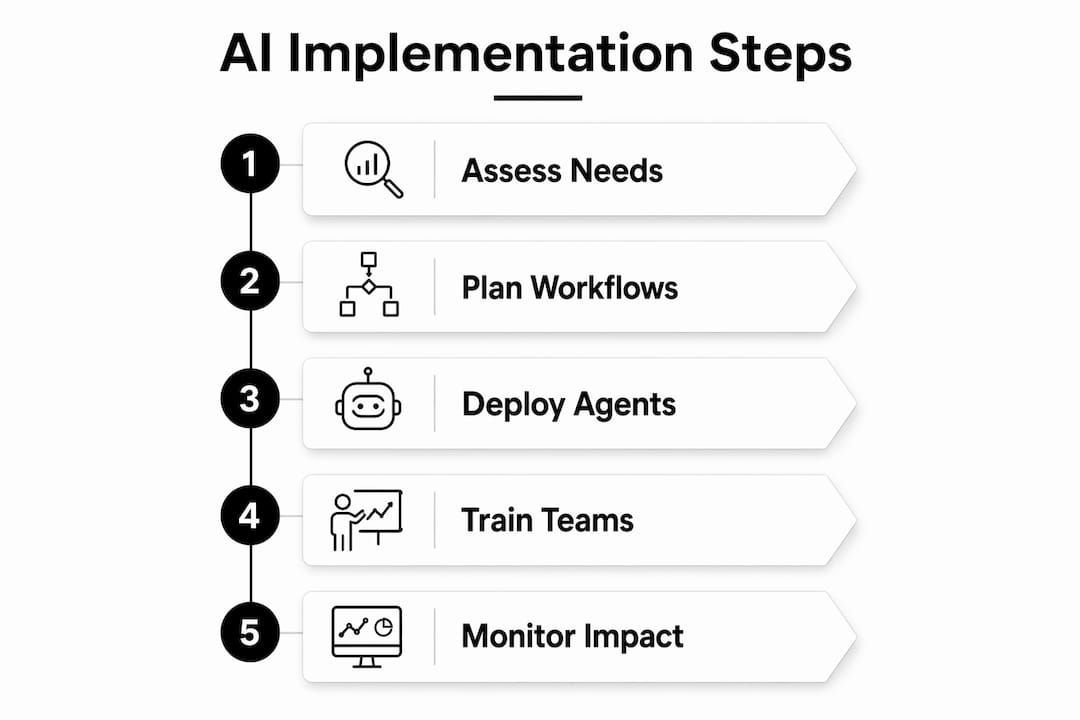
Shifting from task-level to workflow-level AI integration requires rethinking how work is sequenced. Here is how businesses make that shift effectively:
- Map the full workflow first. Identify every step in a process, not just the obvious bottlenecks. Understand where human judgment is genuinely required versus where it is habitual.
- Group automatable steps. Cluster consecutive tasks that share the same data inputs and outputs. Assign these clusters to AI agents rather than automating each step separately.
- Define clear handoff points. Establish specific moments where human review adds real value, such as final approval on a client proposal or exception handling in financial reconciliation.
- Monitor output quality continuously. Set measurable quality benchmarks for AI outputs at each handoff point. Adjust the workflow when AI accuracy drops below the threshold.
- Iterate based on coordination data. Track how much time humans spend reviewing AI outputs. If review time is high, the handoff point is too early in the sequence.
Human judgment remains irreplaceable for ambiguous decisions, relationship management, and ethical oversight. The goal is not to remove humans from workflows. The goal is to position humans at the points where their judgment creates the most value, and let AI handle everything else.
What challenges affect practical AI use in daily tasks?
Skills shortage is the primary barrier to AI adoption, particularly for small and mid-sized businesses. The OECD reports that 40% of employers in manufacturing and finance cite skills as the main adoption obstacle. The same report finds that 40% of SMEs say generative AI helps compensate for those gaps. Generative AI can produce first drafts, summarize documents, and guide non-technical employees through complex processes, partially filling the role a specialist would otherwise occupy.
The key challenges businesses face when adopting AI for daily tasks include:
- Data quality: AI systems produce unreliable outputs when trained on incomplete or inconsistent data. Cleaning and structuring data is a prerequisite, not an afterthought.
- Employee training: Workers need to understand what AI can and cannot do. Without training, employees either over-trust AI outputs or avoid using the tools entirely.
- Governance gaps: Without clear ownership of AI outputs, errors go uncorrected and accountability becomes unclear. Every AI-assisted process needs a named human owner.
- Measurement failures: Only 25% of OECD countries assess AI benefits systematically. Businesses that do not measure impact cannot identify which automations are working and which are creating hidden rework.
For skill-constrained teams, generative AI can partially fill gaps but requires continuous learning loops and feedback mechanisms. Without those feedback loops, AI tools drift toward producing outputs that look correct but contain subtle errors that compound over time.
Pro Tip: Build a simple AI impact log. For each automated task, record the time saved per week, the error rate before and after, and the employee hours spent on review. Review this log monthly. It will show you exactly where AI is delivering value and where it is creating new work.
How can businesses implement AI to maximize efficiency?
AI adoption produces measurable productivity gains only when treated as a complementary investment. Statistics Canada research shows that AI adopters demonstrate a 16.8% higher labor productivity level versus non-adopters. That gap does not come from the AI tools alone. It comes from the combination of AI tools, workflow redesign, management practice changes, and employee development that adopters invest in together.
Businesses that treat AI as a standalone productivity switch consistently underperform those that align AI projects with broader operational goals. The table below compares two implementation approaches across key dimensions.
| Dimension | Isolated task automation | Workflow-integrated AI |
|---|---|---|
| Scope | Single task or tool | End-to-end process redesign |
| Productivity impact | Marginal, short-term | Sustained, measurable |
| Human role | Unchanged | Repositioned to high-judgment work |
| Measurement | Ad hoc | Systematic, tied to business outcomes |
| Governance | Informal | Defined ownership and review cycles |
| Risk | Low initial, high drift | Managed through continuous monitoring |
Aligning AI projects with measurable business outcomes is the single most important implementation decision. Before deploying any AI tool, define the specific metric it will move, such as hours saved per week, error rate reduction, or customer response time. Without a target metric, there is no basis for evaluating success or adjusting the approach.
Reducing operational costs with AI also requires a governance framework that assigns ownership of AI outputs, sets quality standards, and schedules regular reviews. IBM's guidance on AI implementation success identifies operational governance, consistent trust standards, and continuous employee training as the three pillars of sustainable AI use. Businesses that build these pillars before scaling AI adoption avoid the costly rework cycles that undermine early gains.
Key Takeaways
AI's real productivity impact comes from workflow-level integration combined with governance, training, and measurable outcome targets, not from automating isolated tasks.
| Point | Details |
|---|---|
| Automate task sequences, not single steps | Chaining related tasks reduces costly AI-to-human handoffs and multiplies time savings. |
| Skills gaps are manageable | Generative AI offsets shortages temporarily, but employee training remains non-negotiable for sustained results. |
| Measure impact systematically | Track time saved, error rates, and review hours monthly to identify what is working and what is creating hidden rework. |
| Treat AI as a complementary investment | Productivity gains of 16.8% appear when AI adoption pairs with workflow redesign and management practice changes. |
| Governance prevents drift | Assign human ownership to every AI-assisted process and set quality benchmarks at each handoff point. |
Why workflow redesign matters more than the tools you pick
I have watched businesses spend months evaluating AI tools and then deploy them into workflows that were never designed for automation. The result is always the same. The tool works as advertised. The workflow does not improve. Employees end up doing more review work than before, and leadership concludes that AI did not deliver.
The uncomfortable truth is that the tool choice rarely determines the outcome. The workflow design does. When I see a business getting real results from AI, it is almost always because someone took the time to map the full process, identify where human judgment genuinely adds value, and redesign the sequence around AI's strengths. That work is unglamorous. It involves process documentation, stakeholder interviews, and honest conversations about which tasks humans are doing out of habit rather than necessity.
The other mistake I see constantly is treating AI governance as a compliance exercise rather than an operational one. Governance is not about policy documents. It is about knowing who owns each AI output, what the quality standard is, and what happens when the output is wrong. Without that clarity, errors accumulate silently until they become expensive problems. Build the governance structure before you scale the automation, not after.
— Carlos
Astarlabshub's Agentica: AI agents built for daily business operations
Astarlabshub built Agentica specifically for entrepreneurs and startup teams who need AI to handle operations end-to-end, not just assist with individual tasks.
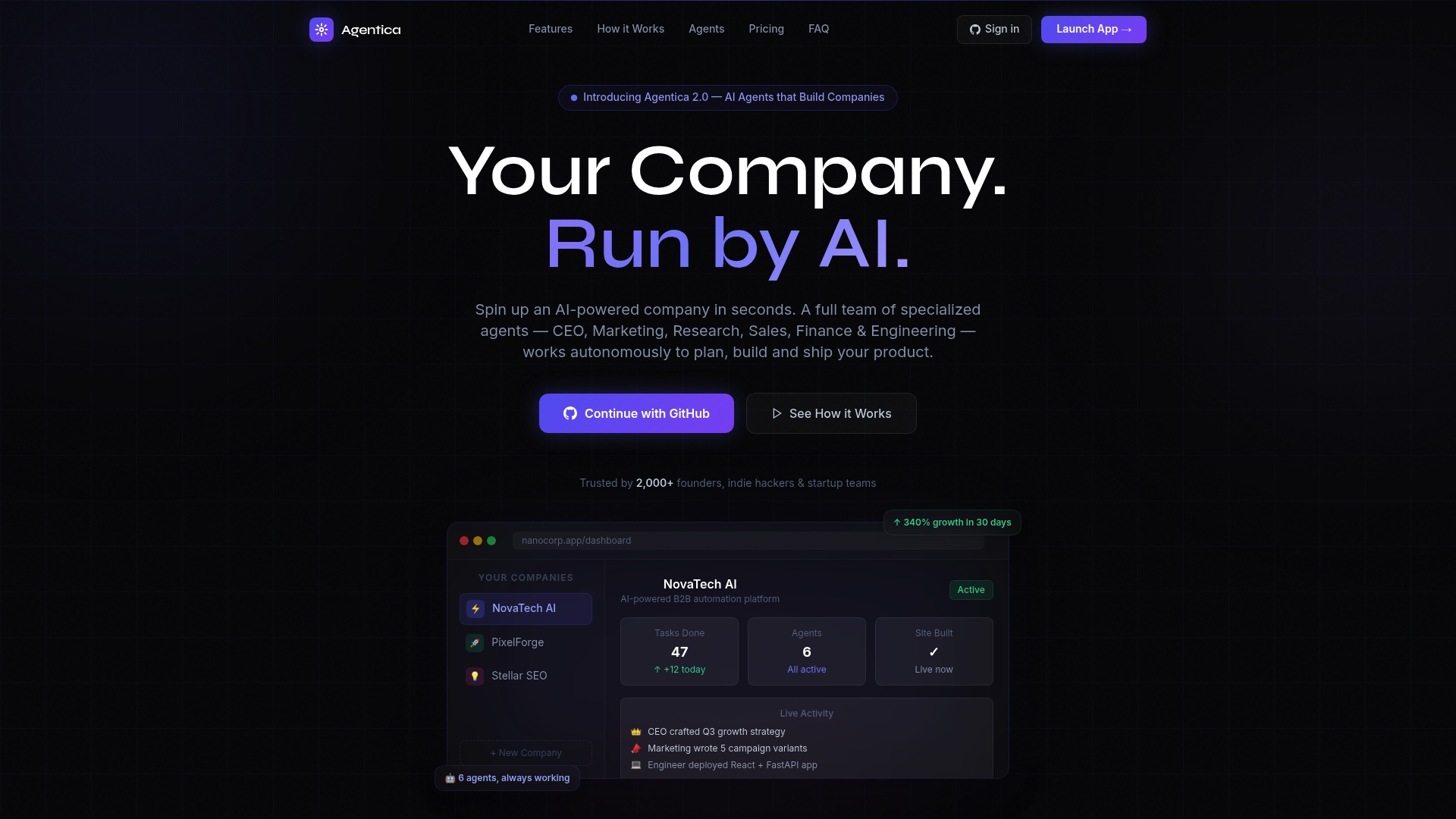
Agentica deploys specialized AI agents across CEO, marketing, and engineering functions. These agents work together to execute tasks, build products, and deploy applications without requiring technical expertise from the founder. The platform's autonomous mode means you set the direction and the agents handle strategy, coding, and deployment. Astarlabshub reports 340% growth for clients within 30 days. Real-time monitoring gives you full visibility over every operation the agents run. Explore Agentica's autonomous agents to see how AI-driven business operations work in practice.
FAQ
What is the role of AI in daily business tasks?
AI automates structured, repetitive work such as data entry, scheduling, and report generation while supporting decision-making through predictive analytics and natural language processing. Its role spans marketing, sales, finance, HR, IT, and procurement.
How does AI improve business efficiency?
AI improves efficiency by chaining related tasks into longer automated sequences, reducing the number of costly handoffs between AI systems and human reviewers. Businesses that redesign workflows around AI capabilities see sustained productivity gains.
What are the biggest barriers to AI adoption in business?
Skills shortage is the primary barrier. The OECD identifies it as the main obstacle for 40% of employers in manufacturing and finance. Data quality gaps and the absence of governance frameworks are the next most common blockers.
Can small businesses benefit from AI in daily operations?
Yes. Generative AI helps SMEs compensate for skills gaps by handling drafting, summarizing, and process guidance tasks. The JPMorgan Chase Institute finds that small businesses are integrating AI into core operational routines at a growing rate.
How should businesses measure AI's impact on productivity?
Define a specific metric before deployment, such as hours saved per week or error rate reduction, and track it monthly. Statistics Canada research shows that businesses pairing AI with complementary operational investments achieve measurably higher labor productivity than those treating AI as a standalone tool.