
Autonomous CEO agent capabilities are defined as the AI-driven abilities to independently plan, execute, and monitor executive-level business operations with minimal human intervention. These systems replicate full C-suite functions, including strategy, finance, marketing, HR, and legal, through specialized sub-agents working in coordination. Frameworks like the JOINCLASS AI CEO framework, the Helsinki-Code AI CEO system, and Astarlabshub's Agentica platform each demonstrate how CEO agent technology can replace or augment human executive roles at startup scale. The result is a new class of intelligent business agents that learn, adapt, and govern themselves with increasing precision.
1. autonomous CEO agent capabilities: core executive functions
Autonomous CEO agents operate through a multi-agent architecture that assigns each executive function to a dedicated sub-agent. The JOINCLASS AI CEO framework, for example, defines 15 AI agents spanning C-suite roles including CTO, CFO, CMO, Legal, and HR. Each sub-agent handles its domain independently while feeding outputs into a shared orchestration layer that tracks overall business objectives.

The division of labor here is not cosmetic. A CFO sub-agent runs financial forecasting models and flags budget anomalies. A CMO sub-agent manages campaign scheduling, audience segmentation, and performance reporting. A Legal sub-agent monitors contract compliance and flags regulatory exposure. Each role runs in parallel, which means a startup gets the equivalent of a full executive team operating around the clock.
Multi-agent orchestration also enables scalability that a human team cannot match. As task volume grows, additional sub-agents spin up to handle load without adding headcount. This is the core promise of automated executive roles: consistent output at a fraction of the cost.
- Strategic planning: Agents generate quarterly roadmaps, prioritize initiatives, and track KPIs autonomously.
- Financial forecasting: CFO agents model revenue scenarios and enforce spending limits in real time.
- Marketing automation: CMO agents run A/B tests, manage ad spend, and report on conversion metrics.
- HR operations: HR agents handle onboarding workflows, performance tracking, and policy enforcement.
- Legal oversight: Legal agents review contracts, monitor compliance deadlines, and escalate high-risk items.
Pro Tip: Start with two or three specialized sub-agents before deploying a full suite. Validate outputs in each domain before expanding autonomy across the entire executive stack.
2. governance and safety protocols that make agents trustworthy
Governance is the feature that separates a reliable autonomous CEO agent from a liability. The AGP protocol mandates a five-step pre-execution flow for every high-risk action: intent registration, authority proof, policy evaluation, human approval, and validated action envelope submission. No step can be skipped. If authorization is missing at any point, the system fails closed rather than proceeding.
This architecture matters because prompt-based permission requests are not sufficient. Architectural HITL enforcement at the dispatcher layer prevents model bypass, meaning the agent cannot talk its way past a governance gate. The enforcement is structural, not conversational.
Tiered action classification separates routine internal tasks from high-consequence external actions. High-frequency internal tasks run autonomously with logging only, while external actions like contract signing or large financial transfers require explicit human approval. This balance keeps workflows moving without exposing the business to unchecked risk.
- Intent registration: The agent declares what it intends to do before acting.
- Authority proof: The system verifies the agent holds the correct scoped token for the action.
- Policy evaluation: Governance rules check the action against predefined risk thresholds.
- Human approval: High-risk actions pause and wait for an authorized human to confirm.
- Validated submission: The action executes only after all prior steps pass.
"Risk controls for agentic AI must be proportional to the degree of autonomy. Meaningful human responsibility requires clear intervention and shutdown options at every tier." — CLTC UC Berkeley
Approval fatigue is a real governance risk. When every minor action requires human sign-off, operators start rubber-stamping decisions without reading them. The Agent Patterns Catalog recommends focusing human approval on high-consequence actions while logging lower-risk tasks automatically. That design keeps humans genuinely engaged where it counts.
3. cost controls and operational efficiency
Runaway agent costs are one of the most underestimated risks in deploying CEO agent technology. Per-agent spending caps and monthly budgets automatically stop agents when limits are reached, preventing unchecked API consumption or third-party service charges. Concrete examples include $10 per run caps and $20 per day spending limits enforced at the runtime level.
Real-time cost dashboards give founders visibility into exactly which agents are consuming budget and at what rate. This is not a reporting feature. It is a control mechanism. When a CMO agent's ad spend sub-task approaches its daily limit, the system halts further execution and logs the event for review.
- Per-run caps: Hard limits on what a single agent execution can spend before stopping.
- Daily and monthly budgets: Aggregate limits that trigger automatic halts when reached.
- Per-agent cost tracking: Dashboards display spend broken down by agent role and task type.
- Automatic halting: No manual intervention required when a budget threshold is crossed.
- Audit logging: Every cost event is recorded for post-run financial review.
Pro Tip: Set your per-run cap at roughly 20% of your daily budget. This prevents a single runaway task from consuming the entire day's allocation before you notice.
Budget enforcement integrates directly into decision-making flows. An agent evaluating whether to launch a paid campaign checks available budget before generating the execution plan. If funds are insufficient, the agent queues the task rather than proceeding. This prevents the common failure mode where autonomous systems commit resources before checking constraints.
4. quality assurance and review mechanisms
Output quality in autonomous CEO agents depends on structured feedback loops, not one-shot generation. The verify-fix QA cycle caps retries at a maximum of three attempts before escalating an unresolved issue to a human supervisor. This prevents infinite loops while giving the agent enough attempts to self-correct.
The critic-review pattern adds a second layer. After an executor agent produces an output, a separate critic agent evaluates it against predefined quality criteria before the result moves downstream. This is the same logic a human editor applies when reviewing a report before it goes to the board.
- Initial execution: The executor agent completes the assigned task and submits output.
- Critic review: A dedicated critic agent scores the output against quality benchmarks.
- Verify-fix loop: If the output fails review, the executor revises and resubmits, up to three times.
- Human escalation: Unresolved failures after three retries route to a human supervisor with full context.
- Outcome logging: Every cycle, pass or fail, is recorded for performance trend analysis.
Silent quality degradation is the failure mode that kills production agent systems over time. Without capped retries and critic review, agents oscillate between low-quality outputs without triggering any alert. The verify-fix pattern with hard retry limits prevents this by forcing escalation when the agent cannot resolve an issue on its own.
5. observability and transparency in enterprise operations
Enterprise-grade observability means every agent action is visible, traceable, and auditable in real time. LangGraph multi-agent patterns implement live dashboards with persistent event and state storage, streaming execution updates, and artifact capture for complete traceability. A founder can open a dashboard and see exactly what every sub-agent is doing at any given moment.
Immutable audit logs serve a dual purpose. They support compliance requirements by providing a tamper-proof record of every decision and action. They also support incident response by giving operators a complete timeline to reconstruct what happened when something goes wrong.
| Observability Feature | Function | Benefit to Founders |
|---|---|---|
| Live execution dashboard | Displays real-time agent activity and task status | Instant visibility without manual reporting |
| Persistent event storage | Logs every state change and decision point | Full audit trail for compliance and review |
| Streaming updates | Pushes execution progress in real time | No lag between agent action and founder awareness |
| Artifact capture | Saves outputs, files, and intermediate results | Complete record of what each agent produced |
| Governance integration | Links audit logs to approval records | Connects decisions to authorization history |
Hash-chained audit logs with revocable scoped tokens prevent unauthorized agent actions from going undetected. Each log entry is cryptographically linked to the previous one, so any tampering breaks the chain and triggers an alert. This is the standard that enterprise compliance teams require before trusting an autonomous system with consequential decisions.
Transparency also builds the kind of trust that allows founders to extend more autonomy over time. When you can see every action, every cost, and every decision in a single dashboard, you have the evidence base to confidently expand what your agents can do without supervision.
Key takeaways
Autonomous CEO agents deliver reliable executive-level performance only when multi-agent orchestration, tiered governance, cost controls, QA loops, and real-time observability work together as an integrated system.
| Point | Details |
|---|---|
| Multi-agent architecture | Specialized sub-agents handle distinct C-suite roles, enabling parallel execution at startup scale. |
| Tiered governance | AGP protocol's five-step pre-execution flow gates high-risk actions while keeping routine tasks moving. |
| Cost enforcement | Per-run and daily spending caps with automatic halting prevent runaway operational expenses. |
| QA with capped retries | Verify-fix loops with a three-retry maximum and critic review prevent silent output degradation. |
| Real-time observability | Live dashboards and hash-chained audit logs give founders full visibility and compliance-ready records. |
What i've learned about trusting autonomous CEO agents
The biggest mistake I see founders make is treating autonomy as binary. They either hand everything to the agent and walk away, or they gate every single action and wonder why the system feels slower than hiring a human. Neither approach works.
The governance frameworks covered here, particularly the AGP protocol's tiered action classification, exist precisely because autonomy needs to be calibrated, not maximized. Start with logging-only autonomy for internal tasks and approval gates for anything that touches money, contracts, or external parties. Build the evidence base. Then expand.
Cost controls are not optional. I have watched founders disable spending caps because they felt like friction, then face unexpected bills that wiped out a month of runway. The $10 per run cap feels trivial until it saves you from a runaway loop at 3 a.m.
The QA loop insight is the one most articles skip. Silent degradation is the real enemy. An agent that fails loudly is easy to fix. An agent that produces subtly worse outputs over weeks, with no alerts and no escalation, is the one that quietly destroys your product quality. Build the critic-review pattern in from day one, not as an afterthought.
The future of autonomous leadership is not about removing humans from the loop. It is about placing humans precisely where their judgment creates the most value and letting agents handle everything else with full accountability.
— Carlos
Build your autonomous company with agentica
Astarlabshub's Agentica platform gives founders a complete system for deploying and managing autonomous CEO agents without writing a single line of code. The platform includes multi-agent orchestration, role-based governance pipelines, per-agent cost controls, and a real-time dashboard that tracks every execution across your entire agent team. Specialized agents covering CEO, Marketing, Engineering, and more work in coordination to execute strategy, build products, and deploy applications. Clients using Agentica's autonomous mode have reported 340% growth in 30 days.
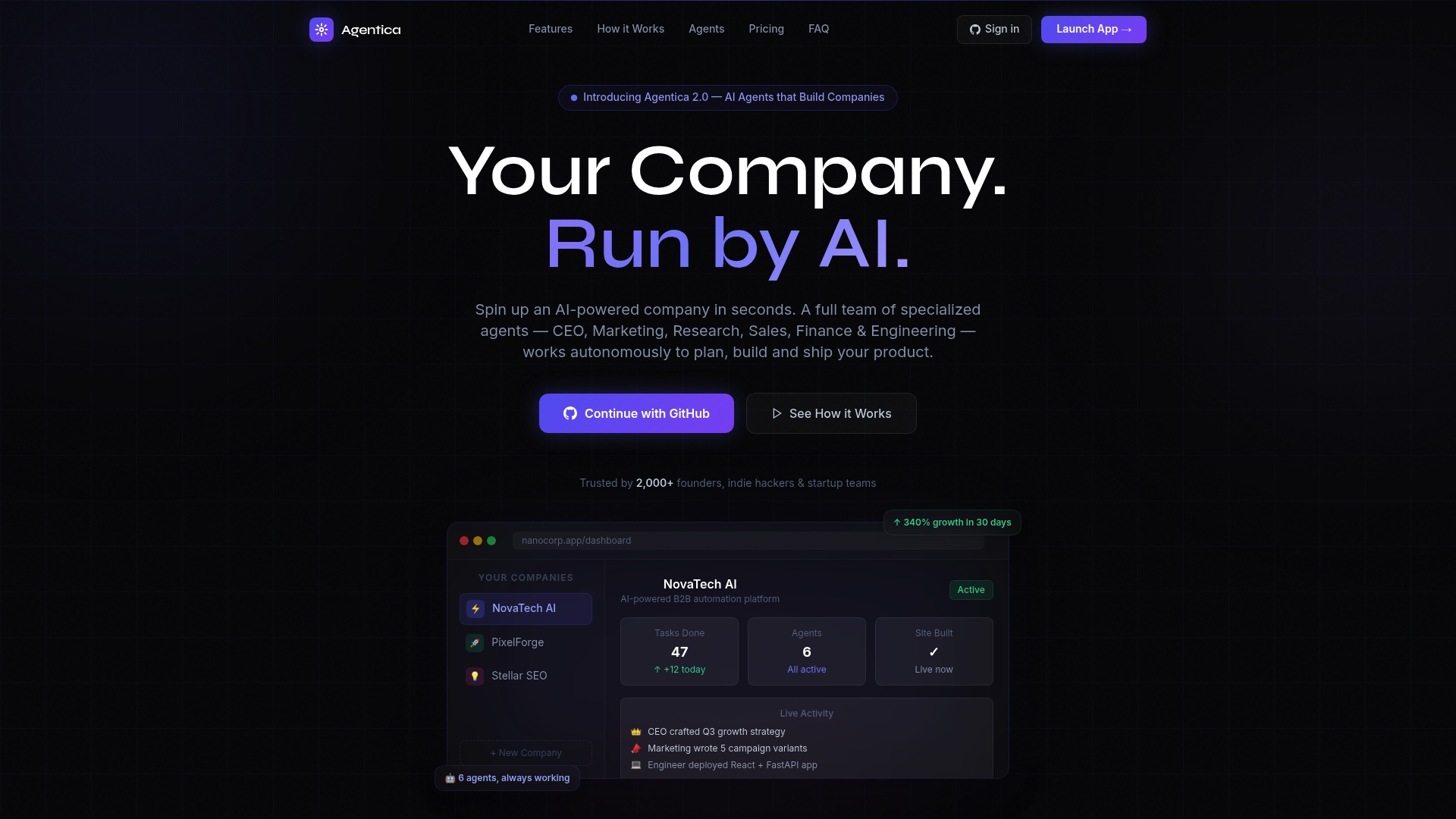
If you are a non-technical founder who wants to focus on vision while your AI team handles execution, explore the full platform features and see how Agentica structures governance, cost enforcement, and observability into a single operating system for your business.
FAQ
What are autonomous CEO agent capabilities?
Autonomous CEO agent capabilities are the AI-driven functions that allow software agents to independently manage executive tasks including strategy, finance, marketing, HR, and legal operations. The JOINCLASS AI CEO framework defines 15 specialized sub-agents covering the full C-suite scope.
How do autonomous CEO agents handle high-risk decisions?
High-risk decisions are gated through a structured approval pipeline that requires human authorization before execution. The AGP protocol enforces a five-step pre-execution flow and fails closed if any authorization step is missing.
What prevents an autonomous CEO agent from overspending?
Per-run spending caps and daily budget limits automatically halt agent execution when thresholds are reached. Systems like the agent-company-ai implementation enforce hard stops at $10 per run and $20 per day with full cost logging.
How do agents maintain output quality over time?
Verify-fix QA loops with a maximum of three retries and a critic-review pattern catch low-quality outputs before they move downstream. Unresolved failures escalate to human supervisors with full execution context attached.
Can founders monitor what autonomous agents are doing in real time?
Yes. Enterprise-grade platforms provide live dashboards with streaming execution updates, persistent event logs, and artifact capture. LangGraph multi-agent patterns and platforms like Agentica implement this observability layer as a core architectural feature.