
Hiring an AI engineer to build your app is the fastest path from business idea to working software in 2026. Entrepreneurs who once waited months for a developer are now launching MVPs in weeks, using AI-native tools like Cursor, Bolt, and Lovable alongside specialized hiring platforms that match candidates in 48 hours. This guide covers everything you need: how to plan your project, where to find the right engineer, how modern AI software development tools work, and how to avoid the pitfalls that derail most early-stage builds.
What should you plan before you hire an AI engineer?
Strong planning is the single biggest predictor of a successful AI app. Successful AI app development depends more on workflow design, data strategy, and UX planning than on picking the right AI model. That finding should reframe how you spend your first two weeks.
Before you write a single job post, work through these four areas:
- Define a narrow business problem. "Automate customer support" is too broad. "Classify inbound support tickets by urgency and route them to the correct team within 30 seconds" is specific enough to build toward.
- Map your AI workflows. Sketch the sequence of inputs, decisions, and outputs your app needs to perform. This becomes the blueprint your engineer works from.
- Audit your data. AI apps live or die on data quality. Identify what data you have, what format it is in, who owns it, and what privacy or compliance rules apply.
- Design for user trust. Users abandon AI features that feel unreliable. Plan for transparency, error states, and fallback behaviors before you write a line of code.
Skipping this phase is the most common reason AI projects run over budget. Scope creep almost always traces back to a problem statement that was never precise enough.
Pro Tip: Write a one-page product brief before your first engineer interview. Include the problem, the user, the key workflow, and one measurable success metric. Engineers who ask sharp questions about that brief are the ones worth hiring.
How do you find and hire the right AI engineer?
Finding the right engineer means understanding that "AI developer" covers a wide range of skills. The person you need is not just a coder. Experienced AI engineers bring specialized skills in AI evaluation, prompt engineering, regression testing, and inference cost optimization that generic developers simply do not have.

Mid-level vs. senior AI engineers: what you actually get
| Factor | Mid-Level AI Engineer | Senior AI Engineer |
|---|---|---|
| Hourly rate (platform) | $30–$35/hr | $35–$40/hr |
| U.S. in-house equivalent | $111–$148/hr (with overhead) | $111–$148/hr (with overhead) |
| Best for | MVPs, well-defined features | Complex architecture, scaling |
| Key added skills | Prompt engineering, basic eval | Hallucination detection, inference tuning |
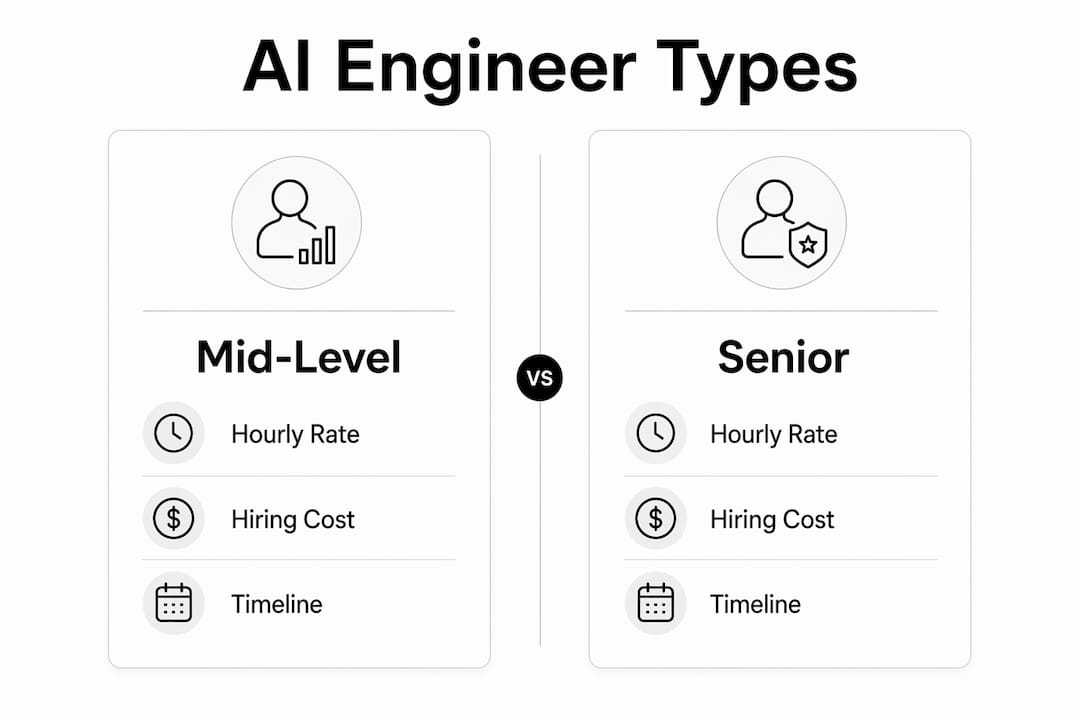
Platform hiring costs are 60–75% lower than U.S. in-house rates when you factor in benefits, office space, and recruiting fees. That gap is significant for a startup watching every dollar.
The hiring timeline difference is equally important. Traditional in-house recruiting takes 60–142 days. Specialized platforms match candidates within 48 hours and complete onboarding in 7–21 days. For a startup, that difference can be the gap between catching a market window and missing it.
When you evaluate candidates, skip generic coding tests. Give them a real scenario from your business. Ask them to outline an AI workflow for your specific problem, identify the data risks, and explain how they would measure whether the AI output is actually correct. That exercise separates engineers who understand AI systems from those who just know how to call an API.
Pro Tip: Ask every candidate: "How do you detect when an AI model starts producing worse outputs over time?" If they cannot answer that question clearly, they are not ready to own your production system.
Here is what a solid hiring checklist looks like:
- Verify past AI projects with live demos or deployed URLs, not just GitHub repos
- Confirm experience with your target stack (mobile, web, or backend AI services)
- Test communication quality. You will be working with this person closely
- Check references specifically on project delivery and post-launch support
How do ai-native tools speed up building your app?
The development process itself has changed fundamentally. AI-native tools like Cursor and Bolt can generate about 80% of MVP code 3–10 times faster than traditional agencies. Human engineers then handle the remaining 20% to address security, architecture, and production readiness.
That 80/20 split is not a shortcut. It is the best practice in 2026. Here is how the workflow runs in practice:
- Scaffold with AI tools. The engineer uses Cursor or Bolt to generate the initial codebase, UI components, and basic logic flows. This takes days, not weeks.
- Review and refine. The engineer audits the AI-generated code for logic errors, security gaps, and architectural problems that automated tools miss.
- Integrate AI functions. Features like natural language processing, classification, or recommendation engines get wired into the app using APIs from providers like OpenAI or Anthropic.
- Harden for production. Authentication, data encryption, error handling, and performance testing get applied by the human engineer. This step cannot be skipped.
- Deploy and monitor. The app goes live with logging and monitoring in place so the team can catch regressions early.
"The 20% that humans handle is not the boring part. It is the part that determines whether your app survives real users." — Senior AI engineer perspective on the hybrid development model
Agentic coding takes this further by integrating AI agents directly into developer environments like Xcode 27, enabling interactive planning and multi-turn Q&A during the build process. This means your engineer can work faster while staying in a single environment. The result is shorter build cycles and fewer context-switching errors.
For entrepreneurs building mobile apps, this approach is particularly powerful. You can learn more about how AI generates app logic to understand what your engineer is actually doing under the hood.
What are the best practices for collaborating with AI engineers?
Collaboration quality determines whether your project finishes on time or drags on for months. The following practices apply regardless of whether you are working with a solo contractor or a small team.
- Set milestones, not just deadlines. Break the project into two-week sprints with specific deliverables. "Working login flow" is a milestone. "Make progress on authentication" is not.
- Hold weekly demos. Seeing the actual product every week keeps both sides aligned and surfaces misunderstandings before they become expensive.
- Test early and often. Do not wait for a finished product to start user testing. Put rough prototypes in front of real users in week two.
- Evaluate AI outputs explicitly. Build a small test set of inputs and expected outputs. Run it after every major change to catch regressions. This is what separates professional AI development from guesswork.
- Avoid vibe coding. A common pitfall in AI app development is building features that seem impressive instead of solving a defined business problem. Every feature request should trace back to your original problem statement.
Pro Tip: Create a shared "decision log" document where you and your engineer record every major technical or product decision and the reason behind it. When scope creep happens, that document is your fastest way back to alignment.
Post-launch is not the finish line. AI apps require continuous measurement and improvement to account for changes in model performance and shifting business needs. Budget time and money for ongoing maintenance from day one.
What challenges should you expect when building an AI app?
Every AI app project hits friction. Knowing where the common problems live lets you prepare rather than react.
Hiring delays still happen even on fast platforms. Have your product brief, technical requirements, and budget approved before you start outreach. Delays almost always come from the client side, not the platform.
AI hallucinations are a real production risk. Your engineer should implement hallucination detection as a standard part of the build, not an afterthought. This means output validation layers, confidence thresholds, and human review workflows for high-stakes decisions.
Inference costs can surprise you at scale. A feature that costs $0.002 per call looks cheap until you have 50,000 daily users. Senior AI engineers who understand inference cost optimization will design your system to minimize unnecessary model calls from the start.
Legal exposure around AI-generated outputs is a growing concern. If your app produces advice, recommendations, or content, you need clear disclaimers and a review process. This is not a legal deep-dive topic, but it belongs in your launch checklist.
Scaling the team as your product grows requires a different engineer profile than your MVP builder. Plan for that transition early. The engineer who builds your first version may not be the right person to lead a team of five.
The AI agency automation model offers one way to address scaling challenges by using specialized agents for different functions rather than hiring generalists.
Key takeaways
Hiring the right AI engineer and pairing them with modern AI-native tools is the most cost-effective path to a production-ready custom app for your startup in 2026.
| Point | Details |
|---|---|
| Plan before you hire | Define a narrow problem, map workflows, and audit your data before writing a job post. |
| Platform hiring saves time and money | Specialized platforms match engineers in 48 hours at 60–75% lower cost than U.S. in-house rates. |
| AI tools handle 80% of the build | Tools like Cursor and Bolt generate most MVP code; human engineers secure and finalize the rest. |
| Evaluate for AI-specific skills | Prioritize engineers with hallucination detection, prompt engineering, and inference cost experience. |
| Post-launch is not optional | Budget for continuous AI model evaluation and improvement from the start of the project. |
Why product strategy beats model selection every time
I have reviewed dozens of AI app projects over the years, and the pattern is consistent. The teams that fail are almost never the ones that picked the wrong AI model. They are the ones that skipped the product strategy work.
Founders get excited about GPT-4o or Claude 3.5 Sonnet and spend weeks debating which model to use. Meanwhile, they have not defined what a correct output actually looks like for their use case. They have not mapped the workflow. They have not thought about what happens when the AI is wrong.
The teams that succeed treat the AI model as a commodity and the workflow as the product. They define success metrics before they write code. They test outputs against real business scenarios. They hire engineers who ask hard questions about data quality and edge cases, not engineers who just know the latest API syntax.
Speed matters too, but not at the cost of architecture. I have seen startups ship in three weeks using Cursor and Bolt, then spend four months fixing the foundation because nobody thought about database design or authentication. The 80/20 model works, but only if the 20% gets real attention.
The best advice I can give you: treat your AI engineer as a product partner, not a code vendor. Share your business context. Explain why the problem matters. The engineers who understand the business build better systems than the ones who just execute tickets.
— Carlos
How Astarlabshub can help you launch faster
Building an AI-powered app is faster and less risky when you have the right team behind you from day one.
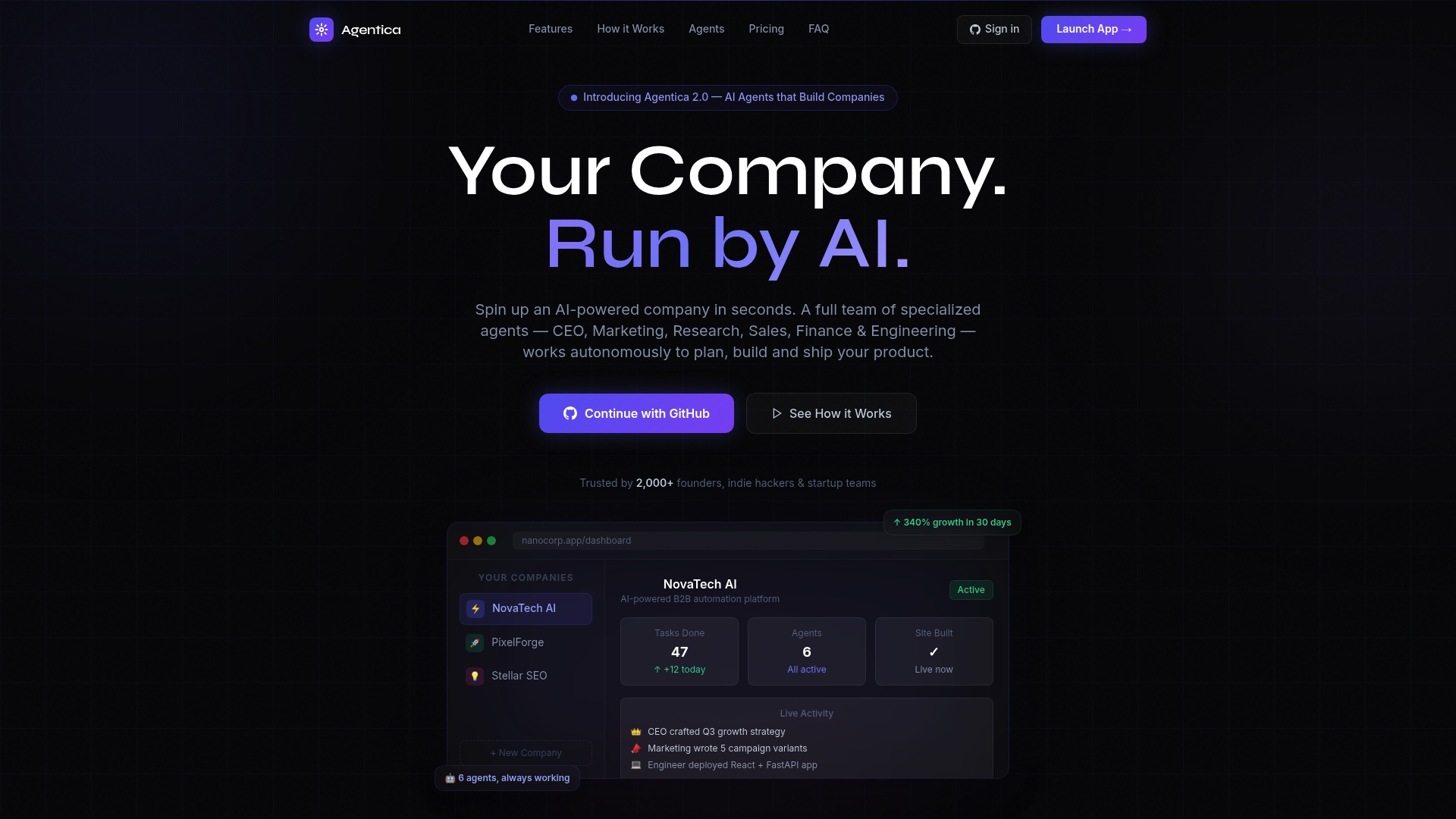
Astarlabshub's Agentica platform gives entrepreneurs access to autonomous AI agents that handle engineering, strategy, and deployment in parallel. Instead of spending weeks recruiting and onboarding, you get a coordinated team of specialized agents, including Engineer, CEO, and Marketing roles, working together from the moment you start. Clients using Agentica have seen 340% growth in 30 days. Explore the full platform features and pricing options to find the right fit for your startup's stage and budget.
FAQ
How long does it take to build an AI app with an engineer?
Most MVPs take 4–12 weeks depending on complexity. Using AI-native tools like Cursor or Bolt, engineers can generate the initial codebase 3–10 times faster than traditional methods, compressing early build phases significantly.
What skills should i look for when i hire an AI engineer?
Look beyond general coding ability. The most effective AI engineers bring prompt engineering, hallucination detection, regression testing, and inference cost optimization to the table alongside standard software development skills.
How much does it cost to hire an AI engineer for a custom app?
Mid-level AI engineers on specialized platforms cost around $30–$35/hr and senior specialists run $35–$40/hr. U.S. in-house hires with overhead cost $111–$148/hr, making platform hiring the clear choice for cost-conscious startups.
What is vibe coding and why should i avoid it?
Vibe coding means building features that seem impressive rather than solving a defined business problem. It leads to wasted resources and apps that users do not actually need. Every feature should trace directly back to a measurable business workflow.
Do i need technical knowledge to work with an AI engineer?
No technical background is required, but you do need a clear product brief. Define your problem, your users, and your success metrics. Engineers can handle the technical execution when the business requirements are specific and well-documented.