
AI in campaign management automation is defined as the use of intelligent systems to autonomously plan, execute, and optimize marketing campaigns without constant human intervention. Platforms like Google Performance Max and Meta Advantage+ already demonstrate this at scale, using real-time signals to adjust bids, creatives, and audiences continuously. Companies integrating AI into their marketing workflows see an 80% reduction in manual tasks within 90 days, along with 35–50% improvement in conversion rates. That kind of output shift changes what campaign managers actually do for a living.
How does AI change the campaign management workflow?
Traditional campaign automation runs on rules. A marketer sets conditions: "If CTR drops below 2%, pause the ad." The system executes that rule and nothing more. It does not learn. It does not adapt. It waits for a human to update the logic.
AI-driven campaign management works differently. AI autonomously plans and optimizes campaigns across channels, learning from every interaction without requiring manual A/B testing or rule updates. The system identifies patterns in audience behavior, adjusts budget allocation in real time, and rotates creatives before fatigue sets in.

The practical difference is speed and scale. AI-managed campaigns make thousands of micro-decisions per hour, processing cross-platform data and live auction signals simultaneously. A human campaign manager reviewing performance dashboards once a day simply cannot match that cadence.
Pro Tip: AI does not replace campaign managers. It replaces the repetitive execution tasks that consume most of their time. The manager's job shifts from doing to directing.
Here is how the two approaches compare across core capabilities:
| Capability | Rule-Based Automation | AI-Driven Automation |
|---|---|---|
| Decision logic | Static, human-defined rules | Dynamic, learned from data |
| Optimization frequency | Manual or scheduled | Continuous, real-time |
| Creative management | Manual rotation | Autonomous fatigue detection |
| Cross-channel coordination | Siloed per platform | Unified orchestration |
| Learning over time | None | Improves with every campaign |
| Human input required | Constant rule updates | Strategic oversight and guardrails |
The shift from rule-based to AI-powered campaign orchestration reflects a systems thinking approach. The AI continuously adapts by reading customer behavior at scale, something no static rule set can replicate.
What are the key phases where AI automates campaigns?
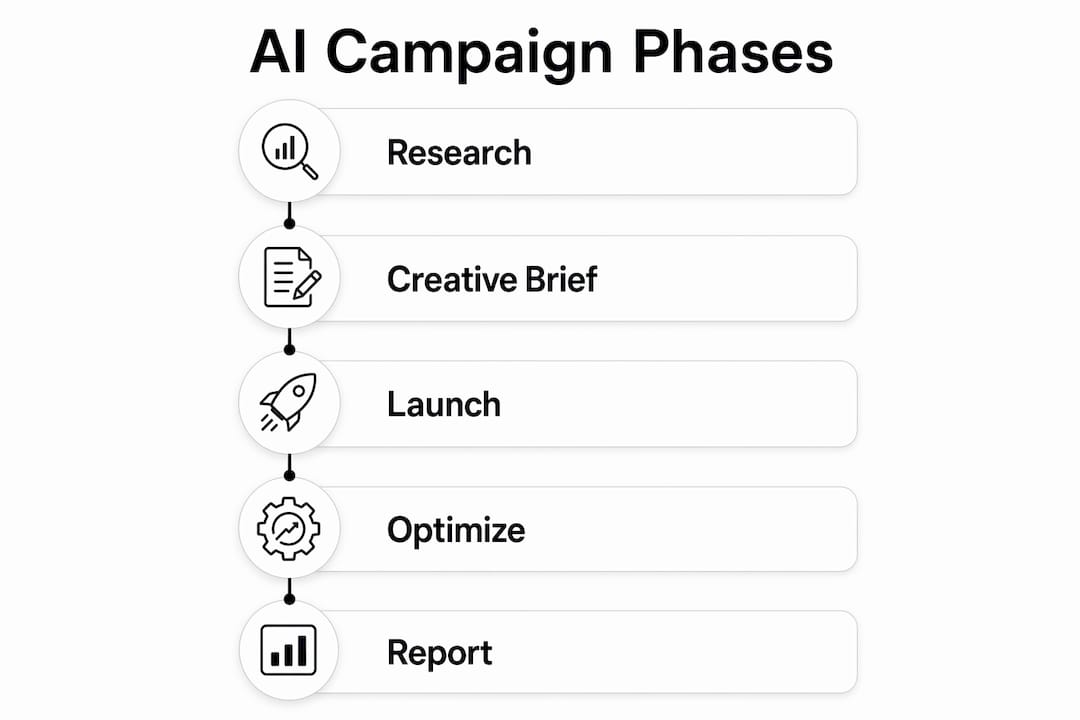
Effective AI-augmented workflows follow a five-phase execution loop. Each phase builds on the last, and AI contributes meaningfully at every stage.
- Competitive research. AI tools scan competitor ads, landing pages, and positioning to surface gaps and opportunities. This phase feeds directly into creative strategy, so the quality of research shapes everything downstream.
- Creative briefing. AI synthesizes research into structured briefs, generating copy variants, headline options, and visual direction. Human review at this gate determines whether the output meets brand standards before any spend is committed.
- Launch structure. AI configures campaign architecture, including audience segmentation, channel selection, and budget distribution. Platforms like Google Performance Max handle this autonomously once campaign goals are defined.
- Real-time optimization. This is where AI earns its keep. The system monitors performance signals continuously, shifting budget toward top-performing segments and pulling underperformers without waiting for a weekly review.
- Fatigue rotation. AI detects when creative performance declines and rotates in fresh variants automatically. This prevents the audience burnout that kills campaigns when managers are not watching closely enough.
Pro Tip: The quality of your AI output is directly proportional to the quality of your inputs. Vague campaign goals and incomplete audience data produce generic, underperforming results regardless of how sophisticated the AI is.
Human quality gates matter most at phases two and five. Creative briefing requires brand judgment that AI cannot fully replicate. Fatigue rotation requires knowing when a creative decline reflects genuine burnout versus a temporary signal fluctuation.
What strategic shifts do campaign managers face with AI?
Campaign managers who adopt AI-powered automation face a genuine identity shift. The job title stays the same. The actual work changes substantially.
Campaign managers evolve into system architects, defining intent and guardrails while AI runs the execution loops. That means setting business-level outcomes rather than optimizing for surface metrics like click-through rate. A manager focused on CTR tells the AI to chase clicks. A manager focused on revenue tells the AI to find buyers.
The strategic priorities for this new role look like this:
- Define outcomes, not tactics. Set conversion goals, revenue targets, and customer acquisition cost limits. Let the AI determine how to reach them.
- Build guardrails before launch. Specify brand safety rules, excluded audiences, and spending caps. These constraints protect the campaign from AI decisions that are technically optimal but strategically wrong.
- Own offer development. AI cannot create a compelling offer. It can test and distribute one. The strategic work of identifying what customers actually want remains entirely human.
- Monitor for drift. AI systems can optimize toward a proxy metric that diverges from the real goal. Regular strategic reviews catch this before it compounds.
- Maintain creative quality control. AI generates volume. Humans determine whether that volume meets the brand standard.
Marketing teams that separate strategic decision-making from execution automation run faster and more consistent campaigns. The division is not about distrust of AI. It is about recognizing what each party does best.
By 2026, 40% of enterprise applications will feature task-specific AI agents. That figure signals a structural shift in how marketing organizations are built, not just how campaigns are run.
How do you implement AI campaign automation effectively?
Implementation success depends on foundations, not features. The most sophisticated AI campaign tool fails when the underlying data is fragmented or dirty.
Unified customer data platforms are the critical prerequisite. A CDP consolidates customer profiles across touchpoints, giving AI the complete behavioral picture it needs to make personalized decisions. Without that unified view, the AI makes decisions based on partial information, and the campaign experience becomes incoherent across channels.
Here is a practical implementation framework:
- Audit your data infrastructure first. Identify where customer data lives across your CRM, ad platforms, email tools, and website analytics. Fragmented data is the single most common reason AI implementations underperform.
- Select tools that support unified orchestration. Look for specialized AI agents that connect across your existing marketing stack rather than operating in isolation.
- Define your human-in-the-loop checkpoints. Decide in advance which decisions require human approval. Creative quality, budget threshold changes, and new audience expansions are the most common gates.
- Start with one campaign type. Prove the model on a single campaign before scaling. This limits risk and generates the performance data you need to build internal confidence.
- Reject the set-and-forget mindset. AI requires ongoing monitoring, not because it fails often, but because goals shift, markets change, and the system needs updated guardrails to stay aligned.
The table below summarizes the core implementation requirements and what each one protects against:
| Requirement | What It Prevents |
|---|---|
| Unified CDP | Fragmented audience decisions |
| Human-in-the-loop gates | Brand safety and strategic drift |
| Clean input data | Irrelevant AI outputs |
| Defined outcome metrics | Proxy metric optimization |
| Continuous monitoring | Compounding errors over time |
AI is only as effective as the quality of its input data and guardrails. That is not a caveat. It is the central implementation truth that separates teams who see results from teams who blame the technology.
For a broader look at how AI reshapes the research phase specifically, the AI-driven market research guide from Astarlabshub covers the data collection and synthesis layer in depth.
Key takeaways
AI in campaign management automation delivers measurable efficiency gains only when paired with clean data, defined guardrails, and strategic human oversight.
| Point | Details |
|---|---|
| AI replaces execution, not strategy | Campaign managers shift to system architects who define goals and guardrails. |
| Five-phase loop drives results | Research, briefing, launch, optimization, and fatigue rotation each require AI input. |
| Data quality determines AI quality | A unified CDP is the non-negotiable foundation for effective AI automation. |
| Human gates protect brand integrity | Creative quality and strategic thresholds require human approval before AI proceeds. |
| Outcome metrics beat surface metrics | Setting revenue and acquisition goals produces better AI behavior than chasing CTR. |
Where i think most teams get this wrong
I have watched marketing teams buy into AI campaign tools with genuine enthusiasm, then report disappointing results six months later. The pattern is almost always the same. They treated implementation as a software problem instead of a workflow problem.
The technology works. Google Performance Max and Meta Advantage+ have proven that at enormous scale. What fails is the organizational assumption that the tool handles everything once it is switched on. Teams skip the data audit. They skip the guardrail definition. They skip the human review checkpoints because those feel like the old way of doing things.
The counterintuitive truth is that AI-driven campaign management requires more strategic clarity upfront, not less. The AI will optimize aggressively toward whatever goal you give it. If that goal is vague or misaligned with actual business outcomes, the system will optimize in the wrong direction with impressive efficiency.
The teams I have seen succeed treat AI as a high-performance execution partner that needs precise direction. They spend more time on offer strategy, audience definition, and creative standards than they did before. The AI handles the volume. The humans handle the judgment. That division is not a limitation of the technology. It is the design.
— Carlos
How astarlabshub's agentica platform handles campaign automation
Astarlabshub built Agentica 2.0 specifically for teams that want AI to handle end-to-end campaign execution without losing strategic control. The platform deploys specialized AI agents across marketing, strategy, and operations roles, each working in coordination to manage the full campaign lifecycle.
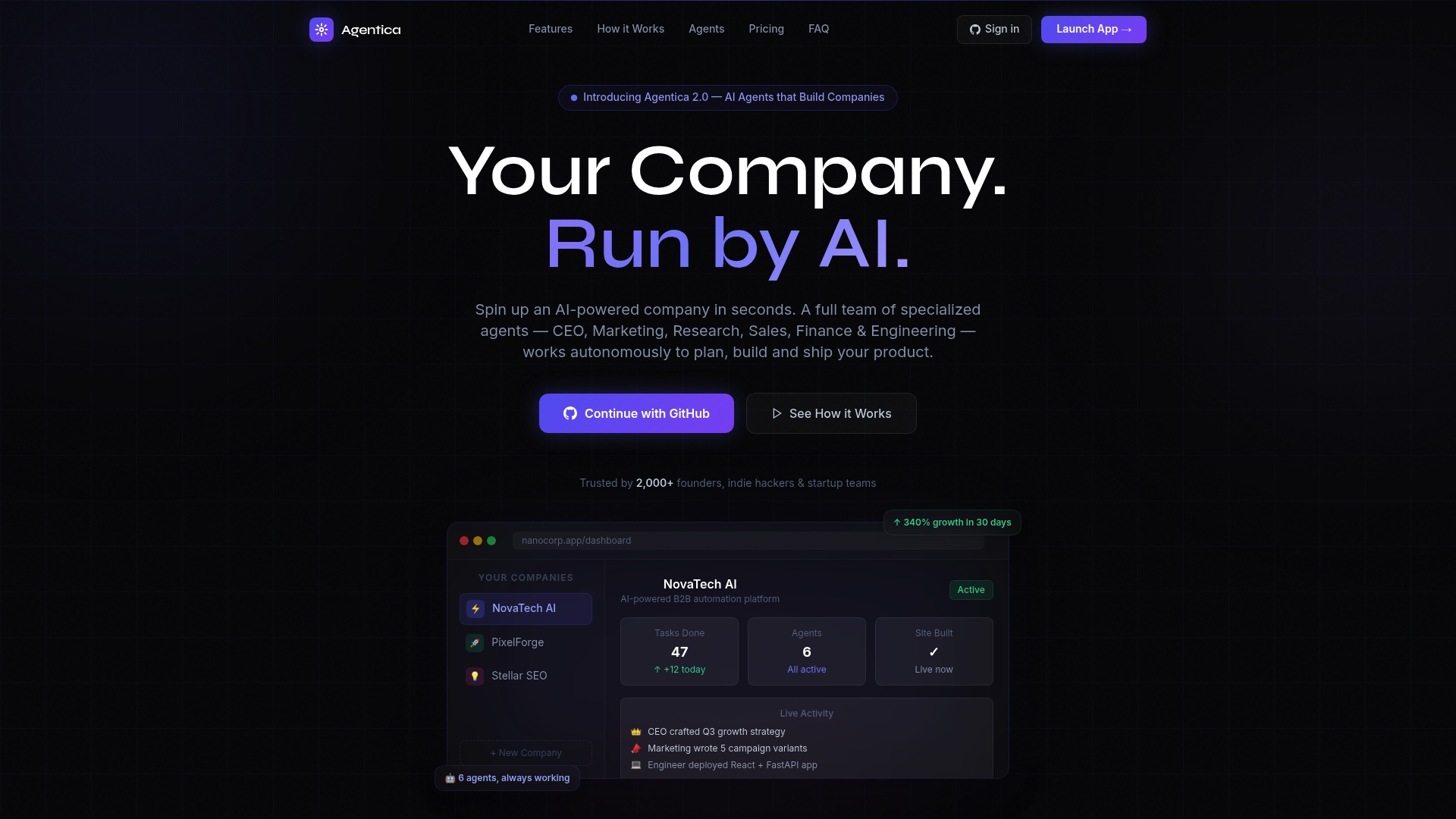
Agentica's autonomous agent system covers competitive research, creative briefing, launch configuration, real-time optimization, and fatigue rotation. Built-in guardrails keep every decision within your defined brand and budget parameters. Real-time monitoring gives you full visibility without requiring constant manual review. Clients using Agentica's autonomous mode have reported 340% growth within 30 days. Explore how Agentica works and see whether it fits your current campaign infrastructure.
FAQ
What is AI campaign management automation?
AI campaign management automation is the use of intelligent systems to autonomously execute, optimize, and adapt marketing campaigns in real time. Unlike rule-based tools, AI learns from performance data and adjusts targeting, bids, and creatives without manual intervention.
How does AI improve campaign efficiency?
Companies integrating AI into marketing workflows report an 80% reduction in manual tasks within 90 days and 35–50% improvement in conversion rates. AI achieves this by making thousands of micro-decisions per hour across channels simultaneously.
Does AI replace campaign managers?
AI replaces execution tasks, not strategic judgment. Campaign managers shift into system architect roles, defining goals and guardrails while AI handles the operational workload.
What data do you need before implementing AI campaign tools?
A unified customer data platform is the critical prerequisite. Fragmented data across CRM, ad platforms, and analytics tools limits AI's ability to make accurate, personalized decisions across channels.
Which platforms already use AI for campaign automation?
Google Performance Max and Meta Advantage+ are the most widely deployed examples. Both use AI to autonomously manage audience targeting, creative selection, and budget allocation based on real-time performance signals.