
An AI automation agency is a specialized firm that designs, builds, and deploys AI-powered workflows connecting your existing tools to eliminate repetitive manual work without requiring any coding from your team. This is the industry's working definition of what is ai agency automation explained in practical terms. Platforms like Claude, GPT-4, and Jasper power the underlying intelligence, while integration layers built on tools like Zapier, Make, or n8n wire everything together. Agencies turn to this model because manual task execution is the single largest drain on billable time, and AI automation converts that drain into margin. The core promise is simple: your team stops doing the work, and the system does it instead.
What services and workflows do AI automation agencies typically provide?
An AI automation agency starts every engagement with a process audit. Before writing a single line of automation logic, the agency maps your existing tools, identifies where human time is being spent on repeatable tasks, and ranks those tasks by ROI potential. This audit phase typically surfaces three to five high-value workflows that can be automated within the first 60 days.
The most common deliverables include:
- Lead qualification workflows that score and route inbound leads from forms or CRM systems like HubSpot or Salesforce without human review
- Client reporting automation that pulls data from Google Analytics, Meta Ads, or project management tools and assembles formatted reports on a schedule
- Meeting summary and follow-up systems that use transcription tools like Otter.ai or Fireflies.ai combined with GPT-4 to generate action items and send follow-up emails automatically
- Content drafting pipelines that take a brief and produce first drafts using Jasper or Claude, ready for human editing
- Onboarding sequences that trigger personalized email chains, task creation in Asana or Monday.com, and Slack notifications based on a single client sign-up event
The critical difference between an AI automation agency and a traditional consulting firm is the output. A consultant delivers a report. An AI automation agency delivers a running system. You are not paying for advice. You are paying for infrastructure that executes tasks on your behalf, every day, without supervision.
Pro Tip: Ask any agency you evaluate to show you a live workflow demo before signing a contract. If they cannot demonstrate a working system in your discovery call, they are selling strategy, not engineering.

What are the measurable benefits of AI agency automation for businesses?
The financial case for AI agency automation is well-documented. 65% of agencies report profitability improvements from AI automation, with cost reductions in specific operational tasks ranging from 20% to 90%. That range reflects the difference between automating a single task versus rebuilding an entire operational function. Even at the conservative end, a 20% cost reduction in a high-volume process compounds quickly across a year.
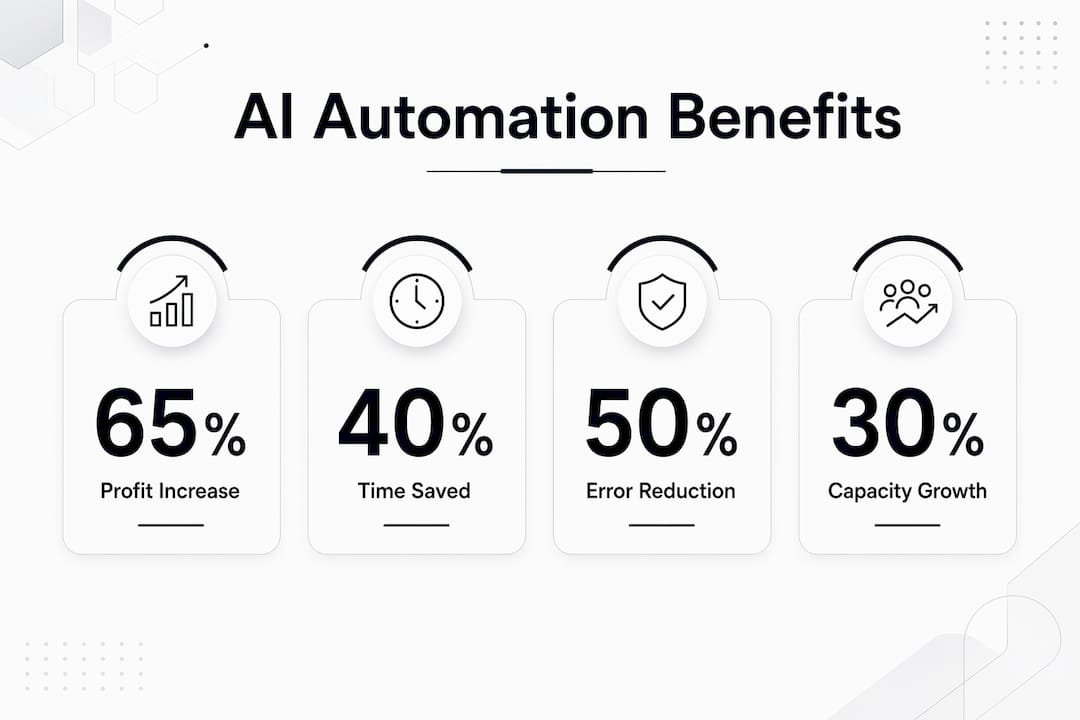
Time savings are equally concrete. Agencies implementing AI workflows see a 40 to 70% reduction in copy drafting time and 50 to 80% less time spent on recurring reports. For a team producing weekly performance reports for 20 clients, that translates to recovering multiple full workdays every week. Those hours shift from execution to strategy, client relationships, and new business development.
| Metric | Typical Range | What It Means |
|---|---|---|
| Cost reduction per task | 20–90% | Highest savings come from high-volume, rule-based tasks |
| Time saved per FTE weekly | 3–12 hours | Equivalent to adding 7–30% capacity without new hires |
| Copy drafting time reduction | 40–70% | Content teams produce more output with the same headcount |
| ROI timeline | 60–120 days | Most implementations break even within one quarter |
| Revenue tooling spend | 4–8% of revenue | Mature AI agencies measure ROI by margin lift, not headcount cuts |
"AI shifts agency roles from manual task execution to strategic leadership. Ignoring AI risks obsolescence as clients expect faster delivery and lower prices." — Industry analyst perspective
The most important reframe here is that AI automation is not about reducing headcount. It is about capacity expansion. A team of ten operating with AI-powered workflows can serve the client load that previously required fifteen people. That margin difference is where agency profitability is rebuilt.
How do investments and pricing models work in AI automation agency engagements?
Understanding the cost structure of an AI automation agency engagement prevents budget surprises and sets realistic expectations. Pricing follows a three-phase model that most reputable agencies use consistently.
- Discovery and audit phase runs $5,000 to $10,000. This covers process mapping, tool stack review, and a prioritized automation roadmap. Some agencies credit this fee against implementation if you proceed.
- Implementation phase ranges from $25,000 to $150,000 depending on complexity. A single workflow connecting two tools sits at the low end. A multi-system integration spanning CRM, email, project management, and reporting sits at the high end.
- Monthly retainer for ongoing maintenance, iteration, and support runs $3,000 to $7,500 per month. This is standard because AI workflows require monitoring, prompt updates, and occasional rebuilds as underlying tools change.
Scope creep is the most common failure mode in agency engagements. It happens when a project starts with one workflow and expands to five without a corresponding budget adjustment. The fix is a tightly scoped Statement of Work with a fixed handover date and a defined list of deliverables. Any additions go through a formal change order process.
Handover is the phase most clients underestimate. A quality agency delivers more than a working system. Best-practice handovers include operator-legible documentation, full admin credentials transferred to the client, and live training sessions so your team can maintain and modify workflows independently. If an agency resists giving you admin access to your own systems, that is a red flag for vendor lock-in.
Pro Tip: Before signing any contract, confirm in writing that you will own all admin keys, API credentials, and workflow documentation at handover. This single clause protects you from dependency on the agency for basic maintenance.
How should businesses prepare for and manage AI automation agency partnerships?
Operational readiness determines whether AI automation amplifies your efficiency or amplifies your existing chaos. Agencies must build solid operational foundations before AI adoption to avoid encoding broken processes into automated systems. If your lead qualification process is inconsistent today, automating it will produce inconsistent results at scale.
Signs that your business is ready for an AI automation agency:
- You have at least three recurring tasks that consume more than five hours per week each
- Your team uses connected SaaS tools (CRM, email platform, project management) with available APIs
- You have a clear owner who can liaise with the agency and make decisions about workflow logic
- You are willing to document your current processes before automation begins
Signs you are not ready yet:
- Your core processes change frequently and have not stabilized
- You do not have a defined owner for the automation project internally
- Your tool stack is fragmented with no clear integration layer
Managing the partnership requires active involvement, not passive oversight. Assign an internal point of contact with decision-making authority. Review workflow performance weekly during the first 90 days. Push back on complexity. Clients prefer agencies that build transparent, maintainable systems with thorough documentation over sophisticated black-box solutions that require the agency for every change.
Post-project, the goal is internalization. Your team should be able to modify trigger conditions, update prompts, and add new steps without calling the agency. This is the difference between a successful engagement and a permanent dependency.
AI automation agency vs. DIY automation: which approach fits your situation?
The choice between hiring an agency and building automation yourself depends on three variables: complexity, speed, and internal capability.
| Factor | DIY Tools (n8n, Make) | AI Automation Agency |
|---|---|---|
| Best for | Narrow, single-tool workflows | Complex, multi-system integrations |
| Time to deploy | Days to weeks | Weeks to months |
| Upfront cost | Low ($0–$500/month in tooling) | High ($25K–$150K implementation) |
| Technical skill required | Moderate (no-code, but logic-heavy) | None from client side |
| Scalability | Limited without engineering support | Built for scale from day one |
| Ongoing maintenance | Internal team handles it | Agency or trained internal staff |
DIY automation with tools like n8n or Make handles narrow, well-defined workflows effectively. If you need to send a Slack notification when a form is submitted, Make solves that in an afternoon. If you need to qualify leads, update your CRM, generate a personalized email, schedule a follow-up task, and log the interaction in a reporting dashboard, that is agency territory.
The honest answer for most growing businesses is a hybrid approach. Use DIY tools for simple, stable workflows. Hire an agency for the two or three high-complexity automations that directly touch revenue. Then internalize what the agency builds so you can extend it yourself over time.
Key takeaways
AI automation agencies deliver the highest ROI when businesses enter engagements with stable processes, clear ownership, and a commitment to internalizing the systems built on their behalf.
| Point | Details |
|---|---|
| Define scope tightly | Use a fixed-scope SOW with a handover date to prevent cost overruns and project drift. |
| Expect 60–120 day ROI | Most implementations break even within one quarter through time savings and capacity gains. |
| Own your credentials | Demand full admin access and documentation at handover to avoid long-term vendor dependency. |
| Prepare before you automate | Stabilize core processes first so AI amplifies efficiency, not existing inefficiencies. |
| Match tool to complexity | Use DIY platforms for simple workflows and agencies for multi-system, revenue-critical integrations. |
Why AI automation is quiet leverage, not a magic switch
I have watched dozens of business leaders approach AI automation with one of two mindsets: either it will solve everything overnight, or it is too complex to be worth the effort. Both are wrong, and both lead to poor decisions.
The leaders who get the most from AI agency automation are the ones who treat it as operational infrastructure, not a product launch. They spend time before the agency engagement documenting what their teams actually do, not what they think they do. That gap between documented process and real behavior is where most automation projects fail.
What I find consistently underappreciated is the compounding effect. A workflow that saves three hours a week looks modest in isolation. Across a team of eight, over twelve months, that is over 1,200 hours recovered. That is the equivalent of hiring a full-time employee, at a fraction of the cost, with zero management overhead.
The other thing I would push back on is the instinct to outsource the thinking permanently. The best AI automation engagements end with the client team fully capable of maintaining and extending the systems themselves. AI augments teams rather than replacing them, and the businesses that internalize that capability build a durable competitive edge. The ones that stay dependent on the agency for every update are just renting efficiency instead of owning it.
— Carlos
See how Astarlabshub builds autonomous AI workflows for your business
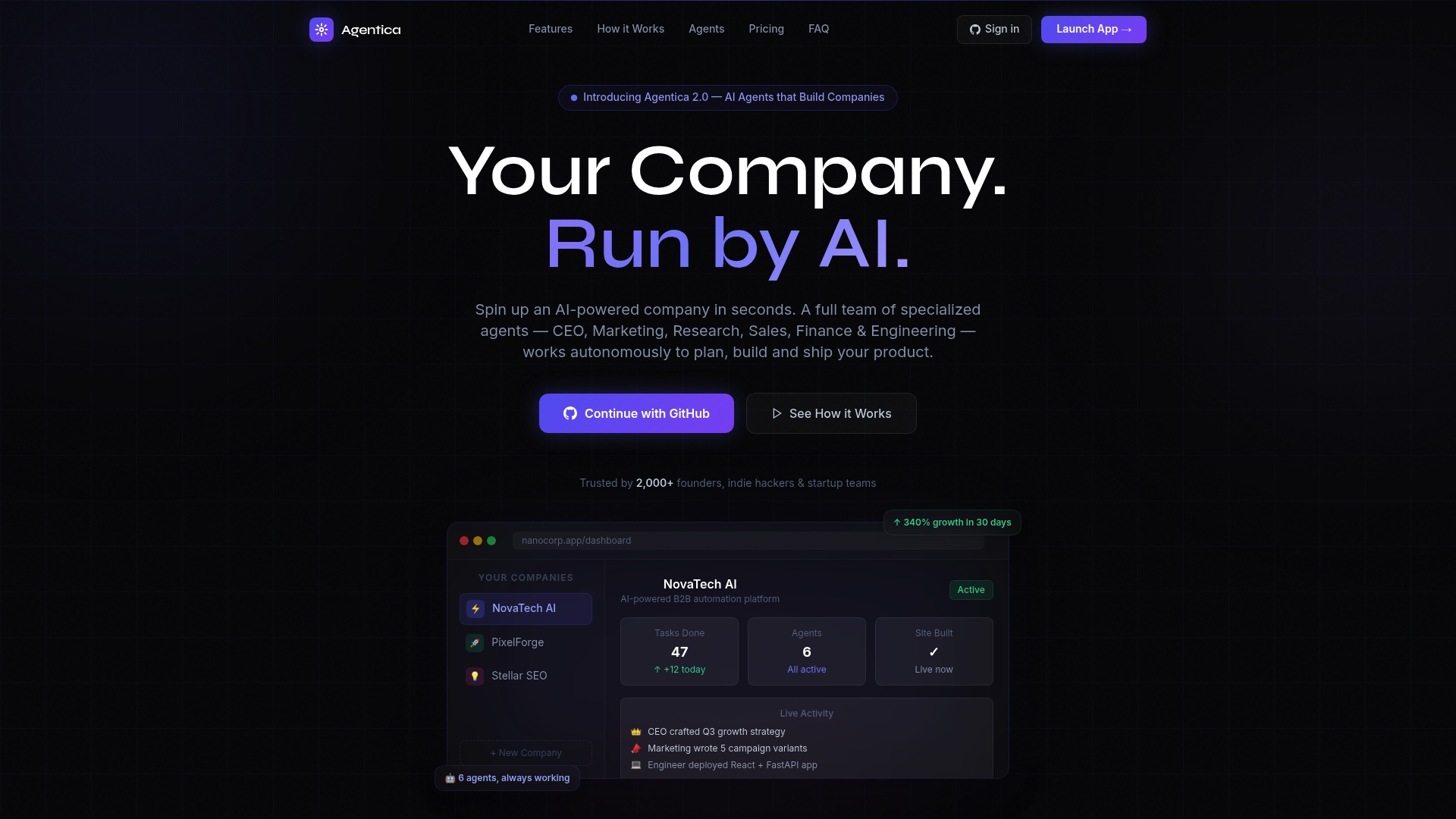
Astarlabshub operates Agentica, an autonomous AI companies platform that goes further than traditional agency automation. Instead of building workflows that require ongoing agency maintenance, Agentica deploys specialized AI agents covering roles like CEO, Marketing, and Engineer that manage end-to-end business operations autonomously. Non-technical founders get full visibility through real-time monitoring, and the platform's transparent architecture means you always know what the system is doing and why. Clients have seen 340% growth within 30 days. If you are ready to move from manual operations to a fully autonomous AI-driven model, Agentica is built for exactly that transition.
FAQ
What is an AI automation agency?
An AI automation agency is a firm that designs and deploys AI-powered workflows connecting your existing business tools to automate repetitive tasks. The agency handles the technical build; your team benefits from the output without writing code.
How much does AI agency automation cost?
Typical engagements run $5,000 to $10,000 for an initial audit, $25,000 to $150,000 for implementation, and $3,000 to $7,500 per month for ongoing support. Most clients see ROI within 60 to 120 days.
What is the difference between AI automation agencies and DIY tools?
DIY tools like Make or n8n work well for simple, single-tool workflows. AI automation agencies are better suited for complex, multi-system integrations that require speed, scale, and minimal internal technical involvement.
How do I avoid vendor lock-in with an AI automation agency?
Require full admin credentials, API keys, and operator-legible documentation at project handover. Any reputable agency transfers complete ownership of all systems to the client at the end of the engagement.
When should a business hire an AI automation agency?
Hire an agency when you have recurring tasks consuming five or more hours per week, a connected SaaS tool stack, and an internal owner who can manage the relationship and make workflow decisions.