
No-code development combined with AI agents is the most significant shift in how entrepreneurs build and scale businesses today. The convergence, often called the "citizen developer revolution" in industry circles, lets founders on platforms like n8n, Zapier, and Microsoft Copilot Studio deploy intelligent automation without writing a single line of code. The AI agents market sits at $10.9 billion in 2026 and is projected to reach $182.9 billion by 2033. That growth is not accidental. It reflects exactly why the no-code movement meets AI agents at this moment: the tools are finally good enough to make the combination work at scale.
Why do no-code platforms empower AI agent creation?
No-code platforms give entrepreneurs a visual interface to design logic, connect data sources, and trigger actions without touching a compiler. Tools like Zapier, Make, and n8n use drag-and-drop canvases where each node represents a step in a workflow. You connect them, configure them in plain English, and the platform handles execution. That simplicity has real numbers behind it.

No-code project delivery takes 3.2 weeks on average versus 14.8 weeks with traditional engineering. That is a 78% reduction in delivery time and a 62% cut in cost. For an entrepreneur testing a new product idea, that difference is the gap between validating a concept this month and waiting until next quarter.
AI agents fit into this picture as the intelligent layer on top of those workflows. Instead of a static trigger-action chain, an AI agent can interpret a goal, decide which tools to use, and adjust its path based on what it finds. Platforms like Microsoft Copilot Studio let you describe what you want in plain language, and the agent figures out the steps. That is a fundamentally different model from traditional automation.
The citizen developer benefits extend beyond speed. When business users handle their own operational logic, IT backlogs shrink. No-code platforms deliver apps up to 10 times faster and at 60–80% lower cost by removing IT as the bottleneck for every workflow change. That frees your technical team to focus on architecture and security rather than building a form for the sales team.
- Speed: Prototypes in days, not months
- Cost: 60–80% savings versus custom development
- Access: Non-technical founders can build functional agents
- Agility: Modify workflows without a developer ticket
Pro Tip: Start with a single, well-defined workflow before building a multi-step AI agent. One clean process you fully understand is worth more than five tangled automations you cannot debug.
What unique value do AI agents add to no-code development?
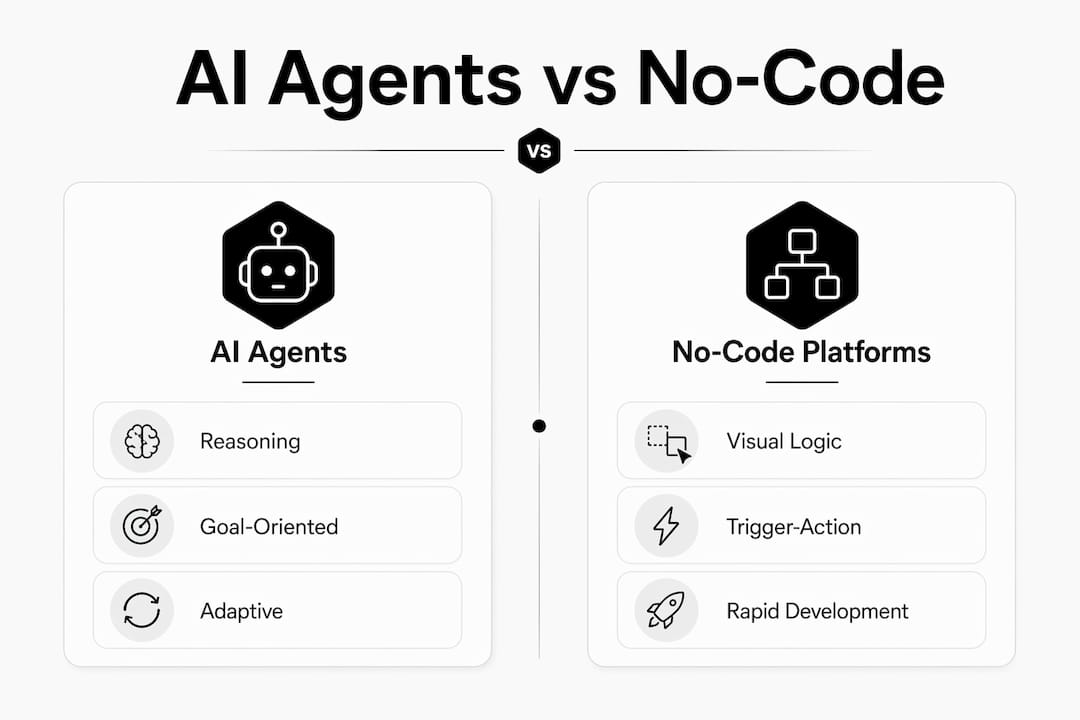
AI agents do not just automate. They reason. That distinction matters enormously for entrepreneurs who need systems that handle exceptions, not just predictable sequences.
A standard no-code workflow breaks when it hits an unexpected input. An AI agent reads the input, interprets context, and decides what to do next. That capability transforms the builder's role. AI agents integrated with no-code platforms shift the builder from a coder to a strategic orchestrator who manages complexity by defining goals and guardrails rather than writing logic line by line.
Here are four concrete ways AI agents add value inside no-code environments:
- Logical branching at scale. An AI agent can evaluate dozens of conditions simultaneously and route tasks accordingly. A human-built decision tree for the same task would require hundreds of nodes.
- Natural language task definition. You describe what you want the agent to accomplish. The agent interprets that description and selects the right tools. This removes the need to map every possible path in advance.
- Data analysis and synthesis. Agents can pull from multiple sources, summarize findings, and surface recommendations. A customer support agent, for example, can check order history, review past tickets, and draft a resolution without human input.
- Continuous improvement loops. Agents can log their own decisions, flag failures, and feed that data back into your workflow for iteration. Static automations cannot do this.
"The convergence of no-code with AI agents reshapes software building from coder-centric to orchestrator-driven, emphasizing clear process thinking over syntax." — Future of No-Code Development
This shift has a practical implication for you as an entrepreneur. Your competitive advantage is no longer whether you can code. It is whether you can think clearly about processes, define goals precisely, and set the right constraints for an AI agent to operate within. That is a skill set any founder can develop.
What are the limitations when combining no-code with AI agents?
No-code AI agents are not a free pass to skip architectural thinking. The abstraction hides complexity. It does not eliminate it.
No-code AI agents often falter at scale due to data bottlenecks, limited observability, and the accumulation of technical debt inside visual workflows. When a workflow breaks in a no-code environment, debugging is harder than reading an error log in code. You are hunting through node configurations and API responses with fewer diagnostic tools.
| Challenge | What it looks like | When it becomes critical |
|---|---|---|
| Data bottlenecks | Slow API responses stall agent loops | High-volume production workflows |
| Limited observability | Hard to trace why an agent took a wrong path | Complex multi-step agents |
| Technical debt | Tangled workflows no one fully understands | After rapid iteration without documentation |
| Security gaps | Credentials stored in workflow configs | Any workflow handling sensitive data |
| Vendor lock-in | Platform changes break your entire stack | Long-term production systems |
The "vibe coding" trap is real. This is the pattern where a founder builds quickly, ships fast, and never documents the logic. Six months later, no one on the team understands why the workflow does what it does. That is not a no-code problem specifically. It is a discipline problem that no-code makes easier to fall into because building feels so frictionless.
Proper architectural design remains critical even when the platform abstracts the code. Think about data flow, failure states, and what happens when an external API goes down. Build those considerations into your agent design from day one.
- Document every workflow with plain-English descriptions of what each node does and why
- Set rate limits and error handlers on every external API call
- Test failure scenarios before going live, not after
- Plan your exit from the no-code platform before you need it
Pro Tip: Use no-code to prove the concept works, then bring in a developer to harden the system for production. The prototype-to-harden pattern is the most reliable path from idea to scalable product.
How can entrepreneurs integrate no-code AI agents into workflows?
Practical integration starts before you open any platform. The biggest mistake entrepreneurs make is automating a broken process. Fix the process first, then automate it.
- Map the workflow manually. Write out every step a human currently takes to complete the task. Identify where decisions happen, where data moves, and where errors occur most often. This map becomes your agent design document.
- Choose your platform based on integrations, not features. The best no-code AI platform is the one that connects to the tools you already use. If your business runs on HubSpot, Slack, and Google Sheets, your platform needs native connectors for all three. Zapier, Make, and n8n each have different integration depths. Evaluate them against your actual stack.
- Define the agent's goal in one sentence. If you cannot describe what the agent should accomplish in a single plain-English sentence, the agent will not perform reliably. Vague goals produce vague behavior.
- Label every tool node with a clear description. Successful no-code AI deployments depend on plain-English descriptions for each tool node. The language model running the agent uses those descriptions to decide which tool to call. A node labeled "send message" will be misused. A node labeled "send a Slack notification to the #ops channel when a new order exceeds $500" will not.
- Run in monitoring mode before full deployment. Let the agent operate with human review for the first 50–100 cycles. Log every decision. Identify patterns in errors before they compound.
- Build an iteration schedule. No agent is correct on day one. Schedule a weekly review of agent logs for the first month, then monthly after that. Treat the agent like a new hire, not a finished product.
You can also explore AI agency automation strategies to understand how larger organizations structure their agent deployments before you design your own.
Key Takeaways
No-code platforms combined with AI agents give entrepreneurs the fastest, most cost-efficient path to intelligent business automation available today.
| Point | Details |
|---|---|
| Speed and cost advantage | No-code cuts delivery time by 78% and costs by 62% versus traditional development. |
| AI agents add reasoning | Agents handle exceptions and logical branching that static automations cannot manage. |
| Architecture still matters | Technical debt and scalability failures happen in no-code just as in custom code. |
| Prototype then harden | Use no-code to validate, then bring developers in for production-grade reliability. |
| Label tools precisely | Plain-English node descriptions are the single biggest factor in agent runtime success. |
What I have learned building with no-code AI agents
Most articles about no-code AI will tell you the tools are powerful and the market is growing. Both are true. What they skip is the part where you realize your beautifully designed agent is making confident, wrong decisions at 2 a.m. because you labeled a tool node "process data" instead of something specific.
I have watched founders treat no-code as a shortcut around thinking. It is not. The AI-assisted no-code platforms democratize complexity, but they do not eliminate the need to understand what you are building. The entrepreneurs who get the most out of this combination are the ones who think like systems designers, not just product builders.
The market growth from $10.9 billion to a projected $182.9 billion is not hype. It reflects a genuine structural shift in who can build software. But the winners in that shift will not be the people who move fastest. They will be the people who move fast and document well, test failure states, and know when to call a developer.
My honest advice: start smaller than you think you need to. Build one agent that does one thing well. Learn how it fails. Then expand. The cost reduction potential with AI is real, but only if the system actually works in production.
The future of building is orchestration. Your job as a founder is to think clearly about goals, constraints, and data. The AI handles the execution. That is a genuinely exciting division of labor, and it is available to you right now without a computer science degree.
— Carlos
Build your first AI-powered company with Astarlabshub
Astarlabshub built Agentica 2.0 specifically for founders who want to move from idea to operating business without a technical team. The platform deploys a coordinated team of autonomous AI agents covering CEO, Marketing, and Engineering roles, each working in parallel to execute strategy, build products, and deploy applications.
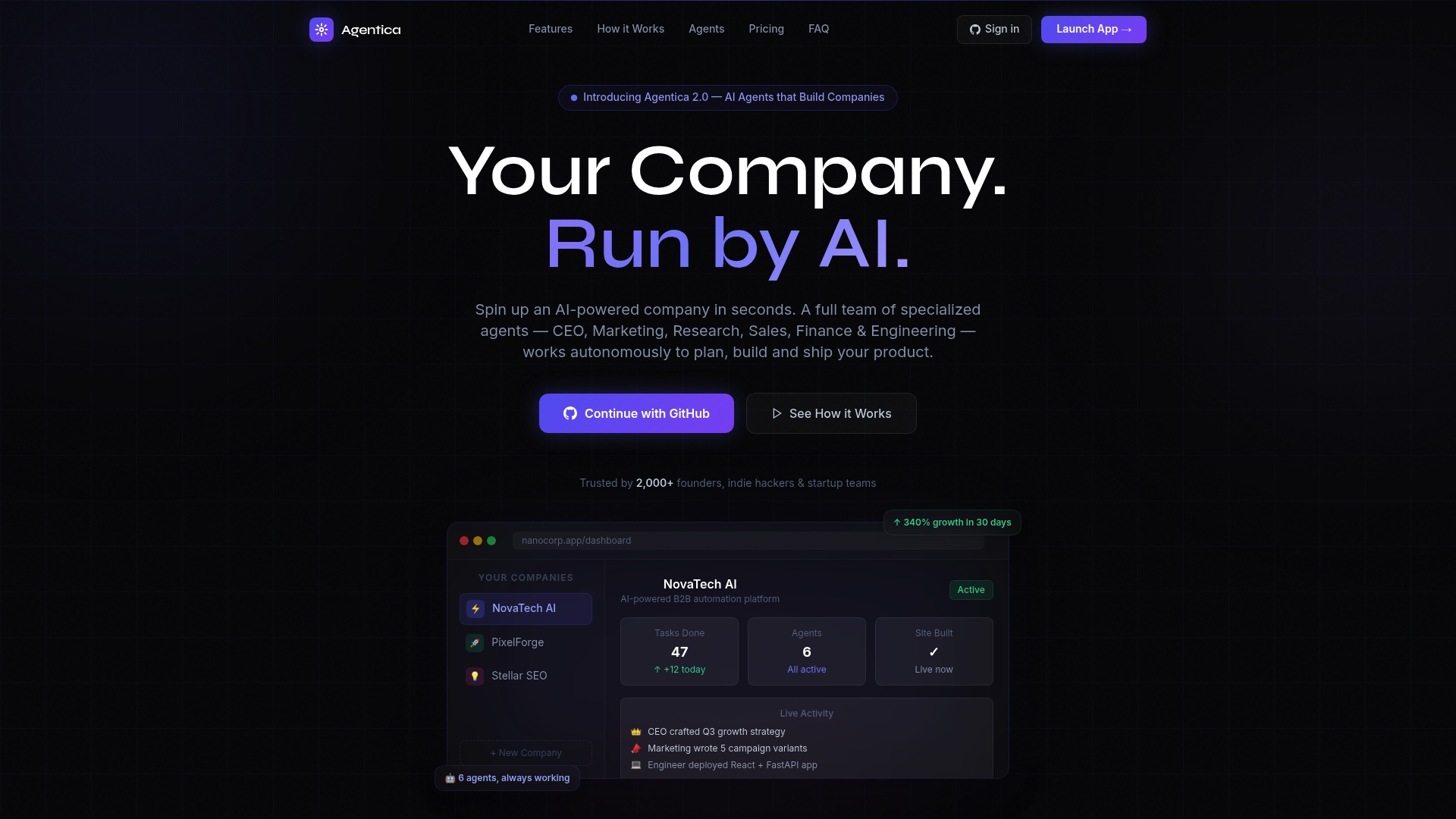
Clients using Agentica's autonomous mode have seen 340% growth in 30 days. The platform gives you real-time visibility into every agent decision, so you always know what is running and why. Explore the full feature set to see how Agentica handles the execution while you stay focused on vision. If you are ready to see how it works end to end, the platform walkthrough is the fastest way to understand what is possible.
FAQ
What is the no-code AI agent movement?
The no-code AI agent movement refers to the use of visual, drag-and-drop platforms like Zapier, Make, and n8n to build and deploy AI agents without writing code. It combines no-code development benefits with the reasoning capabilities of large language models to make intelligent automation accessible to non-technical founders.
How do AI agents differ from standard no-code automation?
Standard no-code automation follows fixed trigger-action rules and breaks on unexpected inputs. AI agents interpret goals, select tools dynamically, and adjust their behavior based on context, making them far more capable for complex, variable business workflows.
Can no-code AI agents scale to production?
No-code AI agents can scale, but architectural thinking is required to avoid data bottlenecks and technical debt. The recommended approach is to prototype with no-code and then engage developers to harden the system for high-reliability production use.
What no-code tools are best for building AI agents?
Zapier, Make, and n8n are the most widely used no-code platforms for AI agent creation. Microsoft Copilot Studio is the leading enterprise option. The right choice depends on your existing tool stack and the complexity of the workflows you need to automate.
How do I prevent my no-code AI agent from making errors?
Descriptive plain-English labels on every tool node are the most effective way to reduce agent errors at runtime. Pair that with a monitoring period of 50–100 cycles before full deployment and a regular log review schedule to catch failure patterns early.