
Autonomous business agents are AI systems that independently perceive their environment, reason through options, act on decisions, and evaluate results with minimal human supervision. The industry term for this category is "agentic AI," and it covers everything from simple rule-based bots to multi-agent systems that coordinate parallel workflows across an entire organization. The autonomous business agent market is projected to grow from $5.1 billion in 2024 to $52.62 billion by 2030. That tenfold expansion signals a fundamental shift in how businesses operate, not just a technology trend. For entrepreneurs and business leaders, understanding the types of autonomous business agents available today is the first step toward deploying them effectively.
What are the foundational types of autonomous business agents?
Foundational research defines five classic agent types, and every enterprise architecture builds on these categories. Knowing them helps you match the right agent to the right problem.
-
Simple Reflex agents react to the current input using fixed rules. They have no memory and no planning capability. A spam filter that blocks emails matching a keyword list is a Simple Reflex agent. These work well for high-volume, low-complexity tasks where the rules never change.
-
Model-Based agents maintain an internal representation of the world. They track context across interactions and adjust behavior based on what they remember. A customer service bot that recalls a caller's account history mid-conversation is Model-Based. This type handles tasks where prior state matters.
-
Goal-Based agents plan sequences of actions to reach a defined objective. They evaluate multiple paths and choose the one most likely to succeed. A procurement agent that sources three vendor quotes before recommending a purchase operates on Goal-Based logic. These agents handle multi-step workflows that require forward planning.
-
Utility-Based agents go further by weighing trade-offs between competing outcomes. They assign a score to each possible action and pick the highest-value option. A dynamic pricing agent that balances margin, inventory, and competitor rates is Utility-Based. This type fits decisions where "good enough" is not acceptable and optimization matters.
-
Learning agents improve from experience. They update their behavior based on feedback from past actions, making them better over time. A fraud detection model that refines its thresholds after each flagged transaction is a Learning agent. These agents require quality historical data and ongoing evaluation to perform reliably.
How do advanced agent architectures expand beyond these five types?
Enterprise deployments typically expand the five foundational types into eight or nine categories based on autonomy and capability levels. Each advanced type targets a specific class of business problem.
Task-Specific agents focus on a single defined workflow. They do one thing well: process invoices, qualify leads, or schedule meetings. Their narrow scope makes them easy to deploy and monitor. An AI marketing agent that handles inbound lead qualification, for example, can reduce response times from hours to under two minutes, directly increasing meeting conversion rates.
Conversational agents manage dialogue with customers or internal teams. They understand natural language, maintain context across a conversation, and escalate to humans when needed. Call center bots, internal HR assistants, and sales chat agents all fall into this category. Their value scales with the volume of repetitive inquiries they handle.
Research agents gather, synthesize, and summarize information from multiple sources. They scan market reports, competitor filings, and news feeds to deliver structured intelligence. A founder using a Research agent can get a competitive landscape summary in minutes rather than days.

Coding agents write, test, and debug software autonomously. They read a specification, generate code, run tests, and iterate on failures without waiting for a human developer. Platforms that build web apps using AI agents rely heavily on Coding agents to compress development timelines.
Orchestrator agents coordinate other agents. They break a complex goal into subtasks, assign each subtask to a specialized agent, and consolidate results. An Orchestrator is the project manager of a multi-agent system. Without one, parallel agent workflows quickly become uncoordinated.
Autonomous Task agents pursue long-horizon goals with minimal check-ins. They plan, execute, monitor, and adjust over extended periods. These agents are closest to the concept of a digital worker operating on a recurring perceive-reason-act-evaluate cycle. They change the human role from operator to supervisor.
Hybrid agents combine rule-based logic with learned behavior. They use fixed rules for high-risk decisions and machine learning for lower-stakes choices. This layered approach gives businesses predictability where it counts and flexibility where it helps.
Multi-Agent Systems deploy multiple specialized agents working in parallel. They offer the highest return on investment for complex, distributed workflows requiring task verification and parallel execution. The trade-off is that they require advanced architecture and monitoring to prevent coordination failures.
Comparing agent types by autonomy, risk, and business fit
Choosing the wrong agent type for a task creates cost and risk without adding value. Matching agent autonomy to task reversibility and business risk is the core selection principle.
| Agent type | Autonomy level | Risk level | Best business fit |
|---|---|---|---|
| Simple Reflex | Low | Low | Email filtering, basic routing |
| Model-Based | Low to medium | Low | Customer support, CRM updates |
| Goal-Based | Medium | Medium | Procurement, scheduling |
| Utility-Based | Medium to high | Medium | Pricing, resource allocation |
| Learning | Medium to high | Medium | Fraud detection, recommendations |
| Task-Specific | Medium | Low to medium | Lead qualification, invoice processing |
| Conversational | Medium | Low to medium | Customer service, HR support |
| Orchestrator | High | Medium to high | Cross-functional workflow management |
| Autonomous Task | High | High | Long-horizon project execution |
| Multi-Agent System | Very high | High | End-to-end business operations |
Low-autonomy agents suit finance and HR functions where errors carry regulatory consequences. High-autonomy agents deliver the most value in IT operations, supply chain, and product development, where speed and scale matter more than caution.
Experts warn against using high-autonomy multi-agent systems as a sledgehammer for simple rule-governed tasks. Overcomplicated agent types for simple tasks increase cost and introduce risks like agentic loops, where agents cycle through actions without reaching a conclusion.
Pro Tip: Before selecting an agent type, write down the task's decision rules on one page. If you can, a Simple Reflex or Task-Specific agent is the right fit. If you cannot, you need a Goal-Based or higher-order agent.
What are the best practices for selecting and deploying autonomous agents?
Deployment decisions determine whether an agent delivers value or creates operational debt. ROI is typically realized by scoping individual workflows within a 90-day period rather than attempting enterprise-wide changes at once. That finding holds across business sizes.
-
Match agent type to problem complexity. A Learning agent deployed on a task with only 200 historical records will underperform a simple rule-based system. Complexity of the agent must match complexity of the problem.
-
Prioritize observability and governance. Businesses often mistakenly prioritize agent reasoning over structured operational controls. Observability means you can see what the agent decided and why. Governance means you can stop it when it goes wrong.
-
Build in the evaluation stage. Many agent deployment failures stem from skipping the step where agents verify results before proceeding. Without evaluation, agents risk infinite loops or error propagation that corrupt downstream processes.
-
Start with human-in-the-loop (HITL) models. HITL means the agent hands off decisions to a human when it encounters exceptions. As the agent proves consistent performance, you transition to human-on-the-loop (HOTL), where humans monitor but rarely intervene. Aiming for full autonomy too soon causes errors and risk.
-
Treat data quality as a prerequisite. Initial deployments spend 60–70% of effort cleaning and structuring data to prevent hallucinations and poor agent decisions. An agent's output is only as reliable as the data it reads.
Pro Tip: Run your first agent deployment on a workflow where mistakes are reversible and the volume is high. You will learn more in 30 days than in six months of planning.
Key takeaways
Autonomous business agents deliver the most value when the agent type matches the task's complexity, risk level, and data maturity.
| Point | Details |
|---|---|
| Start with foundational types | The five classic agent types (Simple Reflex through Learning) form the basis of every enterprise architecture. |
| Advanced types expand capability | Orchestrator, Autonomous Task, and Multi-Agent systems handle complex, long-horizon business goals. |
| Match autonomy to risk | High-autonomy agents belong in low-consequence or high-volume workflows, not in finance or HR without guardrails. |
| Deploy in phases | Scope individual workflows first; prove ROI within 90 days before expanding agent scope. |
| Data quality gates success | Cleaning and structuring data before deployment prevents the most common agent failures. |
Why the "digital worker" framing changes everything
The phrase "AI assistant" undersells what autonomous agents actually do. After working with agentic systems across multiple business functions, I am convinced that the biggest mistake leaders make is treating agents as faster software rather than as a new category of worker.
When an autonomous agent operates as a digital worker on a perceive-reason-act-evaluate cycle, the human role genuinely shifts. You stop being the operator and become the supervisor. That is not a small change. It requires new skills: setting guardrails, reading agent logs, and knowing when to intervene.
The misconception I see most often is that more autonomy equals more value. It does not. A Utility-Based agent running a pricing model with clear constraints often outperforms a Multi-Agent System on the same task, because the simpler system has fewer failure points. Governance and observability matter more than clever reasoning. The teams that get the most from autonomous agents are the ones that incorporate governance upfront, not as an afterthought.
The leaders who will win are not the ones who deploy the most agents. They are the ones who deploy the right agents, monitor them honestly, and keep humans in the loop until the data proves otherwise.
— Carlos
Astarlabshub's Agentica platform for autonomous business operations
Astarlabshub built Agentica 2.0 specifically for entrepreneurs who want to run autonomous business operations without a large technical team. The platform deploys a coordinated team of specialized agents, including CEO, Marketing, and Engineer roles, that manage strategy, coding, and deployment end to end.
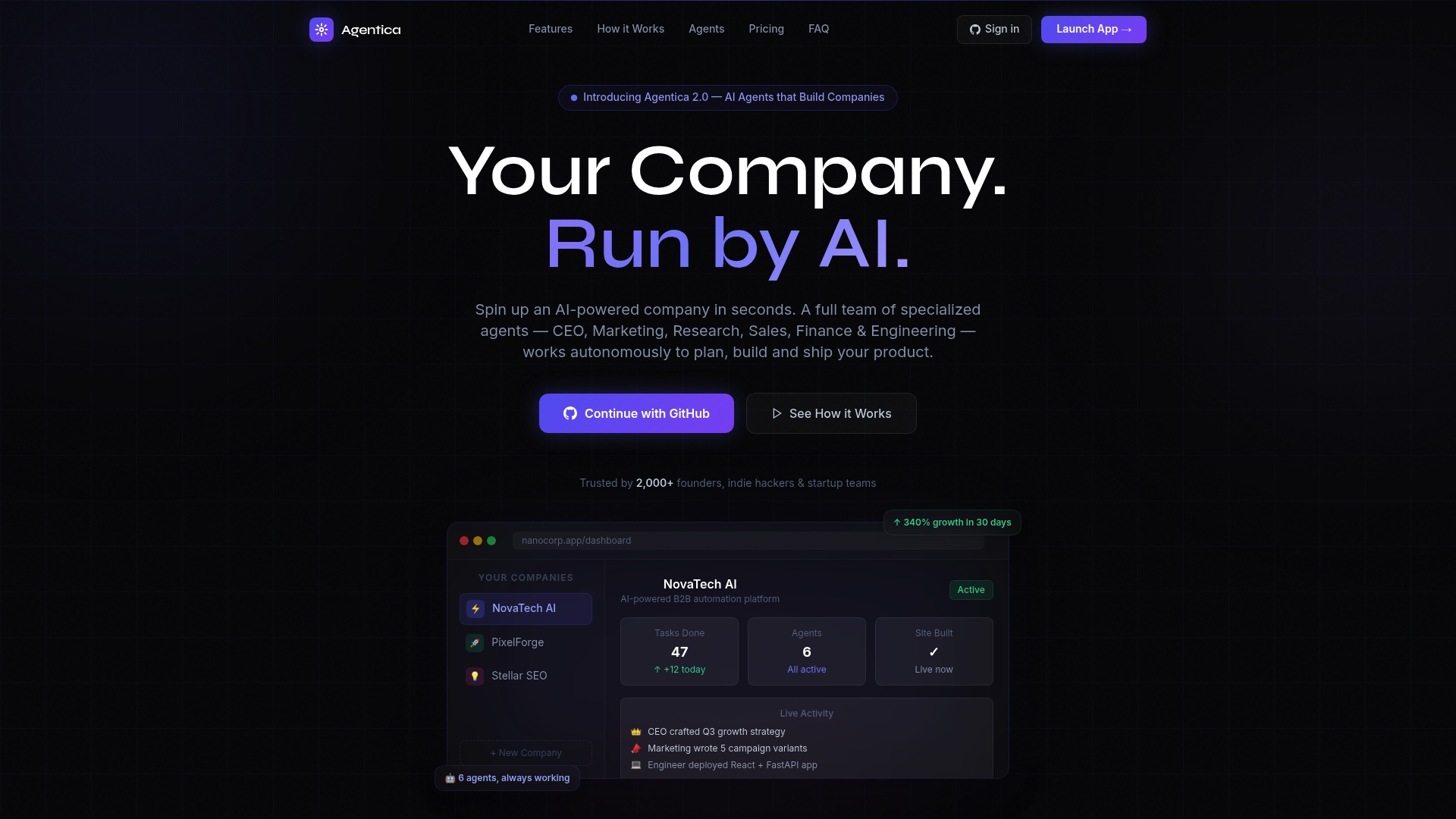
Astarlabshub reports 340% growth for clients within 30 days of deployment. The platform supports everything from Task-Specific agents for focused workflows to full multi-agent architectures for end-to-end business operations. Real-time monitoring gives founders full visibility into what each agent is doing and why. Non-technical founders can set the vision and let the agents execute. Review Agentica's pricing and features to find the agent configuration that fits your business stage.
FAQ
What are the main types of autonomous business agents?
The five foundational types are Simple Reflex, Model-Based, Goal-Based, Utility-Based, and Learning agents. Enterprise deployments extend these into advanced categories including Task-Specific, Conversational, Orchestrator, and Multi-Agent systems.
How do autonomous agents work in a business context?
Autonomous agents follow a perceive-reason-act-evaluate cycle, taking in data, deciding on an action, executing it, and checking the result before proceeding. This cycle repeats continuously with minimal human input.
What is the biggest risk when deploying autonomous business agents?
The most common failure is skipping the evaluation stage, which causes agentic loops where agents repeat actions without reaching a conclusion. Starting with human-in-the-loop models and phased deployment reduces this risk significantly.
Which agent type is best for a small business or startup?
Task-Specific agents deliver the fastest ROI for small businesses because they focus on one high-volume workflow, such as lead qualification or invoice processing, and are straightforward to monitor and adjust.
How does data quality affect autonomous agent performance?
Data quality directly caps agent performance. Initial deployments typically spend 60–70% of setup time cleaning and structuring data, because an agent making decisions on incomplete or inaccurate data will produce unreliable outputs regardless of its architecture.