
An AI marketing agent is autonomous software that manages end-to-end marketing campaigns, from strategy and audience targeting to content generation and real-time optimization, without constant human input. Unlike a chatbot or a simple scheduling tool, these agents perceive data, decide actions, execute across platforms, and learn from results in a continuous loop. Tools like Google Gemini, Meta Advantage+, and platforms built around agentic AI represent the leading edge of this shift. For entrepreneurs running lean teams, understanding what does an AI marketing agent do is the difference between scaling marketing efficiently and staying stuck in manual execution.
What does an AI marketing agent do across a full campaign?
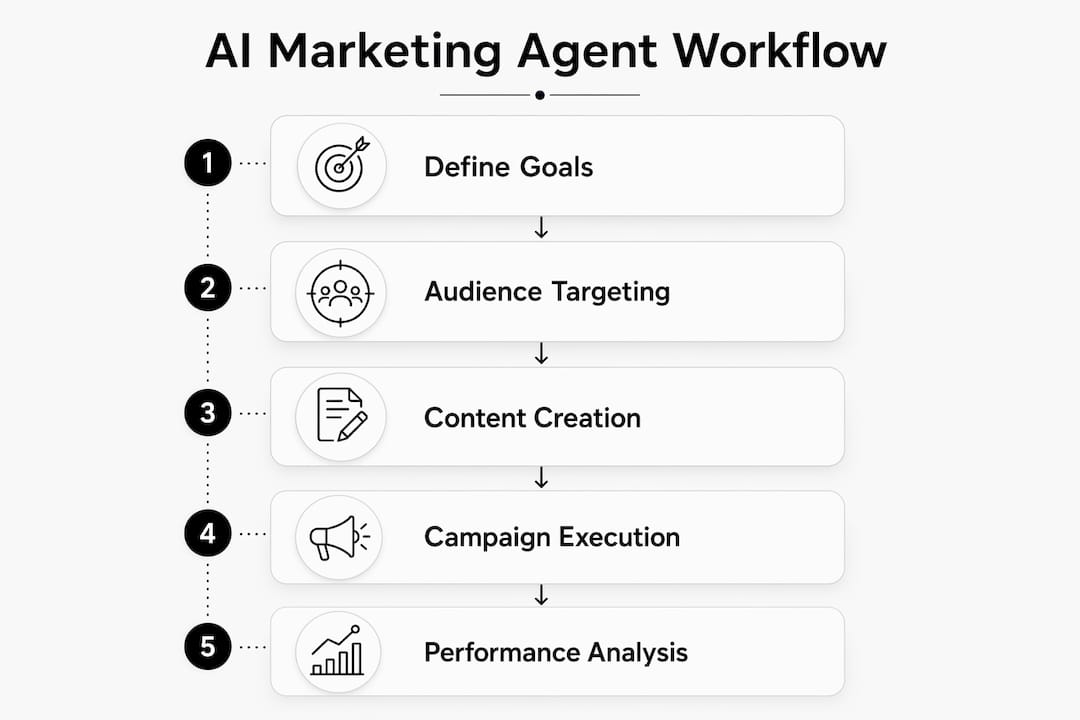
An AI marketing agent manages end-to-end campaign phases including strategy, audience discovery, content generation, journey building, optimization, and reporting. Each phase runs with minimal human intervention. The agent sets objectives, selects channels, builds audience segments, generates creative assets, monitors performance, and adjusts in real time.
Here is how the full lifecycle breaks down:
- Campaign planning. The agent analyzes business objectives, identifies target segments, selects the right channel mix, and defines KPIs before a single dollar is spent.
- Audience discovery. Machine learning models score and segment audiences based on behavioral signals, going far beyond static demographic filters.
- Content generation. The agent produces personalized ad copy, email subject lines, and creative variants grounded in real customer and product data.
- Journey building. It constructs multi-step campaign flows with branching logic, channel assignments, triggers, and timing delays.
- Real-time optimization. The agent monitors live performance, reallocates traffic to winning paths, and pauses underperforming segments automatically.
- Reporting. Automated dashboards and export-ready performance summaries replace hours of manual data pulling.
AI marketing agents save marketers 40+ hours per campaign by handling journey configuration, personalization setup, and reporting conversationally. That time savings compounds across every campaign you run in a quarter.
Pro Tip: Set clear KPI guardrails before activating an agent. Agents optimize toward the goals you define, so vague objectives produce vague results.

How do AI marketing agents differ from traditional automation?
Traditional marketing automation follows fixed if/then rules. An agent plans and executes multi-step campaigns independently while learning from results to improve future decisions. That distinction matters enormously for entrepreneurs who have outgrown rigid workflow builders.
| Feature | Traditional automation | AI marketing agent |
|---|---|---|
| Decision-making | Predefined if/then rules | Autonomous within human guardrails |
| Learning | None. Rules stay static. | Continuous. Improves from each campaign. |
| Content creation | Template fills | Generates original copy and creative variants |
| Optimization | Manual adjustments required | Real-time reallocation without human input |
| Campaign scope | Single channel, linear flows | Cross-platform orchestration |
| Oversight model | Full human control | Partial autonomy with approval gates |
The critical difference is the closed-loop feedback cycle. A traditional tool sends an email when a trigger fires. An AI marketing agent operates autonomously under human-set guardrails, writes its own campaign script, monitors outcomes, and rewrites the next iteration based on what worked. Most current deployments use partial autonomy with approval gates, meaning humans review high-stakes decisions while the agent handles routine execution. That balance keeps quality high without requiring a full-time operator.
Pro Tip: Start with approval gates on budget changes and creative approvals. Let the agent run freely on audience segmentation and reporting. Expand autonomy as trust builds.
What marketing tasks do AI agents actually automate?
Paid media management is where AI marketing agent functions show the clearest return. Agents like Google AI Max and Meta Advantage+ autonomously handle bidding, media buying, dynamic creative optimization, and cross-platform reporting. They lift conversions by continuously adjusting campaigns based on live signal data.
Beyond paid media, AI agents automate a wide set of marketing production tasks:
- Ad copy and subject lines. Agents generate dozens of variants, test them, and promote winners without a copywriter in the loop.
- Audience building. Behavioral signals like page sequences and time-on-page feed predictive models that identify high-value segments before a campaign launches.
- Campaign orchestration. A single agent can coordinate campaigns across Meta, Google, and TikTok simultaneously, adjusting each platform's budget and creative based on relative performance.
- Content packages. Agents orchestrate entire marketing packages including copywriting, landing pages, and emails, then place deliverables directly into collaboration tools like Notion or Slack.
- Analytics and summaries. Agents produce structured performance summaries that replace manual reporting, making it easy to brief stakeholders without touching a spreadsheet.
For a business owner running AI-driven marketing strategies without a large team, this list represents work that previously required a media buyer, a copywriter, a data analyst, and a project manager. An agent consolidates those functions into one always-on operator.
How do AI marketing agents integrate with your existing tools?
AI marketing agents connect to your existing marketing stack through APIs. They integrate across CRM platforms, ad networks, content management systems, and analytics tools to orchestrate cross-platform campaigns from a single reasoning layer. The agent maintains context across all connected tools, not just within one platform.
Here is how integration typically works in practice:
- API connections. The agent links to platforms like Salesforce, HubSpot, Google Ads, and Meta Ads Manager through standard API credentials.
- Data grounding. First-party behavioral data such as page sequences and time-on-page grounds the agent's decisions. Generic demographic data alone produces unreliable outputs.
- Workflow orchestration. The agent shifts your team's role from executing tasks to reviewing handoffs. It produces deliverables and routes them to the right tools or team members.
- Audit logs. Every agent action is logged, giving you a clear record of what ran, when, and why. This is non-negotiable for compliance and quality control.
- Human review gates. Human oversight remains critical for high-stakes decisions. Approval gates let you stay in control without micromanaging routine tasks.
The shift in operations is significant. Adopting AI marketing agents moves marketing from content generation to production orchestration. Your team stops writing every email and starts reviewing agent outputs, setting guardrails, and approving budget moves. That is a fundamentally different job, and it requires deliberate planning to manage well. Entrepreneurs exploring specialized AI agent roles will find that the marketing agent is one of the most immediately impactful functions to deploy.
Key Takeaways
AI marketing agents deliver the most value when entrepreneurs treat them as always-on operators with defined guardrails, not as passive suggestion tools.
| Point | Details |
|---|---|
| Full campaign autonomy | Agents handle planning, audience targeting, content, optimization, and reporting end-to-end. |
| Not traditional automation | Agents learn from results and rewrite strategies. Rule-based tools follow static if/then logic only. |
| Real time savings | Automating journey setup, personalization, and reporting saves 40+ hours per campaign. |
| Data quality drives results | First-party behavioral data grounds agent decisions. Poor data inputs produce unreliable outputs. |
| Partial autonomy is standard | Most deployments use approval gates for high-stakes decisions while agents run routine execution freely. |
Why I think most entrepreneurs underestimate what these agents actually do
Most business owners I talk to think of AI marketing agents as faster chatbots. They expect a tool that writes better emails or suggests ad headlines. That framing undersells the technology by a wide margin.
What surprised me most when I started working closely with agentic marketing systems is how much of the cognitive load they absorb. Setting campaign strategy, selecting audience segments, deciding when to pause a creative, and writing the performance brief for a client call. These are not mechanical tasks. They require judgment. Watching an agent handle all of them in a single campaign cycle, with minimal input, changes how you think about what a marketing team actually needs to do.
The honest challenge is that agents are only as good as the guardrails and data you give them. I have seen campaigns go sideways when an agent optimized toward the wrong metric because the objective was defined too loosely. The technology is not a replacement for marketing thinking. It is an amplifier of it.
My advice for entrepreneurs evaluating these tools: start with one campaign type, set tight guardrails, and review every output for the first two weeks. You will learn faster from watching an agent work than from reading any documentation. Once you trust the outputs, expand the scope. The efficiency gains at scale are real, and they compound quickly.
— Carlos
How Astarlabshub puts autonomous marketing agents to work
Astarlabshub's Agentica platform deploys a coordinated team of AI agents, including a dedicated Marketing agent, that autonomously manage campaigns from planning through execution. The platform connects across ad networks, content tools, and analytics to run cross-platform campaigns without requiring a large in-house team.
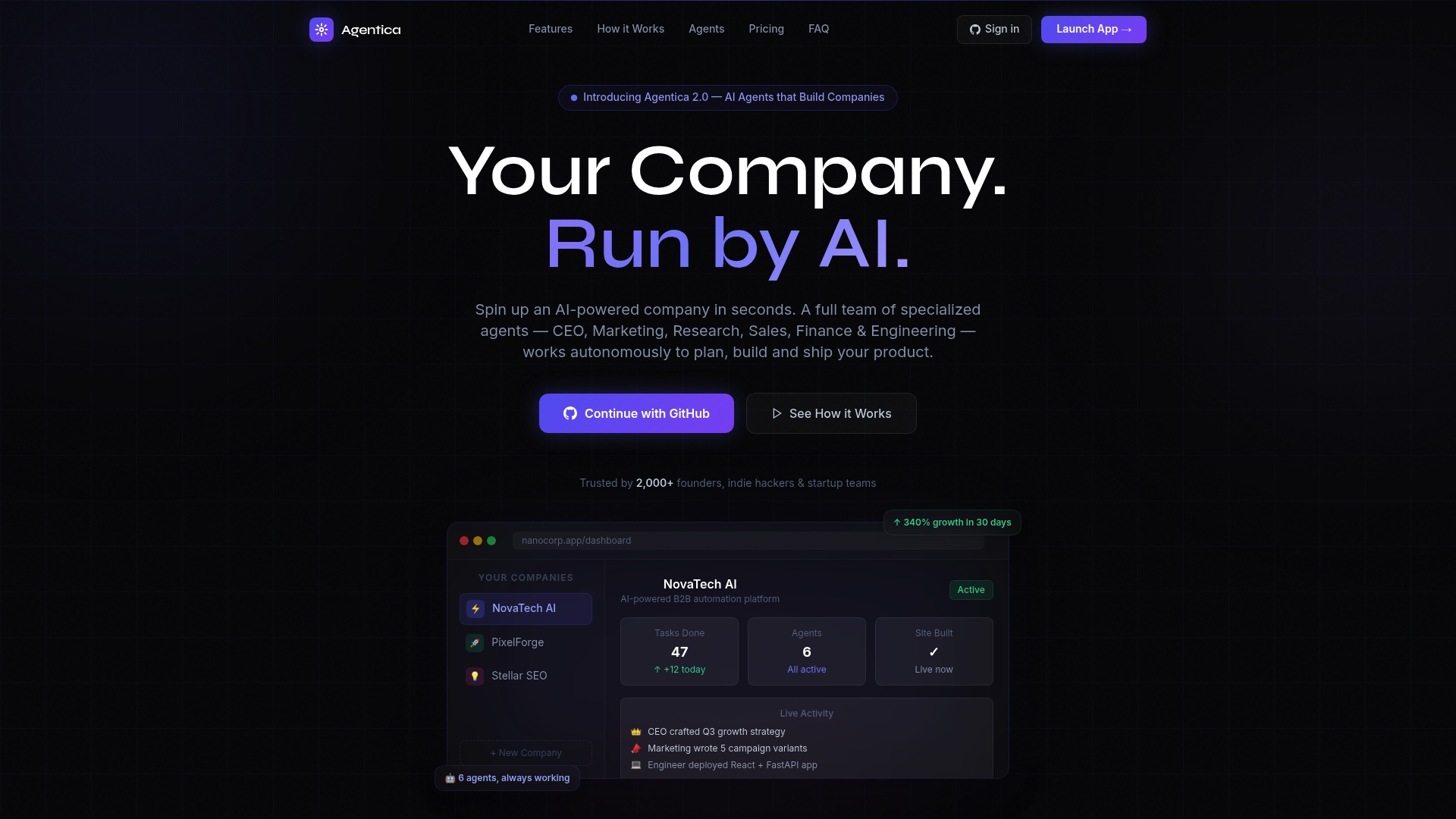
Agentica's autonomous mode lets non-technical founders focus on business vision while the marketing agent handles audience targeting, content production, and performance reporting. Clients using the platform have reported 340% growth within 30 days, according to Astarlabshub. Real-time monitoring gives you full visibility into every agent action. Explore Agentica's marketing agent features or review available plans to see which tier fits your current stage.
FAQ
What does an AI marketing agent do differently than a chatbot?
A chatbot responds to user queries. An AI marketing agent runs full campaigns autonomously, making decisions, executing across platforms, and learning from results without waiting for a prompt.
Can AI marketing agents replace a marketing team?
Agents automate execution tasks but require human oversight for strategy, guardrail-setting, and quality review. They reduce the team size needed, not the need for marketing judgment entirely.
How do AI marketing agents improve over time?
Agents observe campaign results after each execution cycle and adjust their decisions in the next cycle. This closed-loop learning means performance improves with each campaign run.
What data do AI marketing agents need to work well?
First-party behavioral data such as page visit sequences and time-on-page grounds agent decisions far more reliably than generic demographic attributes alone.
Is it safe to let an AI agent run campaigns without approval?
Most production deployments use partial autonomy with approval gates on budget changes and creative decisions. Fully unsupervised operation is possible but not recommended until trust in the agent's outputs is well established.