
Specialized AI agents are AI systems designed to perform specific tasks exceptionally well by focusing on narrow domains using tailored tools and structured workflows. The role of specialized AI agents explained simply: each agent owns one job, does it with precision, and hands results to the next layer. Unlike general-purpose AI, which tries to handle everything from customer support to code review in a single context window, specialized agents achieve task completion rates of 90% or higher within their domain. That number matters because it separates production-ready automation from expensive experimentation. Tools like Grammarly demonstrate this principle at the software level: one focused function, done reliably, at scale.
How do specialized AI agents work?
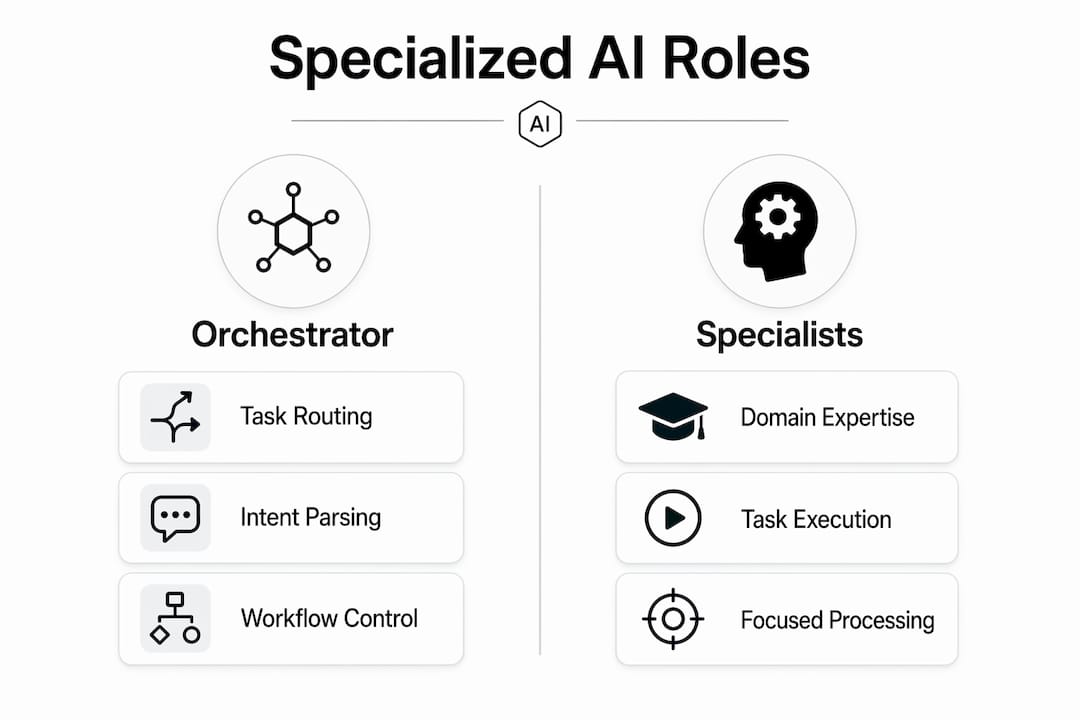
The function of specialized AI agents depends on a clear division of labor. Industry-standard multi-agent systems use a four-tier role-based architecture: Planner, Executor, Critic, and Orchestrator. Each tier has a distinct job, and the system only works when those jobs stay separate.
Here is what each role does in practice:
- Orchestrator receives the user's intent and routes it to the right specialist. Think of it as the dispatcher in a logistics company. It does not do the work itself. It decides who does.
- Planner breaks a complex goal into ordered subtasks. If the goal is "launch a marketing campaign," the Planner defines the steps: research, copy, design, scheduling.
- Executor carries out individual subtasks using specific tools. A coding Executor calls APIs. A research Executor queries databases. Each one operates inside its own isolated context window.
- Critic reviews outputs before they move forward. This agent catches hallucinations, logic errors, and format violations before they compound into larger failures.
The minimum viable version of this system requires just an Orchestrator and one Specialist agent. You add tiers as complexity grows.
| Role | Primary Function | Example Task |
|---|---|---|
| Orchestrator | Routes intent to specialists | Assigns billing query to billing agent |
| Planner | Decomposes goals into steps | Breaks "write report" into research, draft, edit |
| Executor | Runs domain-specific tasks | Calls a payment API or scrapes web data |
| Critic | Validates outputs before synthesis | Flags factual errors in generated content |
Pro Tip: Start with a two-agent system: one Orchestrator and one Executor. Add a Critic only when your error rate becomes a real operational cost. Premature complexity kills more projects than simple architectures ever do.
Specialized agents act like independent callable functions that encapsulate domain expertise. The Orchestrator calls them the same way a developer calls a function in code: pass in structured input, get structured output, move on. This design keeps each agent focused and the overall system predictable.

Specialized vs. generalist AI agents: which one fits your needs?
Generalist AI agents handle a wide range of tasks from a single context window. That works fine at low volumes. Generalists suffice for roughly 1,000 daily interactions, but surpassing 100,000 interactions across multiple domains requires specialized architectures. That threshold is where most growing businesses hit a wall.
The core performance gap comes down to three factors:
- Domain accuracy. Specialized agents train on narrow datasets and use domain-specific tools. A billing agent knows billing logic deeply. A generalist knows billing logic shallowly alongside dozens of other domains.
- Token efficiency. Specialized agents operate in independent context windows, receiving only structured inputs. This prevents context dilution and controls token costs as the system scales.
- Failure isolation. When a generalist fails, the whole workflow stops. Effective specialized systems allow hot-swapping agents independently, so one agent's failure does not halt the entire operation.
| Factor | Specialized Agent | Generalist Agent |
|---|---|---|
| Task completion rate | 90%+ in domain | Lower across mixed domains |
| Context window | Isolated, structured input | Shared, grows with conversation |
| Failure impact | Contained to one agent | Can cascade across workflow |
| Cost at scale | Lower per-task token cost | Higher as domains multiply |
| Best use case | High-volume, single-domain tasks | Low-volume, exploratory tasks |
The decision to switch from generalist to specialized architecture is not about preference. It is about volume and reliability requirements. If your AI system handles customer billing, technical support, and content creation simultaneously at scale, a single generalist agent will degrade across all three. Separate specialists maintain performance in each lane independently.
Many current AI agents are just chatbots overloaded with roles, which degrades reasoning and task performance. Separate agents specialized for tasks like research, coding, content creation, and analytics yield measurably higher reliability. That is the core argument for specialization: not elegance, but output quality under real operational load.
How specialized AI agents are transforming business operations
Specialized AI agents in industry are changing how companies handle volume, speed, and cost simultaneously. The practical applications span every major business function.
Consider what a multi-agent system looks like inside an autonomous company. A CEO agent sets strategic priorities. A Marketing agent runs campaigns and analyzes performance data. An Engineer agent writes and deploys code. Each one operates in its lane, and parallel task execution through specialized agents scales output in ways a single generalist model cannot match.
The benefits of specialized AI agents in real business contexts include:
- Billing and finance. A billing agent processes invoices, flags anomalies, and reconciles accounts without touching unrelated data. Accuracy stays high because the agent's entire context is financial logic.
- Technical support. A support agent trained on product documentation resolves tickets faster than a generalist because it does not waste context on irrelevant knowledge.
- Sales and outreach. A sales agent tracks pipeline stages, drafts personalized follow-ups, and updates CRM records. It does not also try to write blog posts.
- Content creation. A writing agent generates drafts, applies brand guidelines, and formats output for specific channels. A separate research agent feeds it verified data.
Pro Tip: Map your highest-volume, most repetitive business tasks first. Those are your best candidates for specialized agent deployment. Start there before building complex multi-agent pipelines.
The scalability argument is concrete. A single generalist agent handling customer interactions across billing, support, and sales will degrade as volume grows. Specialized agents running in parallel maintain performance because each one only processes what it was built for. You can also add business intelligence AI agents to the mix for analytics and reporting without disrupting the existing workflow. That modularity is the real operational advantage.
What are the key design pitfalls to avoid?
Building a specialized AI agent system correctly requires more than splitting tasks across agents. The architecture decisions you make early determine whether the system scales or collapses under real workload.
The most dangerous mistake is skipping the Critic layer. Without a validation layer between specialized agents, errors propagate silently and cause unpredictable failures downstream. A Critic agent catches hallucinations, logic errors, and format inconsistencies before they reach synthesis. Adding one does not require prompt complexity. It requires architectural discipline.
Context management is the second major failure point. Agents that share full conversational histories bloat their context windows quickly. Specialized agents should operate in isolated context windows with structured JSON-like inputs and outputs. This controls token growth and keeps each agent focused on its actual task.
Model selection also matters more than most teams realize. Small, fine-tuned models work well as specialized agents, while expensive frontier models like GPT-4o or Claude Opus are better reserved for Orchestrators handling complex planning and routing. This approach cuts cost and improves response time without sacrificing output quality where it counts.
A few additional design rules that experienced practitioners follow:
- Never assign more than one primary domain to a single agent. An agent that does research and also writes copy will underperform at both.
- Test each agent in isolation before integrating it into the full pipeline. Bugs compound fast in multi-agent systems.
- Use coherence cascades to prevent agents from overwriting prior strategic decisions as context passes through the chain.
- Build for hot-swapping from day one. If replacing one agent requires rebuilding the whole system, the architecture is too tightly coupled.
Incremental scaling beats big-bang deployment every time. Add one agent at a time, validate its output in production, then extend the system.
Key takeaways
Specialized AI agents outperform generalist systems at scale because each agent owns a narrow domain, operates in an isolated context window, and fails without disrupting the rest of the workflow.
| Point | Details |
|---|---|
| Specialization drives accuracy | Specialized agents achieve 90%+ task completion rates by focusing on narrow domains with tailored tools. |
| Four-tier architecture is standard | Planner, Executor, Critic, and Orchestrator roles each handle distinct functions to keep systems reliable. |
| Generalists have a volume ceiling | Generalist agents work up to roughly 1,000 daily interactions before performance degrades across domains. |
| Critic layers prevent cascading failures | A dedicated validation agent catches errors before they compound through the rest of the pipeline. |
| Model selection cuts cost | Fine-tuned small models handle specialist tasks; frontier models are reserved for Orchestrators only. |
Why specialization is the only serious path forward
I have watched teams build AI systems the wrong way more times than I can count. They start with one large language model, pile on tools and instructions, and call it an agent. Then they wonder why it halts, hallucinates, or gives inconsistent answers when volume picks up.
The honest truth is that overloading a single model with multiple roles is not an architecture. It is a prototype that works in demos and fails in production. The moment you separate creation from validation using a dedicated Critic agent, output quality improves without any change to your prompts. That single structural decision has more impact than any amount of prompt engineering.
What I find most underappreciated is the Orchestrator's role. Most people focus on the specialists. The Orchestrator is where the real intelligence lives. It has to understand user intent well enough to route correctly, manage task dependencies, and recover gracefully when a specialist fails. That is why autonomous CEO agent capabilities are so interesting to study. The CEO agent in a multi-agent company is essentially an Orchestrator with strategic context.
The future of AI-driven business automation is not one smarter model. It is many focused models working in parallel, each accountable for a specific output, all coordinated by an Orchestrator that understands the bigger picture. Businesses that build this way now will have a structural advantage that is very hard to replicate later.
— Carlos
Build your own ai-powered company with Astarlabshub
Astarlabshub's Agentica 2.0 platform puts the architecture described in this article into practice for entrepreneurs and startup teams. The platform deploys a coordinated team of specialized autonomous agents covering roles like CEO, Marketing, and Engineer, each operating within its own domain to execute strategy, write code, and deploy applications without requiring technical expertise from the founder.
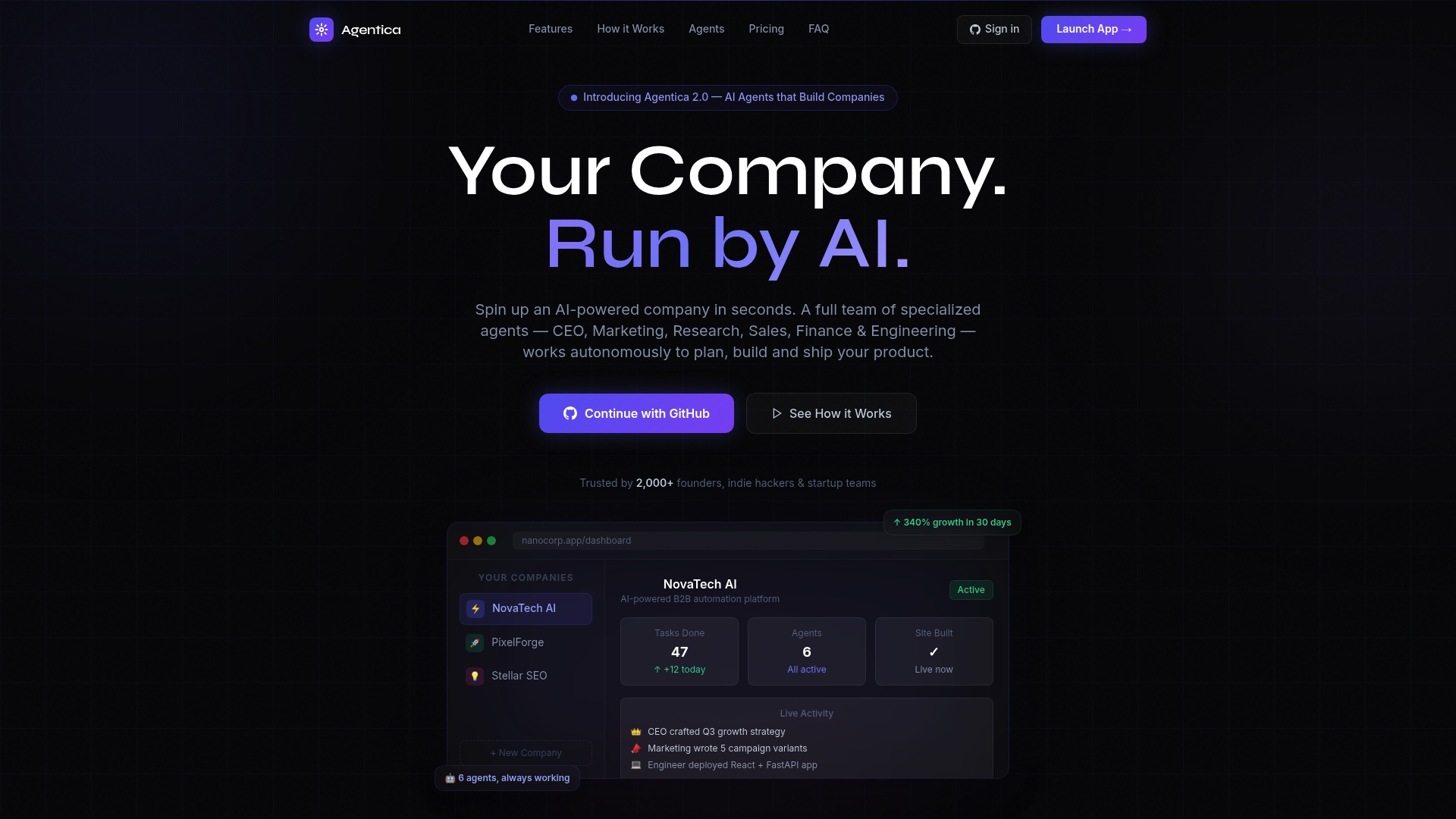
Agentica's autonomous mode handles the full business lifecycle: from product development to deployment to growth. Clients have reported 340% growth within 30 days, with real-time monitoring giving full visibility into what each agent is doing at every step. If you are ready to move from theory to a working AI-driven operation, explore the platform features and see how role-based agent architecture works in a live business context.
FAQ
What are specialized AI agents?
Specialized AI agents are AI systems designed to perform a single, well-defined task within a narrow domain using tailored tools and structured workflows. They differ from general-purpose agents by focusing exclusively on one function, which produces higher accuracy and lower error rates.
How do specialized AI agents work together?
Specialized agents operate within a multi-agent system where an Orchestrator routes tasks to the appropriate specialist, a Critic validates outputs, and results are synthesized into a final deliverable. Each agent runs in its own isolated context window to prevent token bloat and maintain focus.
When should a business switch to specialized agents?
A business should move to specialized architectures when daily AI interactions exceed roughly 1,000 across multiple domains, or when a single generalist agent shows degraded accuracy in any one area. High-volume, multi-domain operations require specialization to maintain performance.
What is the role of the critic agent?
The Critic agent validates outputs from specialist agents before they move to the next stage of the workflow. Without this layer, errors including hallucinations and logic failures propagate silently and compound into larger system failures.
Are specialized AI agents expensive to build?
Not necessarily. The minimum viable system requires only an Orchestrator and one Specialist agent. Cost is further controlled by using small, fine-tuned models for specialist roles and reserving expensive frontier models for the Orchestrator only.