
AI agents are defined as autonomous software systems that plan, act, and learn to complete complex, multi-step tasks with minimal human oversight. The role of AI agents in startups has shifted from experimental to foundational. Founders now use these systems to run engineering, customer support, content, and research functions that once required full teams. The result is a new class of lean, fast-moving company that competes on intelligence rather than headcount. This guide covers how agentic AI works, which functions it handles best, and how to integrate it without creating more problems than you solve.
How do AI agents enhance founder productivity and startup operations?
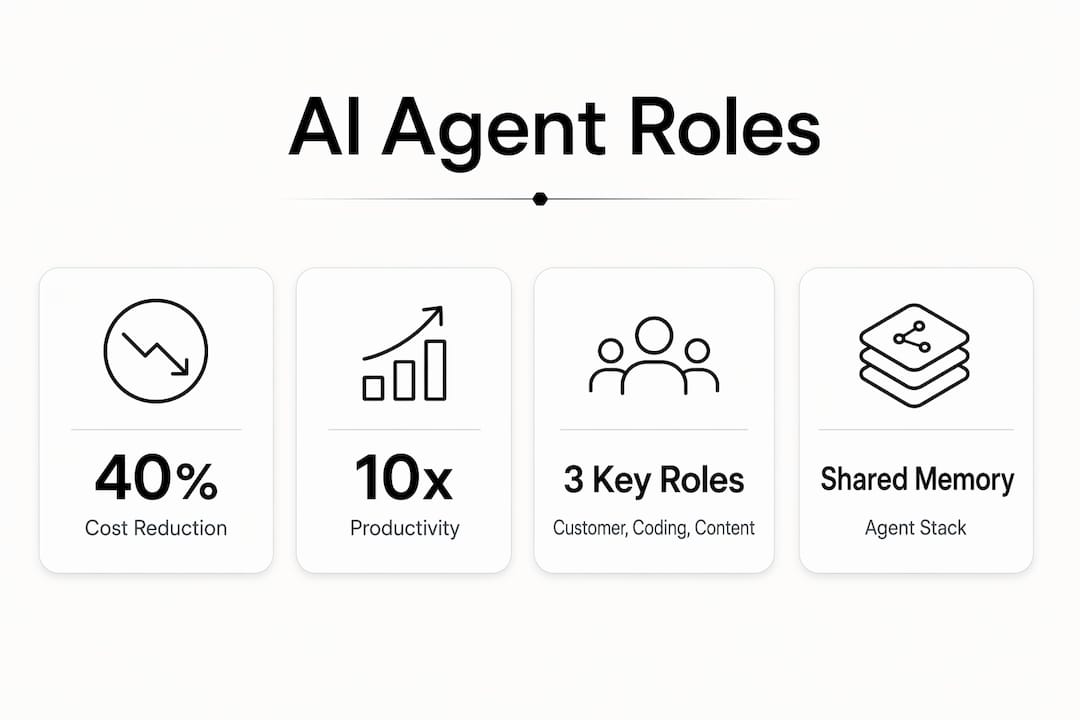
A single founder in 2026 can achieve 10x the code output of a 2020 founder, compressing the work of four to five people into one. That shift is driven by a 95% reduction in cost per token of AI compute since 2020. The math changes everything about how you staff and spend.
The productivity gains extend well beyond coding. Tech startups that apply AI-driven workflow automation from day one reduce operational costs by at least 40%. At the $25,000 to $100,000 revenue stage, those startups show 40% lower burn per dollar of revenue compared to non-AI peers. That is not a marginal improvement. It is the difference between extending your runway by months and running out of cash.

AI agents achieve this by cycling through three phases: planning, acting, and learning. They interpret goals, execute steps using external tools, and improve from feedback without waiting for human instruction at each step. This iterative loop is what separates an AI agent from a simple automation script. A script follows fixed rules. An agent adapts.
The practical impact shows up across four core startup functions:
- Engineering: AI agents generate, review, and debug code continuously, not just when a developer prompts them.
- Customer support: Agents handle inbound tickets, deflecting 30–60% of queries before a human ever sees them.
- Content creation: Agents draft, edit, and publish content at a pace no small team can match manually.
- Research: Agents monitor competitors, summarize market signals, and surface insights on a schedule.
Pro Tip: Treat your AI agents as always-on team members with defined roles and performance metrics, not as one-off tools you activate when stuck. Agents that run continuously catch problems before they escalate.
What are the primary AI agent roles used by startups?
By december 2026, most seed-stage startups will have customer support, content creation, and basic coding handled primarily by autonomous AI agents. That prediction is already materializing. Understanding which agent type fits which function is the first step to building a system that actually works.
The table below maps the most common AI agent roles to the startup functions they replace and the direct benefit each delivers.
| Agent role | Function replaced | Primary benefit |
|---|---|---|
| Customer support bot | Tier-1 support staff | Deflects 30–60% of inbound tickets automatically |
| Code generation copilot | Junior developer tasks | Compresses 4–5 person workload into one founder |
| Content drafting agent | Copywriter and content manager | Publishes at scale without per-piece labor cost |
| Data research automator | Research analyst | Monitors markets and surfaces signals continuously |
| Workflow orchestrator | Operations manager | Coordinates other agents and routes tasks by priority |
Two categories of agents exist: task-focused agents and multi-functional agents. Task-focused agents do one thing well, such as answering support tickets or generating ad copy. Multi-functional agents, sometimes called orchestrators, coordinate other agents and manage shared context across functions. The most effective specialized AI agent stacks combine both types.
The emerging standard is an integrated agent stack where agents share memory and context. When your support agent knows what your content agent published last week, responses stay consistent. When your research agent feeds data directly to your content agent, output stays relevant. Siloed agents working from separate data sources produce inconsistent results and require more human correction.
What are the best practices for integrating AI agents in startups?
Deploying AI agents without a clear management model creates more work, not less. The right model is human-in-the-loop for judgment, not for execution. Founders should review decisions, not approve every action. That distinction determines whether AI agents free up your time or consume it.
Follow these steps to build an agent integration that holds up at scale:
- Map your workflows before automating them. Agents inherit the inefficiencies of broken processes. Fix the workflow first, then automate it.
- Assign each agent a defined role and scope. Ambiguous mandates produce inconsistent outputs. Treat agent role design the same way you would a job description.
- Build continuous intelligence loops. Monitoring agent outputs for hallucinations and drift requires dedicated effort. Agents that self-monitor against defined metrics produce more reliable results over time.
- Consolidate your agent stack. Fragmented AI tools create data silos and maintenance overhead that can consume 20–30% of the time you saved. Unified multi-agent stacks with shared memory reduce that drag significantly.
- Redesign workflows around agents, not around people. Founders who redesign workflows for AI from the start shorten execution cycles and reduce operational waste. Piecemeal automation on top of human-designed processes produces diminishing returns.
Pro Tip: Build your AI agent stack with shared context from day one. Agents that access the same memory layer collaborate without human coordination, which is where the real time savings accumulate.
The leadership shift required here is real. Founders who succeed with AI agents stop thinking like managers of people and start thinking like architects of systems. The question changes from "who handles this?" to "which agent handles this, and how do I verify the output?"
How are startups gaining competitive advantage through AI agents?
AI commoditizes execution in startups, shifting the constraint away from capital toward distribution, trust, and human judgment. That is a fundamental change in what it means to compete. A startup with three people and a well-built agent stack can now execute at the pace of a team ten times its size.
The cost structure shift is equally significant. AI moves startup costs from fixed to variable, replacing seat-based software licensing with pay-per-task workflows. During a funding squeeze, that flexibility keeps burn low without cutting capability. A startup paying for AI compute only when tasks run carries far less overhead than one paying monthly salaries for functions agents can handle.
The competitive advantages compound across three areas:
- Capital efficiency: Lower burn per dollar of revenue extends runway and reduces dilution pressure at each funding round.
- Speed to market: Agents compress product development cycles, letting founders test and iterate faster than competitors relying on manual processes.
- Focus on what matters: When agents handle execution, founders spend time on product-market fit, customer relationships, and distribution. Those are the areas where human judgment still creates irreplaceable value.
"Startups must evolve from product builders to architects of intelligence systems." — World Economic Forum, 2026
The AI adoption timeline itself has compressed. What once took 20 months to implement now takes two months. That acceleration means the window for gaining an early advantage is narrowing. Founders who build AI-driven cost reduction into their operations now will have a structural advantage over those who wait.
The one thing AI does not replace is human judgment in ambiguous situations and the trust that comes from genuine customer relationships. Founders who understand this use agents to handle everything that can be systematized, then show up personally for the decisions and relationships that cannot.
Key Takeaways
The role of AI agents in startups is to replace execution-layer work so founders can focus on judgment, distribution, and trust, the three things AI cannot commoditize.
| Point | Details |
|---|---|
| Founder productivity multiplier | AI agents compress 4–5 person workloads into one founder through a 95% drop in compute costs. |
| Operational cost reduction | Startups applying AI automation from founding reduce operational costs by at least 40%. |
| Core agent functions | Customer support, code generation, content creation, and research are the first functions to automate. |
| Avoid automation sprawl | Fragmented agent tools create silos; unified stacks with shared memory cut maintenance overhead. |
| Competitive advantage source | AI shifts costs from fixed to variable and frees founders to focus on distribution and customer trust. |
Why most founders are thinking about AI agents the wrong way
The conversation around AI agents in startups tends to focus on replacement. Which roles can AI take over? How many hires can you avoid? That framing misses the more important question: what does your company become when execution is no longer the bottleneck?
I have watched founders spend months picking the perfect AI tool for each function, then spend the next six months managing a fragmented stack that fights itself. The tools were fine. The architecture was broken. Agents that do not share context do not collaborate. They just create a more expensive version of the siloed team you were trying to avoid.
The founders who get this right treat agent design as a core competency, not an IT project. They define agent roles with the same rigor they would apply to a key hire. They build monitoring into the system from day one, not as an afterthought when something goes wrong. And they stay personally involved in the decisions that require judgment, customer trust, or creative direction. Those are not tasks to delegate to an agent. They are the work that defines the company.
The practical advice I give every founder is this: start with one function, build the monitoring loop before you scale it, and resist the urge to automate everything at once. The compounding benefits of a well-run agent stack take time to materialize. Patience in the build phase pays off in the growth phase.
— Carlos
Astarlabshub's Agentica platform for autonomous startup operations
Astarlabshub built Agentica 2.0 specifically for founders who want to run a company with a small team and a well-designed agent stack. The platform deploys specialized agents across CEO, Marketing, and Engineer functions, each working autonomously to execute tasks, build products, and deploy applications.
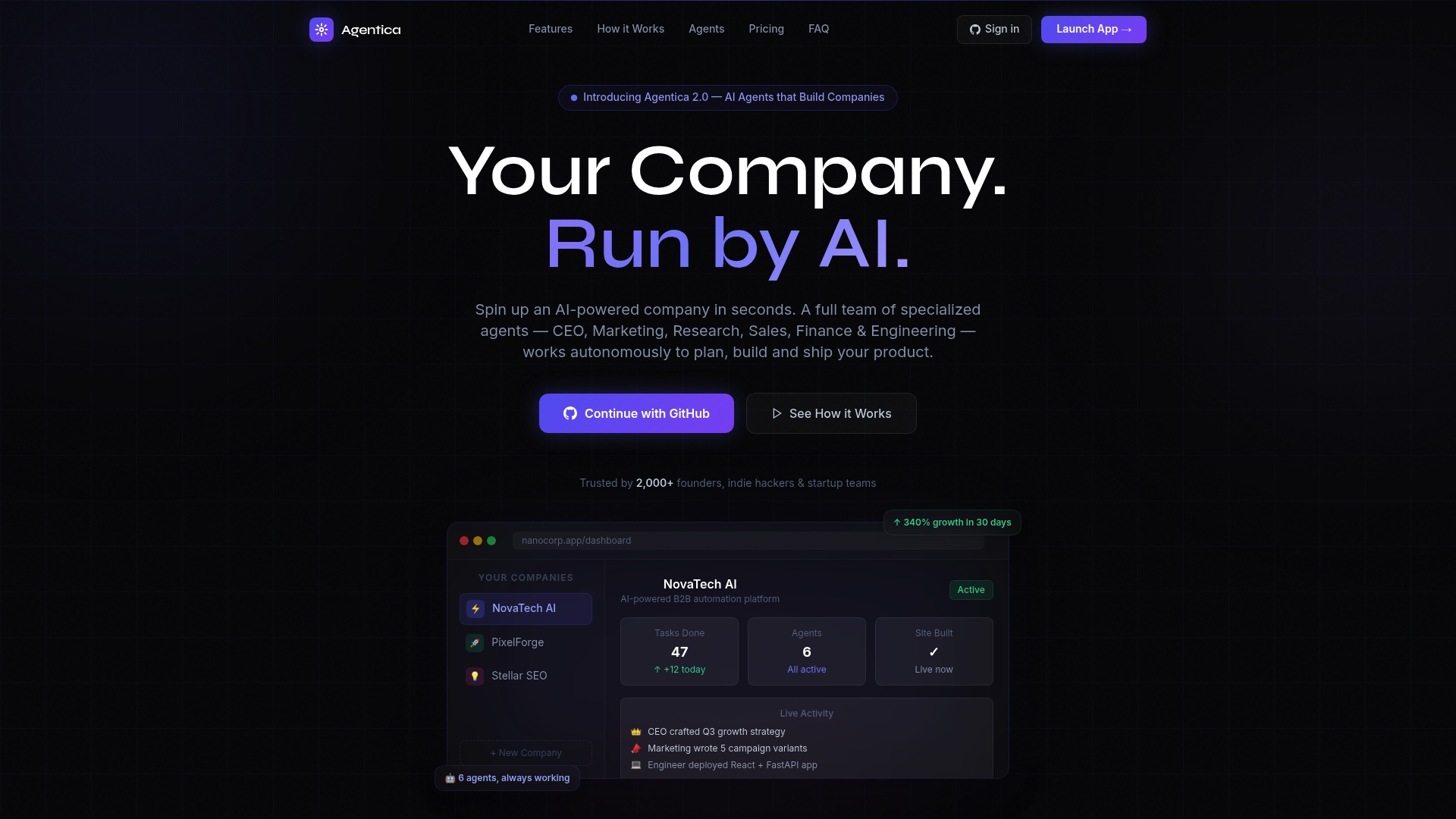
Non-technical founders get full operational capability without writing a line of code. Astarlabshub reports 340% growth for clients within 30 days of deployment. The platform includes real-time monitoring so founders see exactly what each agent is doing at every stage. Explore the autonomous agent platform to see how Agentica handles the execution layer while you focus on vision, customers, and growth. Pricing details and feature breakdowns are available at Agentica's features page.
FAQ
What is the role of AI agents in startups?
AI agents are autonomous software systems that handle planning, execution, and learning across core startup functions including engineering, customer support, content, and research. Their primary role is to multiply founder output and reduce operational costs without adding headcount.
How much can AI agents reduce startup costs?
Tech startups that apply AI-driven automation from founding reduce operational costs by at least 40%, with 40% lower burn per dollar of revenue at the $25,000 to $100,000 revenue stage compared to non-AI peers.
What startup functions do AI agents handle best?
Customer support, code generation, content creation, and data research are the three functions most commonly automated by AI agents. By late 2026, these functions will be primarily agent-run at most seed-stage startups.
How do you avoid automation sprawl when using AI agents?
Build a unified agent stack with shared memory rather than deploying separate tools for each function. Fragmented stacks create data silos and maintenance overhead that can consume 20–30% of the time savings agents generate.
Do AI agents replace the need for human founders?
AI agents commoditize execution but do not replace human judgment, customer relationships, or distribution strategy. Founders who use agents well shift their focus to the decisions and relationships that require trust and creative thinking.