
AI in competitive analysis is defined as the use of large language models, autonomous agents, and machine learning algorithms to automate the collection, processing, and interpretation of competitive intelligence data at a scale no human team can match. The industry term for this practice is AI-augmented competitive intelligence, and it has moved from experimental to standard practice in 2026. Tools like GPT-based reasoning layers, agentic scraping frameworks, and platforms such as Agentica are replacing spreadsheet-driven research cycles. AI-powered workflows reduce manual research time by 85%–95%, freeing analysts to focus on strategy rather than data collection. The result is faster decisions, broader market coverage, and a genuine competitive edge.
How does AI improve the speed and scale of competitive intelligence?
The speed advantage of AI in competitive analysis is not incremental. It is structural. Automated AI tools produce comprehensive reports in 2–5 minutes compared to the weeks traditional research requires. That is a compression of the intelligence cycle by several orders of magnitude, and it changes what is even possible for a lean team.
Scale is equally significant. A single AI agent can monitor more than 100 competitor sources simultaneously, tracking pricing pages, product updates, job postings, press releases, and social sentiment in real time. No human analyst team can sustain that coverage without enormous cost. Real-time AI monitoring of competitor messaging and positioning gives businesses a leading indicator of brand perception rather than a rearview mirror view of what already happened.

The data types AI handles are also expanding. Unstructured data, including product reviews, Reddit threads, LinkedIn posts, and app store feedback, was previously too expensive to process at scale. Now, AI-native tools generate structured intelligence from thousands of product reviews without any human summarization. Companies use that synthesized review intelligence to make direct product and positioning decisions.
Here is what this means practically for a business analyst or marketer:
- Research time drops sharply. Tasks that previously required 10 or more hours weekly now need only 1–2 hours of expert review.
- Coverage expands without headcount. AI monitors sources across geographies, languages, and channels simultaneously.
- Unstructured data becomes usable. Social posts, forums, and review sites feed directly into competitive reports.
- Synthesis accelerates. LLM-based approaches compress research timelines from months to days, enabling smaller teams to run larger, higher-quality studies.
"The transition in competitive intelligence is from information logistics to strategic synthesis. AI handles the former so humans can own the latter."
Pro Tip: Set up AI monitoring agents to flag competitor pricing changes and new product launches the moment they go live. Reacting within hours instead of weeks is a genuine strategic advantage.
Where does AI fall short in competitive intelligence?
AI excels at pattern recognition, data aggregation, and synthesis. It does not excel at judgment. The effective model is AI augmentation, not full automation, because full automation produces faster but lower-quality intelligence without human context layered on top.
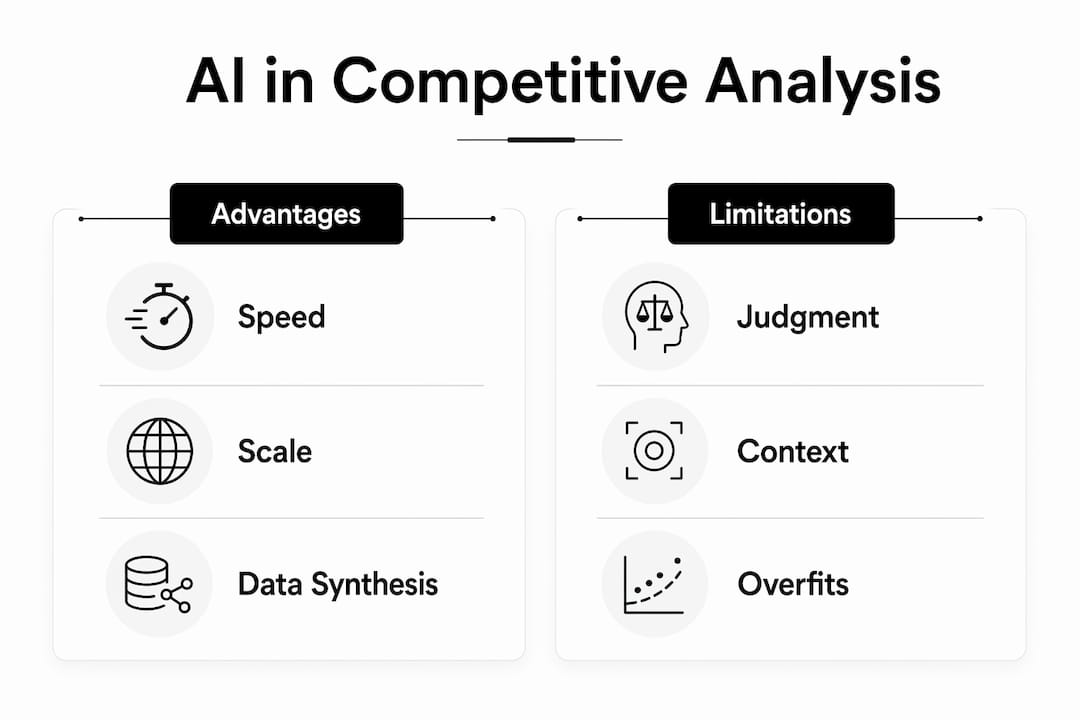
Human analysts bring three things AI cannot replicate. First, contextual intelligence: understanding why a competitor made a move, not just that they made it. Second, relational intelligence: insights gathered from conversations, conferences, and closed-door interactions that never appear in any data feed. Third, ethical oversight: deciding what intelligence is appropriate to collect and how it should be used.
The risks of over-relying on AI are concrete. Consider these failure modes:
- Hallucinated facts. LLMs trained on historical data will confidently state outdated or fabricated competitor information when no live data source corrects them.
- Missing strategic context. An AI can report that a competitor cut prices by 15%. Only a human analyst can interpret whether that signals desperation, a land-grab strategy, or a response to a new entrant.
- Blind spots in closed channels. Earnings call transcripts, industry analyst briefings, and executive interviews require human access and interpretation.
- Ethical and legal exposure. Automated scraping without oversight can cross legal boundaries or damage relationships with partners and vendors.
The shift in analyst roles is from data collection to strategic synthesis and executive influence. Analysts who adapt to this model become more valuable, not less. Those who resist it get buried in manual tasks while AI-augmented peers outpace them.
Pro Tip: Treat your AI system like a junior analyst. Push it for specificity. If it gives you a vague summary, ask it to produce a concrete recommendation with supporting evidence. Vague outputs are a prompt problem, not an AI limitation.
How do live data agents outperform llm-only approaches?
The most important technical distinction in AI-driven market insights today is between LLM-only systems and live data agent architectures. An LLM working alone draws from its training data, which has a cutoff date and contains no real-time competitor facts. Relying solely on LLM training data for competitor facts risks hallucination. The correct architecture uses a live data tracking engine combined with an AI reasoning layer on top of that data.
Here is how the two approaches compare:
| Feature | LLM-Only Approach | Live Data Agent Architecture |
|---|---|---|
| Data freshness | Training cutoff (months old) | Real-time or near real-time |
| Hallucination risk | High for specific facts | Low, grounded in live sources |
| Coverage | Limited to training corpus | 100+ sources simultaneously |
| Accuracy for decisions | Moderate | High |
| Best use case | Synthesis and drafting | Full competitive intelligence cycle |
AI agents calling live data sources and reasoning on top produce superior competitive intelligence compared to LLMs working from training data alone. The agent pulls factual data first, then applies reasoning to that data. The intelligence output is grounded, not generated from memory.
A second technical risk is the Oracle Fallacy. This occurs when an AI model overfits its predictions to recent patterns without accounting for historical base rates. Base-rate calibration nodes improve accuracy in predictive competitive analysis by anchoring AI forecasts to historical analogs. Executives trust calibrated outputs more because they show the model has been tested against reality, not just trained on it.
Pro Tip: When evaluating AI competitive intelligence tools, ask vendors directly whether their system pulls live data or reasons from training data alone. The answer tells you everything about the reliability of their outputs.
What steps should businesses take to implement AI in their workflows?
Implementing AI for competitive analysis does not require a data science team. It requires a clear workflow and the right tool selection. The goal is for AI to free teams to play offense by automating data gathering so analysts focus on strategic decisions.
Start with these steps:
- Audit your current intelligence sources. List every competitor data source your team uses: review sites, pricing pages, job boards, social channels, and industry publications. This becomes your agent's monitoring list.
- Select tools that combine live data with AI reasoning. Avoid tools that rely on static databases. Prioritize platforms with real-time scraping and AI synthesis layers. Understanding how to reduce operational costs with AI can also help you build the business case internally.
- Build a human review checkpoint. Schedule a weekly 60-minute session where an analyst reviews AI-generated reports, adds strategic context, and converts findings into recommendations.
- Push AI for actionable outputs. Do not accept summaries. Require the system to answer: "What should we do differently based on this intelligence?" That question forces specificity.
- Integrate outputs into decision workflows. Feed competitive intelligence directly into product roadmap reviews, marketing campaign briefs, and pricing strategy sessions. Intelligence that sits in a report nobody reads has zero value.
For marketers, AI-generated sentiment analysis on competitor campaigns can inform messaging pivots within days. For product teams, synthesized review intelligence from competitor apps can surface feature gaps before a single customer complains. For entrepreneurs, continuous monitoring of competitor hiring patterns reveals strategic direction before any press release confirms it. Learning more about AI automation workflows can help you design these processes from the ground up.
Key takeaways
AI augmentation is the most effective model for competitive analysis because it combines the speed and scale of machine processing with the strategic judgment only human analysts provide.
| Point | Details |
|---|---|
| Speed and scale gains | AI reduces manual research time by 85%–95% and monitors 100+ sources simultaneously. |
| Live data beats LLM-only | Agent architectures grounded in real-time data eliminate hallucination and produce trustworthy outputs. |
| Human judgment stays critical | Strategic interpretation, relational intelligence, and ethical oversight require human analysts. |
| Avoid the Oracle Fallacy | Use base-rate calibration to anchor AI predictions in historical analogs for executive-grade accuracy. |
| Integrate, don't just generate | Competitive intelligence only creates value when it feeds directly into product, marketing, and pricing decisions. |
Why i think most teams are using AI for competitive analysis wrong
Most teams I see treat AI as a search engine upgrade. They ask it a question, get a summary, and call it intelligence. That is not competitive intelligence. That is a faster Google search.
The teams getting real value from AI-augmented competitive intelligence treat the system like a reasoning partner with a specific job. They define the monitoring scope precisely, they push for concrete outputs, and they build a human review step that adds the context AI cannot generate on its own. The AI handles the volume. The analyst handles the meaning.
The part that surprises most people is how much the quality of your prompts determines the quality of your intelligence. Vague inputs produce vague outputs. If you ask an AI to "summarize what competitors are doing," you get a paragraph of observations. If you ask it to "identify which competitor has the strongest positioning against our mid-market segment and explain what specific moves they made in the last 90 days to achieve it," you get something you can act on.
My prediction for the next 18 months is that the gap between AI-augmented teams and traditional research teams will become impossible to close manually. The volume of data, the speed of market shifts, and the cost of real-time intelligence will all favor teams that have built agentic workflows now. The analysts who will matter most are not the ones who can collect data faster. They are the ones who can ask better questions and interpret answers with strategic precision.
— Carlos
Build your own ai-powered competitive intelligence system
If you want to move beyond one-off AI queries and build a continuous, autonomous competitive intelligence operation, Astarlabshub's Agentica platform is built for exactly that.
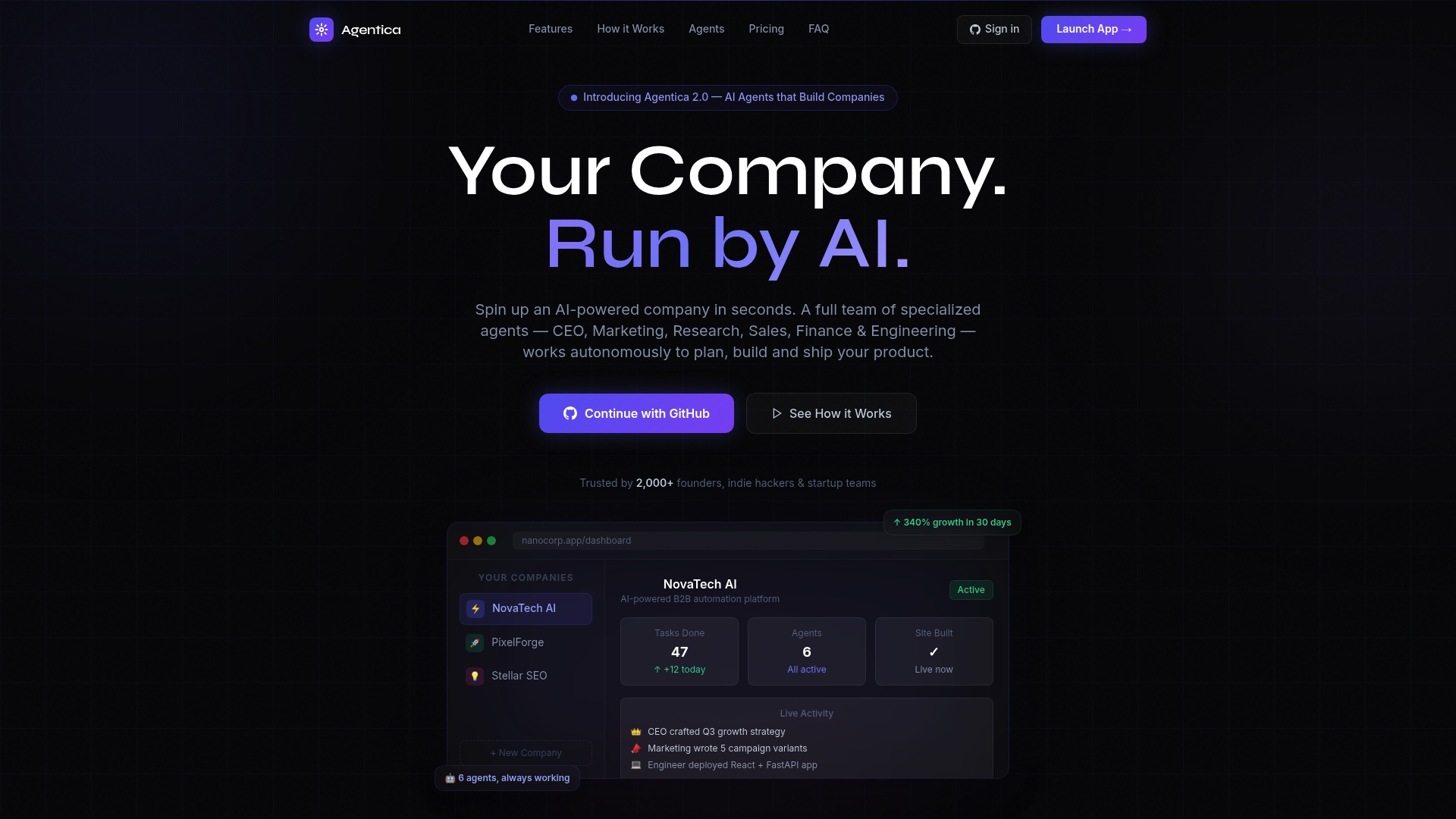
Agentica deploys specialized AI agents, including roles covering marketing intelligence, product analysis, and strategic synthesis, that work autonomously around the clock. The platform's transparent, real-time monitoring means you see exactly what each agent is doing and why. Clients using Agentica's autonomous agent platform have reported 340% growth within 30 days. You can explore the full feature set or review pricing options to find the right fit for your team size and intelligence needs.
FAQ
What is the role of AI in competitive analysis?
AI in competitive analysis automates data collection, processes unstructured sources like reviews and social posts, and synthesizes findings into structured intelligence reports. The most effective model combines AI speed with human strategic interpretation rather than replacing analysts entirely.
How much time does AI save in competitive intelligence workflows?
AI-powered workflows reduce manual research time by 85%–95%, cutting tasks that previously required 10 or more hours weekly down to 1–2 hours of expert review. That time savings shifts analyst focus from data gathering to strategic decision-making.
What is the oracle fallacy in AI competitive analysis?
The Oracle Fallacy occurs when an AI model overfits predictions to recent data patterns without accounting for historical base rates. Using calibrated historical analogs corrects this bias and produces forecasts executives can trust for high-stakes decisions.
Should businesses use llm-only tools or live data agent systems?
Live data agent architectures produce more accurate competitive intelligence because they ground AI reasoning in real-time facts rather than training data. LLM-only tools carry a high hallucination risk for specific competitor facts and are better suited to synthesis tasks than primary research.
How do marketers specifically benefit from ai-driven market insights?
Marketers use AI to monitor competitor messaging, sentiment shifts, and campaign positioning in real time. That visibility replaces reactive analysis with proactive strategy, allowing teams to adjust messaging and positioning before a competitor's move gains traction.