
AI-driven cost reduction is defined as the systematic use of intelligent automation, machine learning, and autonomous agents to eliminate labor-intensive tasks, cut waste, and lower the total spend required to run a business. Companies that implement comprehensive AI automation see 38–40% total operational cost reductions within 6 to 18 months. That figure is not a ceiling. It is a starting point for businesses willing to treat AI as a core operational strategy rather than a departmental experiment.
The ability to reduce operational costs with AI is no longer reserved for Fortune 500 companies with dedicated engineering teams. Platforms like Agentica, tools like UiPath, and frameworks like LangChain have made autonomous workflow automation accessible to founders and small business operators. The real question is not whether AI can cut your costs. It is which functions to target first, how to manage the AI spend itself, and how to measure what you actually save versus what the marketing materials promise.
What are the primary AI-driven strategies to reduce operating costs?
The most effective approach to AI for cost reduction is layered automation, where each process you automate compounds savings across adjacent workflows. A single AI agent handling customer support frees your human team to focus on retention, which reduces churn-related revenue loss. That is the compounding effect most business owners miss when they evaluate AI tools in isolation.
The five core strategies that consistently deliver measurable results are:
- Customer support deflection. AI agents handle Tier-1 and Tier-2 queries 24/7 at 1/10th the cost per conversation compared to human agents. Deflection rates of 65 to 80% of inbound volume are standard, meaning your support headcount stays flat even as your customer base grows. Air India reduced call volumes by 50% and saved approximately Rs 100 crore annually using 30+ in-house AI tools, proving this is not theoretical.
- Workflow orchestration. AI workflow platforms with autonomous agents achieve 38% cost reduction and 42% faster process execution in mid-sized enterprises. A 47% reduction in manual approval activities alone justifies the investment in most finance and operations teams.
- Predictive maintenance and inventory optimization. AI models that forecast demand and flag equipment degradation before failure reduce both waste and unplanned downtime. Manufacturers using predictive analytics report maintenance cost reductions of 10 to 25% within the first year.
- Finance and accounting automation. Invoice processing, financial reconciliation, and expense categorization are highest ROI automation targets because they combine high labor cost with structured, repetitive data.
- HR screening and onboarding. AI-assisted resume screening and onboarding workflows cut time-to-hire by 30 to 50% while reducing recruiter hours per placement.
Pro Tip: Start with the function that costs you the most in labor hours per month. That is your highest-leverage entry point, not the function that sounds most technically exciting.
How to manage and optimize AI operational expenses effectively?

Cutting costs using AI while simultaneously running up large AI compute bills is a real trap. The gross savings AI delivers can be reduced by 50 to 75% once you account for the total cost of ownership of your AI systems, including compute, maintenance, and human review. Net savings land closer to 15 to 25% for businesses that ignore this. Managing AI expenses is therefore as important as deploying AI in the first place.
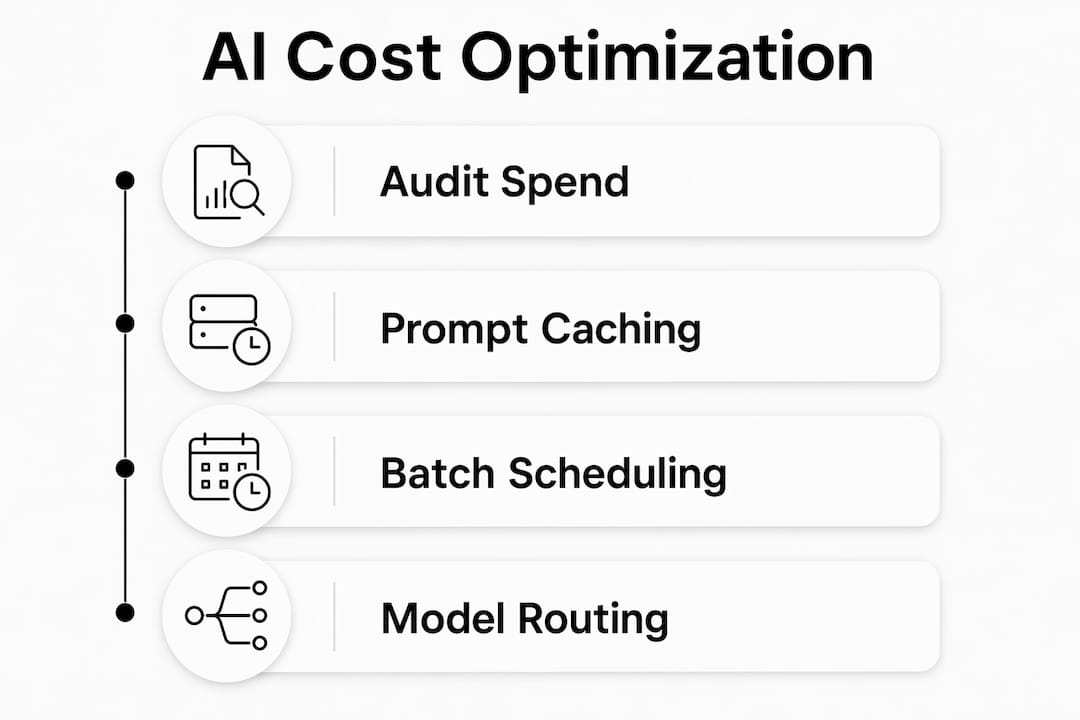
Here is a four-step framework for cost-aware AI operations:
- Implement prompt caching. Prompt caching reduces repeated compute costs by 70 to 90% for AI agents that process similar inputs repeatedly. Enterprise applications typically see cache hit rates of 30 to 50%, which translates directly to lower API bills without any change in output quality.
- Schedule batch workloads off-peak. Non-real-time tasks like report generation, data enrichment, and document summarization do not need to run during business hours. Batch scheduling for these tasks saves around 50% compared to on-demand processing.
- Route tasks by complexity. Dispatcher-first architectures that route simple tasks to inexpensive AI models cut inference costs by 40 to 60%. Only complex reasoning tasks should consume expensive frontier model compute. This single architectural decision is the most underused cost lever in AI operations.
- Optimize for task-level cost, not token cost. A cheaper model that requires three retries to produce a usable output costs more than a mid-tier model that succeeds on the first attempt. Measure cost per successful task completion, not cost per 1,000 tokens.
| Optimization method | Typical cost saving | Best for |
|---|---|---|
| Prompt caching | 70–90% on repeated inputs | Customer support, document processing |
| Batch scheduling | ~50% on non-urgent tasks | Reporting, data enrichment, summaries |
| Model routing (dispatcher-first) | 40–60% on inference | Mixed-complexity workflow pipelines |
| Task-level cost measurement | Prevents 20–30% hidden waste | Any AI agent deployment |
Pro Tip: Audit your AI API invoices monthly. Most teams discover 20 to 30% of their compute spend goes to redundant calls or oversized models handling simple classification tasks.
Which business functions yield the highest ROI from AI automation?
Prioritizing where to deploy AI is the decision that separates businesses that see transformational savings from those that run expensive pilots with marginal results. The highest ROI targets share two characteristics: high labor cost and structured, high-volume data. When both conditions are present, AI automation pays back fast.
The table below maps functions to expected savings ranges based on documented case studies and industry benchmarks:
| Business function | Expected cost saving | Primary AI method |
|---|---|---|
| Customer support (Tier 1 & 2) | 25–33% of support budget | Conversational AI agents |
| Invoice and financial reconciliation | 40–60% of processing labor | Document AI, RPA |
| HR screening and onboarding | 30–50% of recruiter hours | NLP screening models |
| Inventory demand forecasting | 10–20% reduction in overstock | Predictive analytics |
| Manufacturing predictive maintenance | 10–25% maintenance cost reduction | Sensor-based ML models |
Customer support delivers the fastest payback because the technology is mature, the data is abundant, and the cost per deflected ticket is measurable from day one. Finance and accounting automation follows closely, particularly for businesses processing more than 500 invoices per month. At that volume, manual processing costs exceed the implementation cost of an AI solution within two to three months.
Supply chain and logistics represent the highest absolute dollar savings for product businesses. AI-driven demand forecasting reduces overstock and stockout events simultaneously, which means you save on carrying costs while also protecting revenue. Accenture's research on self-funding supply chains shows that prioritizing high-cost, high-impact areas with a cost-categorization framework allows AI savings to fund subsequent automation initiatives. The strategy becomes self-sustaining.
How to implement AI cost reduction strategies step by step
Sustainable AI cost reduction requires a structured implementation process. Businesses that skip the baseline measurement phase consistently underestimate their actual savings and struggle to justify further investment.
- Map your current process costs. Document labor hours, error rates, and cycle times for every process you plan to automate. This baseline is the only way to calculate real net savings later. Include the cost of errors and rework, not just direct labor.
- Identify automation candidates by ROI potential. Score each process on two dimensions: current cost and automation feasibility. High-cost processes with structured, repetitive data score highest. Start there.
- Select tools matched to task complexity. Do not deploy a frontier large language model to handle simple data extraction. Match the model capability to the task requirement. This decision directly controls your ongoing compute spend.
- Define governance and oversight protocols. Determine which AI outputs require human review and build that review cost into your TCO calculation from the start. Ignoring human oversight costs is the most common reason AI projects appear profitable in pilots but disappoint at scale.
- Measure net savings, not gross savings. Track the total cost of ownership of your AI systems monthly. Gross savings minus compute, maintenance, and oversight costs equals your actual return. Businesses that measure only gross savings routinely overstate ROI by 50% or more.
- Reinvest savings into the next automation layer. BCG's research on AI-first cost advantage confirms that leaders treat AI cost reduction as a unified transformation strategy, not a one-time project. Each round of savings funds the next.
Pro Tip: Run a 30-day pilot on one high-volume process before committing to a full deployment. Measure actual cost per task during the pilot, not projected cost from vendor estimates.
Key takeaways
Businesses that reduce operational costs with AI most effectively combine workflow automation, cost-aware model management, and continuous reinvestment of savings into the next layer of transformation.
| Point | Details |
|---|---|
| Target high-cost, high-volume functions first | Customer support, invoice processing, and HR screening deliver the fastest payback. |
| Manage AI spend as actively as AI output | Prompt caching, batch scheduling, and model routing cut AI compute costs by 40–90%. |
| Measure net savings, not gross savings | TCO reduces apparent gross savings by 50–75%; track actual returns monthly. |
| Layer automation for compound savings | Each automated process frees resources to fund the next, creating a self-sustaining cycle. |
| Governance prevents scale-up failures | Define human review protocols before deployment to avoid hidden oversight costs. |
Why AI cost reduction only works when you change the workflow too
I have watched businesses spend six figures on AI tools and walk away with a 3% cost reduction. The technology was not the problem. The workflow was. They automated a broken process and got a faster broken process.
The framing that actually works, and the one BCG now calls an AI-first cost advantage, is to treat AI deployment as a trigger to redesign the workflow entirely. When you automate customer support, you do not just replace agents with a chatbot. You rethink the entire support funnel: what triggers a ticket, how it gets classified, what data the agent needs, and when a human should intervene. That redesign is where the real savings live.
The businesses I have seen achieve 30 to 40% cost reductions are not the ones with the most sophisticated AI. They are the ones that used AI as an excuse to remove the friction that had been accumulating in their operations for years. The AI did not cut costs. The workflow redesign did. The AI made the redesign possible and sustainable.
For smaller businesses just starting out, my honest advice is to pick one process, measure it obsessively, and prove the model before scaling. The temptation to automate everything at once is real, but it creates a governance nightmare and makes it nearly impossible to attribute savings accurately. One clean win builds the internal credibility to fund the next initiative.
— Carlos
How Astarlabshub's Agentica can accelerate your cost reduction
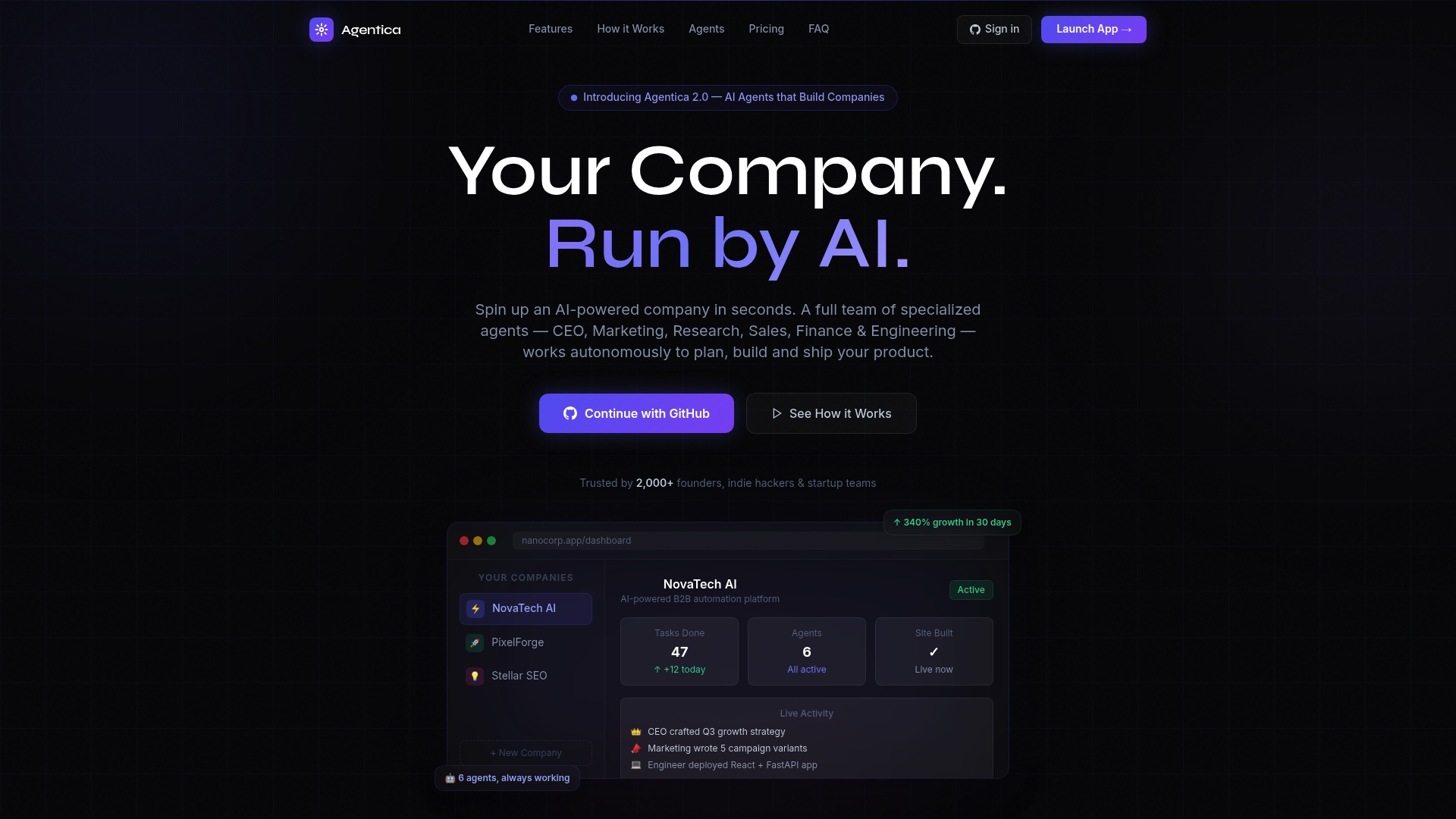
Astarlabshub built Agentica specifically for entrepreneurs and startup teams who need AI-driven operational savings without a dedicated engineering team to manage them. Agentica 2.0 deploys a coordinated team of autonomous AI agents covering functions like strategy, marketing, engineering, and operations, executing tasks end to end while you focus on growth. Clients using Agentica's autonomous mode have reported 340% growth within 30 days, with full real-time visibility into every agent action and cost. If you are ready to move from isolated AI experiments to a unified cost-reduction operation, explore Agentica and see what autonomous AI workflow management looks like in practice.
FAQ
How much can AI realistically reduce operational costs?
Businesses implementing comprehensive AI automation see 38 to 40% total cost reductions within 6 to 18 months, though net savings after accounting for AI system costs typically land between 15 and 25%.
What is the fastest AI cost reduction win for a small business?
Customer support automation delivers the fastest payback, with AI agents deflecting 65 to 80% of inbound queries at a fraction of human agent cost. Most small businesses see measurable savings within the first 30 to 60 days of deployment.
How do you avoid overspending on AI while trying to cut costs?
Use prompt caching, batch scheduling for non-urgent tasks, and dispatcher-first model routing to reduce AI compute costs by 40 to 90%. Measure cost per successful task completion rather than raw token usage to catch inefficiencies early.
Which AI tools are best for reducing operational costs?
The right tool depends on the function. Conversational AI platforms handle support deflection, document AI and robotic process automation address invoice processing, and predictive analytics platforms cover inventory and maintenance. Match tool capability to task complexity to avoid overpaying for compute.
What is the biggest mistake businesses make when implementing AI for cost reduction?
Measuring gross savings instead of net savings is the most common error. Total cost of ownership, including compute, maintenance, and human oversight, reduces gross savings by 50 to 75%, so businesses that skip this calculation routinely overstate their actual ROI.