
An AI marketing agent is an autonomous system that executes, tests, and optimizes marketing campaigns without waiting for human instruction. For startup founders who need traction fast, these agents represent the most direct path to early growth without a full marketing team. Organizations using agentic AI in marketing see 10–30% revenue growth through hyperpersonalized campaigns and automated execution. That number matters because it comes from workflow automation, not just better ad copy. This guide shows you exactly how to use an AI marketing agent to drive early growth, from data foundations to multichannel execution.
How AI marketing agents drive early growth for startups
The industry term for what most founders call an "AI marketing agent" is an autonomous marketing agent. It is a software system that perceives data inputs, makes decisions, and takes actions across marketing channels without step-by-step human direction. Think of it as a tireless growth operator running 24 hours a day.

The cost comparison alone makes the case. A senior growth hire costs $180,000–$220,000 annually before equity and takes 90 days to ramp up. An AI agent starts executing on day one. That gap in speed and cost is the core reason autonomous agents are now a serious early growth strategy for lean founding teams.
Marketing is shifting from isolated tools to an operating system where AI agents handle execution and humans focus on strategy. This shift changes what a founder's job actually looks like. You stop writing ad copy and start setting direction, reviewing economics, and deciding which channels deserve more budget.
What data foundations do you need before deploying AI agents?
The biggest mistake founders make is deploying agents too early. Agentic AI success depends on clean signal and structured brand knowledge before any agent goes live. Without those inputs, the agent optimizes noise instead of real patterns.
An effective autonomous agent requires four layers in place before launch:
- First-party behavioral data. You need roughly 10,000 monthly pageviews as a minimum threshold. Below that, the agent lacks enough signal to recognize reliable patterns and will make poor optimization decisions.
- Clean, validated data. Duplicate records, broken tracking, and inconsistent UTM parameters corrupt agent outputs. Audit your analytics stack before connecting any agent.
- A structured knowledge base. Document your ideal customer profile (ICP), brand voice, positioning, and messaging hierarchy. Agents need this context to generate on-brand content and target the right audience.
- Governance controls. Define which actions require human approval before execution. Budget changes above a set threshold, new audience segments, and creative pivots should all pass through an approval gate.
The defensible advantage in agentic AI is your unique, proprietary customer data grounded in brand context, not the quality of the underlying model. Two startups using the same agent platform will get very different results based on the quality of their data and knowledge layer.
Pro Tip: Before connecting any agent to your ad accounts, run a full data audit. Check that Google Analytics 4 events fire correctly, UTM parameters are consistent, and your CRM syncs cleanly. One week of cleanup saves months of bad optimization.
How do AI agents execute multichannel marketing campaigns?
Once your data foundation is solid, agents can take over execution across every major channel simultaneously. This is where the speed advantage becomes concrete.
- Campaign brief generation. The agent pulls from your knowledge base to draft campaign briefs, ad copy variants, and email sequences aligned with your ICP and brand voice.
- Paid media management. AI agents fully manage SEO and paid ad campaigns, performing multi-platform budget allocation and daily rebalancing across Meta, LinkedIn, Reddit, and TikTok. A human media buyer cannot rebalance budgets daily across four platforms. An agent does it automatically.
- Continuous A/B testing. Agents run split tests on subject lines, headlines, landing page copy, and audience segments. They kill underperformers and scale winners without waiting for a weekly review meeting.
- Outbound sequence management. Agents personalize and send outbound email and LinkedIn sequences, track reply rates, and adjust messaging based on response data.
- CRM automation. Lead scoring, follow-up triggers, and pipeline stage updates happen automatically based on behavioral signals the agent monitors in real time.
One COO built an AI-powered acquisition engine that drove 38% ARR growth in six months without a dedicated growth team. The system automated ICP research, paid media, outbound channels, and CRM management together. The key was that all channels shared intelligence. An insight from outbound reply data informed paid ad targeting, which fed back into CRM segmentation. That shared intelligence loop is what separates a collection of tools from a true AI-driven marketing operating system.
What steps should startups follow to implement AI marketing agents?
A phased rollout beats a full deployment on day one. Start narrow, prove lift, then expand agent scope.
Step 1: Build your data substrate. Install event tracking, clean your CRM, and confirm your attribution model works. This is non-negotiable before any agent touches a live campaign.
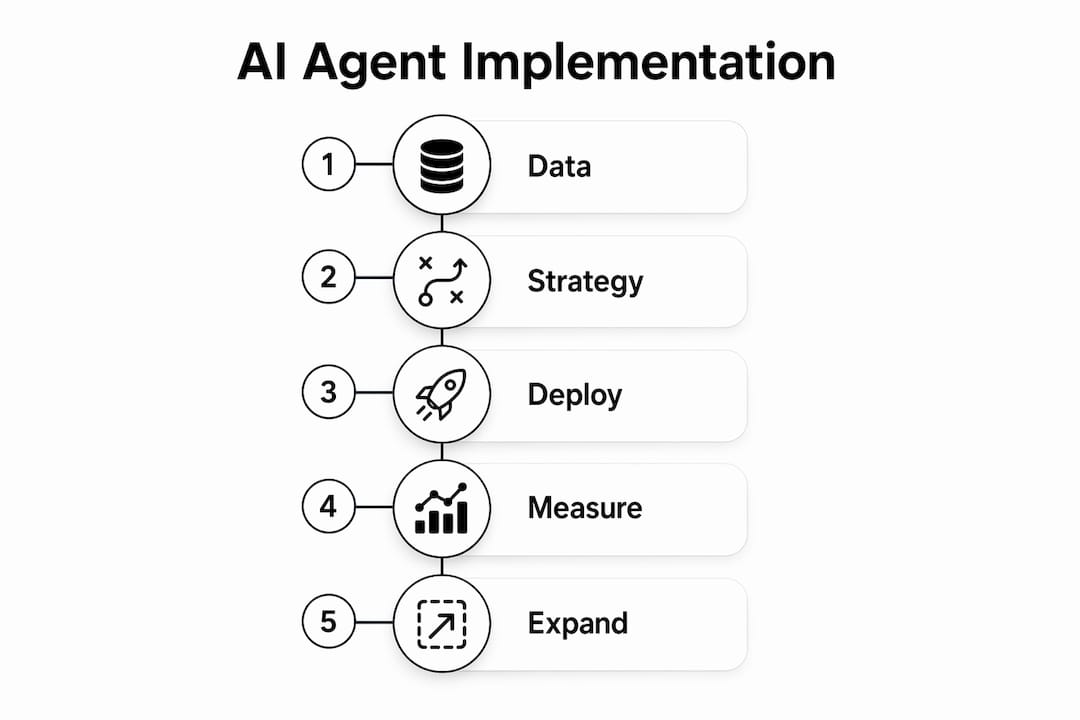
Step 2: Define strategy as a human team. AI agents excel at campaign execution but cannot replace the human judgment required to define your ICP, brand voice, and channel strategy. Write these down in a structured document the agent can reference.
Step 3: Deploy on narrow tasks first. Start with one channel, such as paid search or email sequences. Set approval gates for any action above a defined spend threshold. Let the agent run for two to four weeks before expanding its scope.
Step 4: Measure with control groups. Split your audience so a portion receives agent-driven campaigns and a portion does not. This gives you a clean read on incremental lift rather than correlation.
Step 5: Expand based on proven results. Once the agent demonstrates measurable lift on a narrow task, extend its authority to additional channels. Add budget rebalancing, then creative generation, then outbound sequencing.
Senior human orchestrators add value by setting direction, evaluating economics, and supervising agent workflows rather than executing manual tasks. Your job as a founder shifts from operator to orchestrator. That is a better use of your time.
Pro Tip: Set a weekly 30-minute review cadence where you check agent decisions against your strategic goals. You are not reviewing every action. You are checking that the agent's direction still matches your business priorities.
| Implementation phase | Key action | Success signal |
|---|---|---|
| Data foundation | Audit tracking and clean CRM | Zero broken events, consistent UTMs |
| Strategy definition | Document ICP, brand voice, channels | Structured knowledge base complete |
| Narrow deployment | Launch one channel with approval gates | Agent executes without errors |
| Measurement | Run control group split | Measurable incremental lift confirmed |
| Expansion | Add channels and increase agent authority | Consistent lift across multiple channels |
What mistakes should founders avoid with AI marketing agents?
Most early failures with autonomous agents come from skipping steps, not from the technology itself.
- Deploying before sufficient traffic exists. Agents need data volume to find patterns. Launching on a site with 2,000 monthly visitors produces unreliable optimization and wasted spend.
- Skipping approval gates on high-stakes actions. Without human-in-the-loop controls, error rates at scale guarantee failures. A single bad budget rebalancing decision can drain a monthly ad budget overnight.
- Letting agents define strategy. Agents execute strategy. They do not set it. If you skip the ICP and positioning work, the agent will execute efficiently toward the wrong audience.
- Retrofitting agents onto legacy manual systems. Building AI-native workflows from inception is far easier than bolting agents onto existing manual processes. If your current process is a spreadsheet and a weekly email, redesign the process before adding an agent.
- Ignoring audit logs. Every agent action should be logged. Review logs weekly to catch drift, where the agent's behavior gradually moves away from your intended strategy.
The math of error rates is unforgiving at scale. An agent making a 1% error rate across 10,000 daily decisions produces 100 mistakes per day. Approval gates and audit logs are not optional overhead. They are the mechanism that keeps autonomous execution safe and correctable.
Why I think most founders underestimate what AI agents actually change
The conversation about AI marketing agents usually focuses on cost savings and speed. Those are real. But the deeper shift is structural, and most founders miss it until they are already inside it.
When an agent handles execution, your competitive advantage stops being "we move faster than the other team." Every founder with the same agent platform moves at the same execution speed. The advantage shifts entirely to the quality of your data, the clarity of your ICP, and the sharpness of your positioning. Those are things a founder defines, not a tool.
I have watched founders deploy agents with vague brand documents and muddy customer definitions, then blame the technology when results disappoint. The agent did exactly what it was told. The problem was what it was told. The founders who win with AI-driven marketing are the ones who treat the strategy work as the hard part and let the agent handle the rest.
The other thing worth saying plainly: nearly 90% of CMOs experiment with AI use cases, but fewer than 10% have captured end-to-end workflow value. That gap is not a technology problem. It is a discipline problem. Founders who build clean data habits and clear governance from day one will pull ahead of the 90% who are still running disconnected experiments.
— Carlos
Astarlabshub's Agentica platform for founders ready to scale
Astarlabshub built Agentica 2.0 specifically for founders who want autonomous marketing execution without a large team. The platform deploys a coordinated set of AI agents, including dedicated Marketing, CEO, and Engineer roles, that work together to run campaigns, develop products, and manage operations from day one.
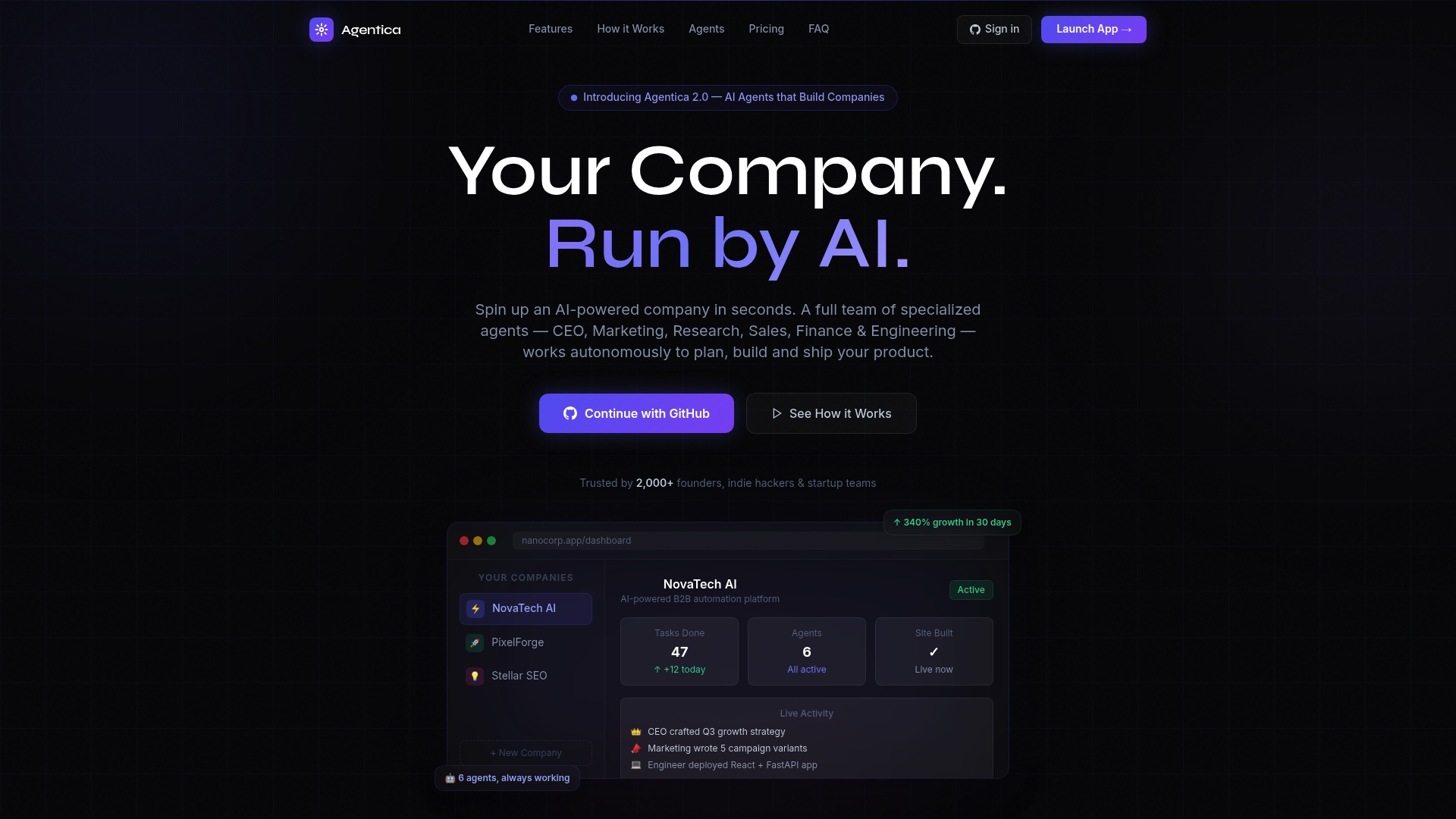
Agentica's autonomous mode handles multichannel marketing execution with built-in governance controls, so you keep visibility over every agent decision. Clients report 340% growth in 30 days, and the platform's real-time monitoring means you always know what the agents are doing and why. Founders can review agent capabilities and features or check Agentica's pricing to find the right starting point. The full platform overview is at astarlabshub.com.
Key takeaways
AI marketing agents deliver measurable early growth only when deployed on a clean data foundation, governed by approval gates, and directed by a founder who has defined clear strategy before the agent touches a single campaign.
| Point | Details |
|---|---|
| Data foundation first | Reach 10,000 monthly pageviews and clean your CRM before deploying any agent. |
| Strategy stays human | Define ICP, brand voice, and channel priorities yourself before handing execution to an agent. |
| Start narrow, then expand | Launch on one channel with approval gates, prove lift with control groups, then scale. |
| Governance is non-negotiable | Audit logs and approval gates prevent error rates from compounding at volume. |
| Build AI-native from day one | Designing workflows for agents from the start outperforms retrofitting agents onto manual systems. |
FAQ
What is an AI marketing agent?
An AI marketing agent is an autonomous software system that executes, tests, and optimizes marketing campaigns across channels without step-by-step human direction. It operates continuously, making data-driven decisions based on behavioral signals and a structured knowledge base.
How much traffic do I need before deploying an AI marketing agent?
Startups should wait until monthly traffic exceeds roughly 10,000 pageviews. Below that threshold, agents lack sufficient signal to recognize reliable patterns and will produce unreliable optimization decisions.
Can AI agents replace a growth marketing hire?
AI agents replace the execution work of a growth hire, running SEO, paid ads, A/B testing, and outreach 24/7 from day one. They do not replace the strategic judgment required to define ICP, brand voice, and channel priorities.
What governance controls should I put in place?
Require human approval for any high-stakes or irreversible action, such as budget changes above a set threshold or new audience segments. Maintain full audit logs of every agent decision and review them weekly.
How quickly can AI marketing agents produce results?
One documented case shows 38% ARR growth in six months using an AI-powered acquisition engine with no dedicated growth team. Results depend heavily on data quality, strategy clarity, and how quickly you iterate based on control group measurements.