
AI marketing agents are autonomous systems that independently plan, execute, and optimize marketing campaigns without requiring manual input at every step. The industry term for this category is "agentic AI," and understanding ai marketing agent capabilities is now a baseline requirement for any marketing team serious about growth. Salesforce's agentic models handle end-to-end tasks like identifying website leads, drafting content, and routing prospects without human intervention at each stage. McKinsey and Salesforce both identify agentic AI as the shift from passive tools to active team members that free marketers to focus on creativity and strategy. The result is a fundamental change in how marketing teams operate, compete, and grow.
1. What are the top AI marketing agent capabilities?
The ten capabilities below represent the most impactful functions available to marketing teams in 2026. Each one addresses a specific workflow problem and delivers measurable efficiency gains.
2. Autonomous campaign planning and execution
AI marketing agents plan and launch full campaigns within defined guardrails, without waiting for a human to approve each step. They pull audience data, select channels, set timing, and trigger creative assets based on pre-set rules and live performance signals. This removes the bottleneck of manual campaign setup, which typically takes days. You can learn more about how agents manage campaigns end to end in a dedicated guide.

The practical result is that a single marketer can oversee multiple simultaneous campaigns that would previously require a full team. Guardrails keep the agent within approved budgets, brand voice, and channel limits.
3. Predictive lead scoring with behavioral micro-segmentation
Predictive lead scoring is one of the highest-value AI marketing agent capabilities available today. AI agents analyze dozens of signals, including email engagement, website behavior, and purchase history, to forecast which prospects will convert. Traditional demographic targeting groups people by age or location. Behavioral micro-segmentation groups them by what they actually do, which is a far more accurate predictor of intent.
AI-driven strategies using behavioral micro-segments convert prospects within 48 hours with higher accuracy than traditional methods. That speed matters because buying intent fades fast. Agents also automate lead routing, sending high-score leads directly to sales without a human review step.
Pro Tip: Set your lead scoring model to weight recency heavily. A prospect who visited your pricing page yesterday is worth more than one who downloaded a whitepaper three months ago.
4. Omni-channel content creation and localization
Content agents generate emails, SMS, and personalized promotions across channels, then automatically localize them for different markets. A campaign that once required a copywriter, a translator, and a channel manager now runs through a single agent workflow. The agent handles production and channel execution while your team focuses on the core message and brand story.
This capability is especially valuable for businesses expanding into new markets. Localization that previously took weeks now takes hours, with consistent brand voice maintained across every output.
5. Real-time campaign performance analysis and dynamic optimization
AI agents monitor campaign metrics continuously and adjust variables in real time. They change ad creative, shift budget between channels, and modify audience targeting based on live data, not yesterday's report. This is a fundamentally different operating model from the traditional weekly review cycle.
The practical impact is that underperforming ads get paused before they waste significant budget. High-performing segments get more spend automatically. You can read more about AI in marketing operations and how this shift plays out across teams.
6. Automated bid and budget management
AI agents manage thousands of micro-adjustments to bids and budgets in real time, optimizing for KPIs like return on ad spend and conversion volume. Manual bid management at this granularity is impossible for a human team. The agent processes thousands of variables simultaneously and acts on them instantly.
This capability directly improves return on ad spend because the agent never sleeps, never misses a signal, and never delays an adjustment. Budget caps and floor limits keep the agent within approved spending ranges at all times.
7. Conversational workflow interfaces
AI agents integrate into collaboration tools like Slack, enabling marketers to manage campaigns through natural language commands. Instead of logging into a separate platform, you type a request and the agent executes it. Integrating agents within Slack reduces time to action from hours or days to minutes.
This "Headless 360" approach embeds shared customer context and business logic directly into daily operations. It eliminates platform-switching and keeps campaign management inside the tools your team already uses.
8. Audience segmentation with machine-learned insights
AI agents build and refine audience segments continuously based on behavioral data, not static rules. They identify patterns that human analysts would miss, such as a micro-segment of users who engage with video content on mobile between 7:00 PM and 9:00 PM and convert at three times the average rate. These segments update automatically as new data arrives.
The result is that your campaigns reach the right people with the right message at the right time, without requiring a data analyst to rebuild segments manually each quarter.
9. Sentiment and trend analysis for social listening
AI agents scan social channels, review platforms, and news sources in real time to detect shifts in brand sentiment and emerging trends. When a topic starts gaining traction in your audience, the agent flags it before it peaks. When negative sentiment spikes, the agent alerts your team immediately.
This capability replaces manual social monitoring, which is slow and incomplete. Agents process far more data than any human team and surface only the signals that require attention.
10. Seamless CRM and platform integration
Effective AI marketing agents connect directly to your CRM, ad platforms, content management systems, and social tools. Agents deeply integrated with proprietary brand context and audience data outperform generic AI tools by delivering brand-consistent recommendations. Without this integration, agents work with fragmented data and make suboptimal decisions.
The integration layer is what separates a useful agent from a generic AI tool. When the agent has live access to your customer data, it acts on real signals rather than assumptions.
11. Continuous learning and AI drift monitoring
AI agents improve over time by learning from campaign outcomes, but they also require ongoing human oversight to stay accurate. Continuous human monitoring addresses AI drift, which occurs when market behaviors and consumer preferences shift faster than the agent's training data reflects. Human annotation and feedback maintain accuracy and brand voice consistency.
Ongoing AI drift monitoring involves constant human review, dataset updates, and performance tracking. This is not a set-and-forget system. The agent gets better with structured feedback, but it needs that feedback to function well.
How AI marketing agents integrate into existing workflows
AI agents connect to your existing stack through direct API integrations with CRMs, ad platforms, content management systems, and social tools. The integration is the foundation of everything else. Without unified customer profiles and real-time data, agents perceive fragmented signals and make poor decisions that reduce ROI.
The key integration benefits include:
- Natural language commands that let marketers trigger campaigns, pull reports, and adjust targeting without leaving their primary workspace
- Unified customer data layers that give agents a single, accurate view of each prospect across every touchpoint
- Workflow automation that eliminates manual handoffs between tools, reducing the time spent on routine tasks
- Embedded business logic that keeps agent actions aligned with brand rules, compliance requirements, and budget limits
Pro Tip: Before deploying any agent, audit your data infrastructure. An agent connected to clean, unified data will outperform one connected to siloed, inconsistent records every time.
General-purpose AI tools lack access to unique business data, which limits their effectiveness in complex marketing environments. The agents that deliver the best results are the ones wired directly into your proprietary data and brand context.
What challenges do marketers face when deploying AI agents?
Deployment challenges are real, and ignoring them is the fastest way to waste your AI investment. The most common obstacles fall into four categories.
- Data quality: Agents need clean, real-time data to function. Dirty or siloed data produces bad recommendations and erodes trust in the system.
- AI drift: As consumer behavior shifts, agent outputs can drift out of alignment with your brand and goals. Regular human review and dataset updates are required.
- Role transition: Marketers shift from making content and running campaigns to managing and directing AI teams. This requires new skills and a new mindset.
- Organizational resistance: Teams accustomed to manual workflows often push back against agent-driven processes. Phased adoption reduces friction.
A phased approach to AI agent adoption lowers risk significantly. Start by delegating low-risk, repetitive tasks to agents first. Scale to autonomous execution only after trust is established through consistent performance. Guardrails, budget caps, and autonomy limits are not optional. They are the mechanism that keeps agents aligned with your business goals as they take on more responsibility.
The role of AI in daily business tasks is expanding fast, and the teams that manage this transition well will have a significant advantage over those that resist it.
How predictive lead scoring improves campaign ROI
Behavioral micro-segmentation is the engine behind predictive lead scoring. Instead of grouping prospects by demographics, agents group them by specific actions: which emails they opened, which pages they visited, and what they purchased before. Each action is a signal. The agent weighs dozens of signals simultaneously to produce a score that predicts conversion probability.
| Signal Type | Example | Impact on Score |
|---|---|---|
| Email engagement | Opened 3 emails in 7 days | High positive |
| Website behavior | Visited pricing page twice | High positive |
| Purchase history | Bought a related product | Moderate positive |
| Inactivity | No site visit in 30 days | Negative |
| Content consumption | Downloaded a case study | Moderate positive |
Predictive workflows that identify real-time optimal conversion paths outperform reactive historic analysis and provide a clear competitive advantage. The agent identifies the optimal moment to engage a prospect and triggers the right message automatically. This is why behavioral micro-segmentation outperforms traditional demographic targeting: it acts on intent, not assumptions.
Pro Tip: Connect your lead scoring model directly to your sales CRM. When an agent scores a lead above your conversion threshold, it should route that lead to a sales rep automatically, without any manual review step.
The role of AI in sales pipeline management extends this capability further, connecting marketing qualification directly to sales execution.
Key Takeaways
AI marketing agents deliver the highest ROI when they are deeply integrated with clean proprietary data, operate within defined guardrails, and receive continuous human feedback to prevent drift.
| Point | Details |
|---|---|
| Integration drives performance | Agents connected to unified, real-time data outperform generic AI tools on every metric. |
| Behavioral scoring beats demographics | Micro-segmentation based on actions predicts conversion far more accurately than age or location data. |
| Phased adoption reduces risk | Start with supervised, low-risk tasks and scale autonomy only after consistent performance is proven. |
| Human oversight is non-negotiable | AI drift requires ongoing monitoring, annotation, and dataset updates to maintain brand alignment. |
| Guardrails protect ROI | Budget caps, autonomy limits, and brand rules keep agents within approved boundaries as they scale. |
What I've learned watching agentic AI reshape marketing teams
The most surprising thing I've observed is how quickly the role of "marketer" is changing. Two years ago, the debate was whether AI would replace marketers. The real answer is more specific: AI replaces the repetitive execution work, and marketers who adapt become directors of AI teams rather than individual contributors.
The teams I've seen struggle are the ones that deployed agents without fixing their data first. An agent running on fragmented CRM data is worse than no agent at all, because it acts confidently on bad information. The teams that succeed treat data quality as a prerequisite, not an afterthought.
The other thing I'd push back on is the idea that agentic AI is a "set it and forget it" solution. AI drift is real. Consumer behavior shifts, and an agent trained on last year's data will gradually drift out of alignment with your current audience. The marketers who get the most from these systems are the ones who treat agent oversight as a core part of their weekly workflow, not an occasional check-in.
My honest advice: start narrow, prove value fast, then expand. The technology is ready. The question is whether your data infrastructure and your team's mindset are ready too.
— Carlos
Astarlabshub's autonomous agents for marketing teams
Marketing teams that want to move from manual execution to autonomous campaign management need more than a single AI tool. They need a coordinated system of agents that work together across functions.
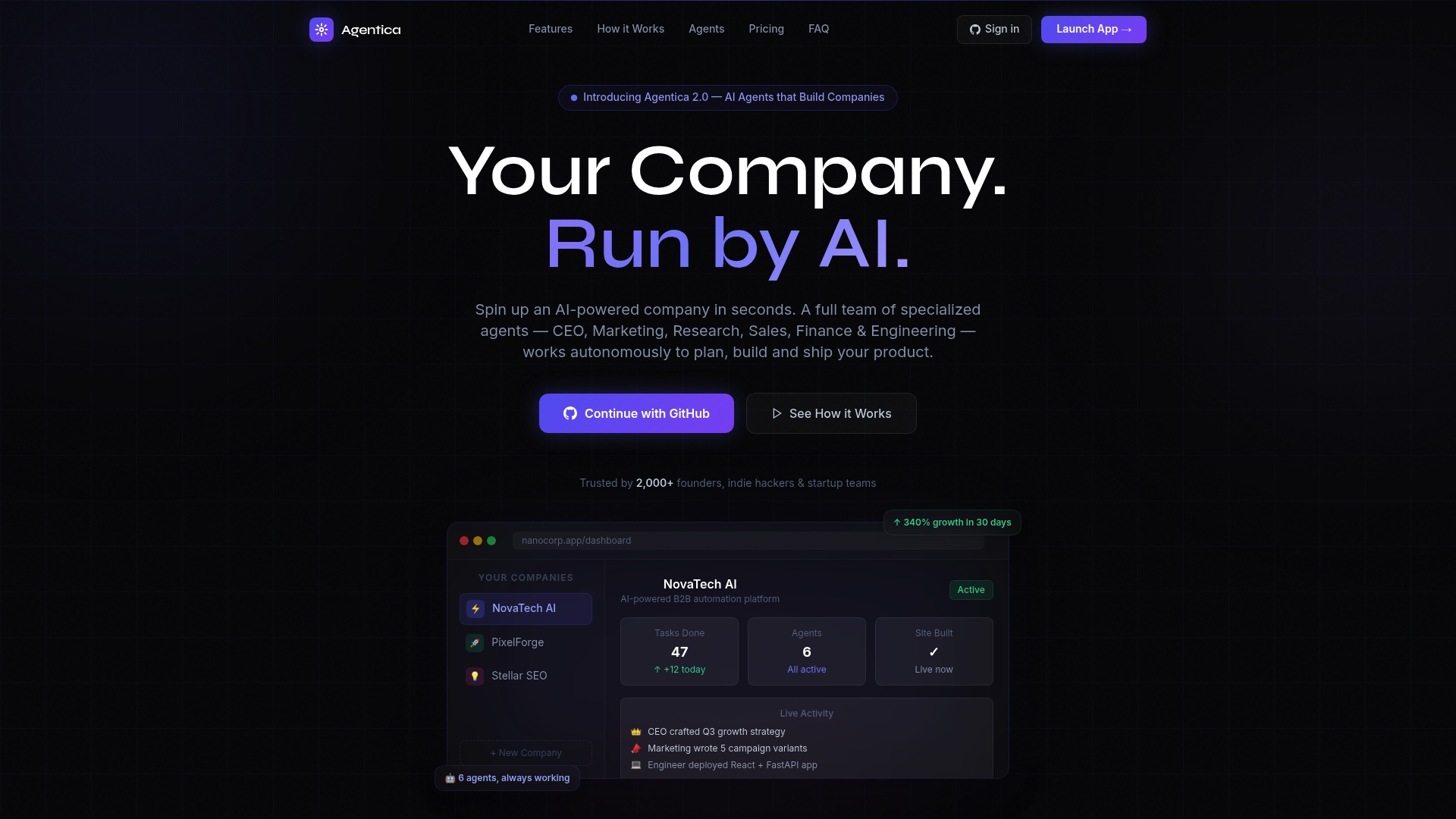
Astarlabshub's Agentica platform deploys specialized AI agents, including dedicated Marketing agents, that autonomously manage campaigns, analyze performance, and execute across channels in real time. The platform's autonomous agent features include real-time monitoring and full transparency into every agent action, so you always know what is running and why. Clients using Agentica report 340% growth within 30 days, according to Astarlabshub. You can review how the platform works and explore current pricing to find the right fit for your team's scale and goals.
FAQ
What are AI marketing agent capabilities?
AI marketing agent capabilities are the autonomous functions agents perform independently, including campaign planning, lead scoring, content creation, bid management, and real-time optimization, without requiring manual input at each step.
How do AI agents integrate with existing marketing tools?
AI agents connect through direct API integrations to CRMs, ad platforms, and content management systems, and embed into collaboration tools like Slack to enable natural language campaign management.
What is AI drift and why does it matter?
AI drift occurs when an agent's outputs become misaligned with current market behavior because its training data no longer reflects how consumers act. Continuous human review and dataset updates prevent it.
How does predictive lead scoring work?
Predictive lead scoring analyzes behavioral signals like email opens, page visits, and purchase history to assign each prospect a conversion probability score, enabling agents to route high-intent leads to sales automatically.
What is the biggest risk when deploying AI marketing agents?
The biggest risk is poor data quality. Agents connected to fragmented or outdated customer data make suboptimal decisions that reduce ROI and erode trust in the system.