
AI engineer agents are defined as autonomous software systems that orchestrate specialized sub-agents to complete complex, multi-step tasks without continuous human input. The industry term for this architecture is "agentic AI," and it covers everything from incident analysis to full software lifecycle automation. The most production-ready ai engineer agent use cases share one trait: they divide work between deterministic code and large language model (LLM) reasoning, keeping each layer doing what it does best. Astarlabshub's Agentica platform applies this exact model, deploying coordinated agent teams that handle strategy, coding, and deployment end to end.
## 1. What are the top AI engineer agent use cases?
Before examining individual scenarios, the clearest signal of value comes from scale. Coordinated AI agent swarms reclaim hundreds of engineering hours monthly by automating data investigations that previously required senior engineers working across multiple systems. That shift in labor is the core business case for agentic AI in engineering organizations.
2. Automated data investigation and root-cause analysis
Root-cause analysis is one of the highest-leverage AI engineering scenarios available today. When a production incident fires, engineers typically spend hours tracing logs, correlating events, and writing summaries for stakeholders. Coordinated agent workflows handle all three steps automatically.
A practical implementation looks like this:
- A log-parsing agent ingests raw service logs and extracts error signatures.
- A correlation agent maps those signatures against recent code changes and deployment events.
- A summarization agent drafts an incident report and posts it to the relevant Slack channel.
- A root-cause agent proposes the most likely failure point with supporting evidence.
The result is a complete incident summary delivered in minutes, not hours. Grab's engineering team built exactly this kind of ecosystem, starting with a single debugging assistant before expanding to a full investigation pipeline.
Pro Tip: Stage each agent workflow independently before connecting them. A log-parsing agent that runs reliably in isolation is far easier to debug than a four-agent chain that fails silently at step three.

3. Multi-phase business process automation pipelines
Multi-phase pipelines represent the most visible class of AI agent applications in production today. Each phase uses a specialized agent equipped with a specific tool, and a coordinator routes outputs between them.
A well-documented example is travel planning automation:
- A search agent uses Playwright to scrape live flight and hotel availability.
- A budget agent runs calculations across multiple price tiers.
- An aggregation agent combines results into a structured itinerary.
- A validation agent checks the output against user constraints before delivery.
Production travel planning agents execute this entire sequence within 30–45 seconds under strict timeout constraints. That speed is only possible because each agent handles one concern and passes a clean output to the next stage.
The same architecture applies to sales pipeline management, procurement workflows, and financial reporting. The modular design means teams can swap one agent without rebuilding the entire pipeline.
Pro Tip: Set explicit timeout budgets per agent phase before you build. A pipeline that has no per-phase limit will silently absorb failures and deliver stale results.
4. Software engineering lifecycle automation
AI agents now cover the full software development lifecycle, not just code completion. The roles of AI engineers are expanding to include agents that propose architecture, review pull requests, and estimate cloud costs.
Specific agent-driven workflows include:
- Architectural trade-off analysis: An agent ingests a system requirements document and produces a comparison table of design options, flagging patterns like CQRS and Event-Sourcing where appropriate.
- Code review automation: An agent surfaces critical design issues, not just style violations, by reasoning across the full diff and the existing codebase context.
- Cloud cost estimation: An agent queries AWS pricing APIs and generates a cost model tied to the proposed architecture.
AI engineers in 2026 use these agents to compress the design-to-estimate cycle from days to hours. The table below shows how agent-driven tasks compare to traditional manual effort across key lifecycle stages.
| Lifecycle stage | Manual effort | Agent-driven effort |
|---|---|---|
| Architectural proposal | 2–3 days | Under 2 hours |
| Code review | 4–8 hours per sprint | Continuous, per commit |
| Cloud cost modeling | 1–2 days | Under 30 minutes |
| Incident summarization | 2–4 hours per incident | Under 10 minutes |
The efficiency gains are real, but they depend on agents that have access to the right context. Multi-tier memory hierarchies combining working buffers, vector indexes, and structured databases give agents the persistent context they need to reason accurately across long-running tasks.
5. Design patterns and best practices for deploying AI agents
The coordinator pattern is the most reliable architecture for production AI agent systems. A central routing agent receives incoming requests and delegates to specialized workers based on request type. This pattern improves reliability by reducing prompt complexity and keeping each agent focused on a narrow task.
The table below compares two common deployment approaches:
| Design approach | Best for | Key risk |
|---|---|---|
| Monolithic agent | Simple, single-step tasks | Prompt bloat, brittle outputs |
| Coordinator pattern | Multi-concern workflows | Routing logic complexity |
| Specialist swarm | High-volume parallel tasks | Coordination overhead |
The division of labor between deterministic code and LLM reasoning is the second critical design decision. Deterministic code handles facts and validation; LLMs handle reasoning and orchestration. Mixing the two in a single layer produces systems that are hard to test and harder to debug.
Validation walls are non-negotiable in production deployments. Every agent decision that could mutate system state must pass through a deterministic verification layer before execution. Without this, a single hallucinated parameter can corrupt a database or trigger an unintended deployment.
Software lifecycle agents should begin in testing, code review, and log analysis before moving to higher-risk stages like design and deployment. This sequencing builds organizational trust and gives teams time to observe failure modes in low-stakes environments.
Pro Tip: Treat your validation layer as a first-class engineering artifact. Write unit tests for it. Document its rules. It is the only thing standing between an agent's output and your production database.
6. Memory management for long-running agent workflows
Agent memory is the most underestimated engineering challenge in agentic AI. A single-context window is not enough for tasks that span multiple sessions or require reasoning across large codebases.
The correct approach uses three layers. An immediate working buffer holds the current task context. A vector-indexed history stores past interactions and retrieved documents. A structured database persists facts, decisions, and state across sessions. Chunking alone is insufficient for agents that need to reason across weeks of incident history or months of code changes.
Teams that skip this architecture hit a predictable wall. The agent performs well on short tasks and degrades on longer ones because it loses context. Building the memory hierarchy upfront is far cheaper than retrofitting it after the agent is in production.
7. Incremental adoption: how to build agent trust inside your organization
Grab's measured incremental deployment proved that building one workflow at a time is the fastest path to a mature agent ecosystem. Starting with a debugging assistant, then expanding to log analysis, then to incident summarization, the team avoided over-engineering and built internal confidence at each step.
The practical sequence for most engineering organizations follows this order. Start with log analysis and test generation, where failure is visible and contained. Move to code review automation once the team trusts the agent's output quality. Expand to architectural proposals and cost estimation only after the review layer is stable.
Incremental adoption starting with verifiable areas like testing and log analysis ensures that feedback on failures is immediate. That feedback loop is what allows teams to improve agent behavior before the stakes get high.
Key takeaways
AI engineer agents deliver the most value when specialized agents coordinate through a validated, layered architecture rather than a single monolithic prompt.
| Point | Details |
|---|---|
| Start with low-risk workflows | Begin with log analysis and testing before moving to design or deployment automation. |
| Use the coordinator pattern | Route tasks through a central agent to reduce prompt complexity and improve reliability. |
| Enforce validation walls | Every agent decision that mutates state must pass a deterministic verification layer first. |
| Build multi-tier memory | Combine working buffers, vector indexes, and structured databases for persistent agent context. |
| Adopt incrementally | Build one workflow at a time to establish trust and catch failure modes early. |
What I've learned about AI agents that most articles get wrong
The dominant narrative around AI engineer agents focuses on capability. What I've found more useful is focusing on failure modes.
Most teams underestimate how much of their agent's reliability depends on the deterministic code surrounding it, not the LLM at its center. The LLM is the reasoning layer. The code is the safety net. When teams treat the LLM as the whole system, they end up with agents that work beautifully in demos and fail unpredictably in production.
The second misconception is that more agents equals more capability. Poorly coordinated multi-agent systems increase latency and instability. I've seen teams build five-agent pipelines for tasks that a single well-prompted agent with two tools could handle in half the time. The coordinator pattern solves this, but only if you apply it to workflows that genuinely need multi-concern handling.
The teams I've watched succeed with AI agent applications share one habit: they treat each agent as a junior engineer who needs clear instructions, constrained authority, and a supervisor checking their work. That mental model produces better system design than any framework or pattern library.
The future of agentic AI in engineering is not a single superintelligent agent. It is a well-organized team of narrow specialists, each excellent at one thing, coordinated by a routing layer that knows when to call which expert.
— Carlos
How Astarlabshub puts these agent patterns to work
Astarlabshub's Agentica platform applies the coordinator pattern, validation layers, and specialist agent roles described in this article to real business operations. The platform deploys a team of AI agents covering CEO-level strategy, marketing, and engineering functions, all working in coordination to launch and operate a business autonomously.
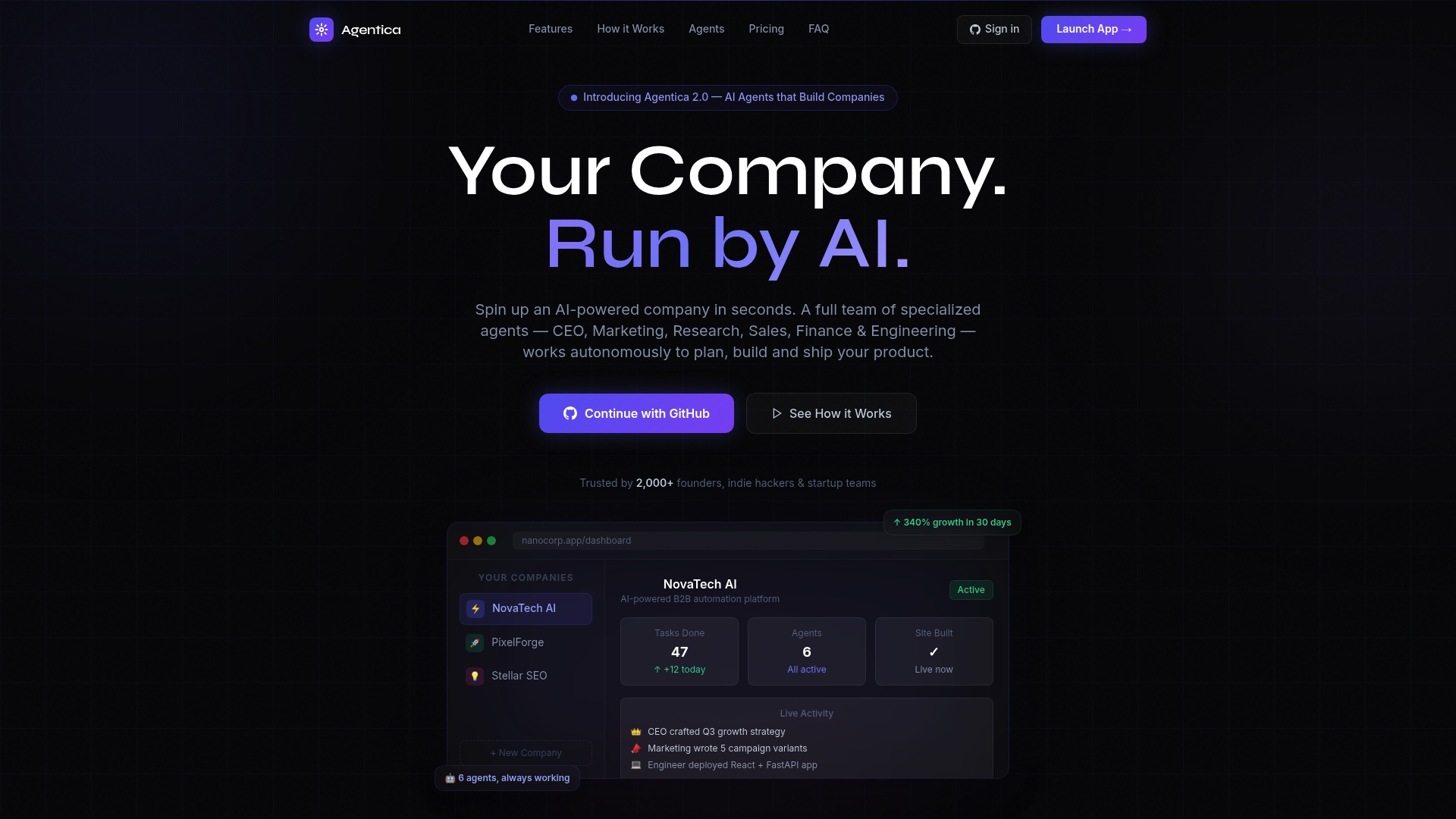
Clients using Agentica's autonomous mode report 340% growth within 30 days, with non-technical founders able to focus on vision while agents handle coding, deployment, and strategy. The platform provides real-time monitoring so teams maintain full visibility over every agent decision. If you are ready to move from theory to production, explore Agentica and see how a coordinated AI agent team can replace months of manual work.
FAQ
What is an AI engineer agent?
An AI engineer agent is an autonomous software system that uses LLM reasoning and specialized tools to complete complex engineering tasks without continuous human input. It typically operates within a multi-agent architecture where a coordinator routes tasks to specialist workers.
How do AI agents automate root-cause analysis?
AI agents automate root-cause analysis by running coordinated workflows that parse logs, correlate events with recent code changes, and generate incident summaries automatically. This process compresses hours of manual investigation into minutes.
What is the coordinator pattern in AI agent design?
The coordinator pattern uses a central routing agent to delegate tasks to specialized sub-agents based on request type. It reduces prompt complexity and improves reliability in systems that handle multiple concerns simultaneously.
Where should teams start with AI agent adoption?
Teams should start with log analysis, test generation, and code review, where failures are visible and contained. Expanding to higher-risk stages like architectural design and deployment should follow only after the initial workflows are stable and trusted.
How does Astarlabshub use AI engineer agents?
Astarlabshub's Agentica platform deploys coordinated specialist agents covering engineering, marketing, and strategy functions to autonomously manage business operations. The platform uses real-time monitoring and validation layers to keep every agent decision transparent and verifiable.