
AI-driven market research is defined as the use of machine learning, large language models, synthetic panels, and agentic AI to automate data collection, analysis, and insight generation at a speed and scale traditional methods cannot match. Platforms like Cashew Research and the AIMI platform demonstrate what this looks like in practice: research timelines compressed from 6 to 12 weeks down to 3 to 5 days, with costs cut by 50 to 60%. That compression changes the economics of the entire discipline. Market researchers who understand what is AI-driven market research and how to apply it gain a structural advantage over teams still running quarterly studies.
What is AI-driven market research and how does it work?
AI-driven market research, also called AI-powered market intelligence, applies artificial intelligence technologies to every stage of the research process. The core workflow covers three phases: automated data collection, AI-assisted analysis, and synthesized insight delivery. Each phase replaces a task that previously required significant manual labor.
The technologies involved are specific. Machine learning models identify patterns in large datasets. Large language models (LLMs) process unstructured text from surveys, interviews, and social media. Synthetic panels simulate consumer responses using generative AI. Agentic AI coordinates multi-step research workflows without constant human instruction. Together, these tools form a system that can run at a scale no human team could replicate.

The efficiency gains are measurable and significant. AI integration saves marketing professionals up to 15 hours per week, with productivity value approximating $4,739 per employee per month. One researcher using AI tools can manage 20 concurrent studies instead of the two or three that traditional methods allow. That is not an incremental improvement. It is a structural shift in research capacity.
The industry term for this practice varies across organizations. You will hear "AI-powered market research," "AI-enabled market intelligence," and "automated consumer insights" used interchangeably. All refer to the same underlying methodology: replacing manual research labor with AI workflows while preserving human judgment at the strategic layer.
How does AI enhance data collection and processing in market research?
AI transforms data collection by expanding both the volume and variety of inputs a research team can process. Traditional research relies on structured surveys and focus groups. AI-driven workflows pull from surveys, customer reviews, social media conversations, interview transcripts, and behavioral data simultaneously.
The processing capabilities are where AI creates the most visible efficiency gains:
- Automated data cleaning removes duplicates, flags outliers, and standardizes formats without manual intervention.
- Sentiment analysis classifies consumer attitudes across thousands of open-ended responses in minutes, a task that previously took analysts days.
- Pattern recognition surfaces correlations across demographic segments that human analysts might miss entirely.
- Dynamic probing in AI-moderated qualitative interviews follows up on unexpected responses in real time, mimicking skilled human moderators.
The AI cost savings achieved through automated data processing parallel what AI agents deliver in other analytical domains: fewer labor hours, faster turnaround, and earlier identification of meaningful signals. Cashew Research reports turnaround times cut by 5 to 6 weeks and prices 60 to 80% lower than traditional research firms, a direct result of automating the data pipeline.
Pro Tip: Feed your proprietary customer data directly into LLMs rather than relying on their general training data. Primary data fed into LLMs produces sharper sentiment analysis, more accurate behavior pattern detection, and market positioning insights that generic models simply cannot generate.
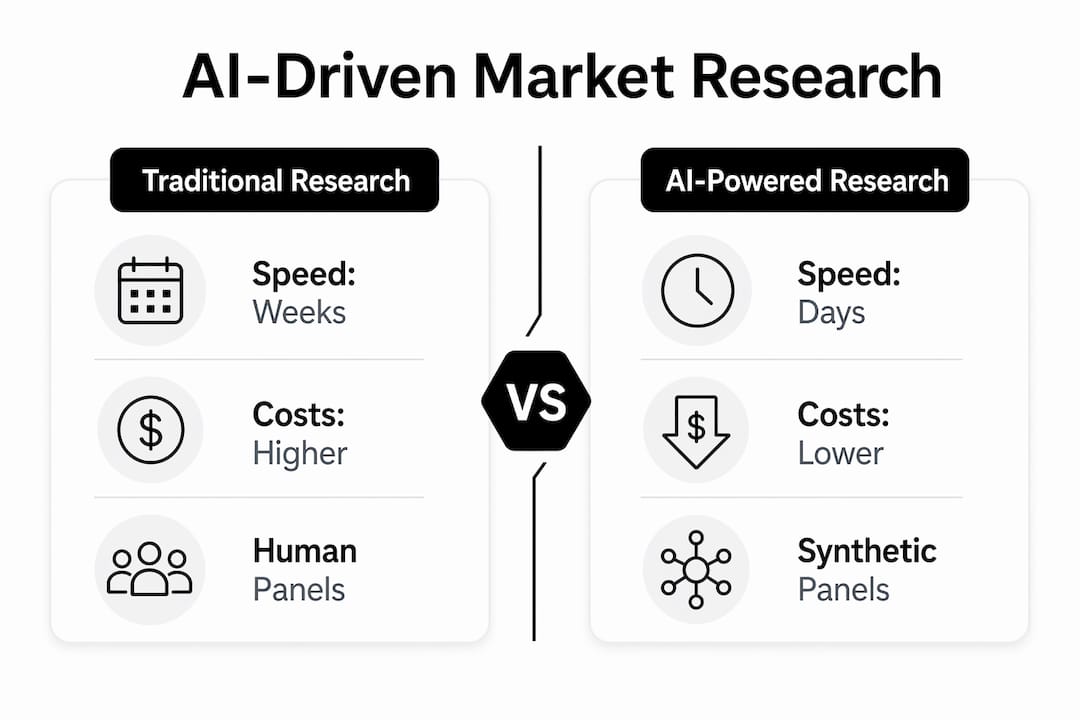
The distinction between using LLMs as data sources versus analytical engines matters enormously. An LLM trained on public internet data reflects the past. An LLM processing your proprietary survey data reflects your specific market, your customers, and your competitive position right now.
What are synthetic panels and AI-generated personas in market research?
Synthetic panels are AI-generated representations of consumer segments, built from historical data and behavioral models, that simulate how real people would respond to research stimuli. The concept borrows from the idea of digital twins: a computational model that mirrors a real-world entity closely enough to generate reliable predictions.
Generative AI constructs these panels by training on demographic data, purchase history, survey responses, and behavioral signals. The output is a set of AI personas that answer questions, react to concepts, and express preferences in ways that statistically approximate real consumer behavior. Synthetic panels achieve 92% accuracy for use cases like pricing research and concept testing when fine-tuned with historical data. That level of predictive accuracy makes them genuinely useful for rapid iteration cycles.
The table below compares synthetic panels to traditional human panels across the dimensions that matter most to researchers:
| Dimension | Synthetic panels | Traditional human panels |
|---|---|---|
| Speed | Hours to days | Weeks to months |
| Cost | 60 to 80% lower | Standard agency rates |
| Scale | Unlimited simulations | Limited by recruitment |
| Accuracy | 92% for known categories | High for novel concepts |
| Best use case | Pricing, concept testing, iteration | Radically new products, cultural nuance |
| Risk | Bias inheritance from training data | Recruitment and response bias |
The limitations are real and worth stating directly. Synthetic panels inherit the biases present in their training data. They perform poorly when the research question involves genuinely novel products or behaviors that have no historical analog. BCG's research confirms that synthetic data requires human validation to remain strategically valid. Use synthetic panels to accelerate iteration and pressure-test hypotheses. Use human panels to validate findings and explore uncharted territory.
How does AI-driven analysis improve insight generation and strategic decision-making?
AI-driven analysis changes how insights are generated, not just how fast they arrive. Agentic AI systems can independently navigate multi-step research workflows: pulling data, running analysis, synthesizing findings, and recommending next steps without waiting for human instruction at each stage. Agentic AI reshapes researcher roles from manual operators to strategic overseers.
The specific capabilities that matter for insight generation include:
- Anomaly detection that flags unexpected shifts in consumer sentiment before they appear in sales data.
- Trend identification across multiple data streams simultaneously, connecting signals that siloed analysis would miss.
- Real-time dashboards that update as new data arrives, replacing static reports with living intelligence.
- AI-enabled risk monitoring that provides earlier signals on financial distress, regulatory shifts, or supply disruptions, enabling proactive strategy rather than reactive decisions.
Pro Tip: Treat AI as a co-pilot, not an autopilot. The most effective research teams use AI to handle pattern detection and synthesis, then apply human judgment to interpret what those patterns mean for their specific business context.
Human oversight is not optional. Trust deficit is the primary barrier to AI adoption in research organizations. Stakeholders distrust black-box outputs they cannot interrogate. Transparency mechanisms, including showing data sources, confidence intervals, and the logic behind AI recommendations, are what convert skeptical executives into AI research advocates. Greenbook's Tech Showcase found that AI moderation reduces logistical burdens while human oversight preserves the trustworthiness of outputs.
MIT Sloan research identifies the hybrid model as most effective: AI automates 80% of manual, repetitive research tasks, while the remaining 20% stays with human researchers for qualitative interpretation and strategic application. That division is not a compromise. It is the architecture that produces the most reliable insights.
What practical steps can market researchers take to integrate AI effectively?
Integrating AI into market research workflows requires deliberate choices about where automation adds value and where human judgment remains non-negotiable. The following steps reflect what successful adopters actually do, not what vendors promise.
-
Shift from project-based to continuous intelligence. Transitioning to always-on workflows replaces slow periodic studies with real-time market responsiveness. This means building data pipelines that feed AI systems continuously rather than activating research only when a business question arises.
-
Feed proprietary data into your AI tools. Generic LLM outputs reflect public knowledge. Your competitive advantage comes from feeding customer surveys, CRM data, and proprietary behavioral data into AI systems. The specificity of the input determines the quality of the insight.
-
Define the research problem before activating AI. AI excels at answering well-formed questions. It performs poorly when the question itself is vague. Human researchers must own problem definition, framing, and hypothesis construction before AI enters the workflow.
-
Build verification into every output. Spot-check AI-generated insights against known benchmarks. Cross-reference synthetic panel findings with small-scale human validation studies. Verification is not distrust of AI. It is professional rigor applied consistently.
-
Address the trust deficit proactively. Present AI findings with full transparency about data sources, methodology, and confidence levels. Stakeholders who understand how an insight was generated are far more likely to act on it. The AI augmentation cost savings argument alone rarely convinces skeptics. Transparency does.
-
Start with high-volume, repetitive tasks. Sentiment analysis, survey coding, and competitive monitoring are ideal entry points. These tasks have clear quality benchmarks, making it easy to verify AI performance before extending automation to more complex analytical work.
Key takeaways
AI-driven market research delivers maximum value when AI automation handles data collection and pattern detection while human researchers own problem definition, interpretation, and strategic application.
| Point | Details |
|---|---|
| Timeline compression | AI reduces research cycles from weeks to days, cutting costs by 50 to 60%. |
| Synthetic panel accuracy | AI-generated panels reach 92% accuracy for pricing and concept testing with proper training data. |
| Human oversight is required | MIT Sloan confirms the hybrid model (80% AI, 20% human) produces the most reliable insights. |
| Continuous intelligence wins | Shifting from periodic studies to always-on AI workflows creates real-time competitive advantage. |
| Trust requires transparency | Stakeholder adoption depends on showing data sources, methodology, and AI reasoning clearly. |
Why the hybrid model is the only model worth building
I have watched organizations make the same mistake repeatedly: they treat AI adoption in market research as a binary choice between full automation and full manual process. Neither extreme works. Full automation produces outputs that no one trusts and that miss the contextual nuance that makes insights strategically useful. Full manual process is simply no longer competitive on speed or cost.
What I have found actually works is treating AI as the analytical engine and human researchers as the interpretive layer. When I use LLMs to process interview transcripts or run sentiment analysis across thousands of reviews, the AI surfaces patterns I would have missed or taken days to find manually. But the moment I ask the AI to tell me what those patterns mean for a specific brand in a specific competitive context, I need a human researcher who understands that market.
The future of AI in market research is not about replacing researchers. It is about changing what researchers spend their time on. The teams that will lead in 2026 and beyond are the ones building continuous intelligence infrastructures now, feeding proprietary data into AI systems, and developing the internal transparency practices that make AI outputs credible to decision-makers. The economics are already compelling. A $1 investment in AI-driven research yields $3.70 in ROI. The question is not whether to adopt. It is how fast you can build the hybrid model that makes adoption sustainable.
— Carlos
See AI-driven market research in action with Astarlabshub
Astarlabshub's Agentica platform brings autonomous AI agents directly to market research workflows, handling everything from data collection and synthetic persona creation to real-time insight synthesis and AI-moderated qualitative research. The platform's specialized agents operate in continuous intelligence mode, replacing slow periodic studies with always-on market monitoring that updates as conditions shift.
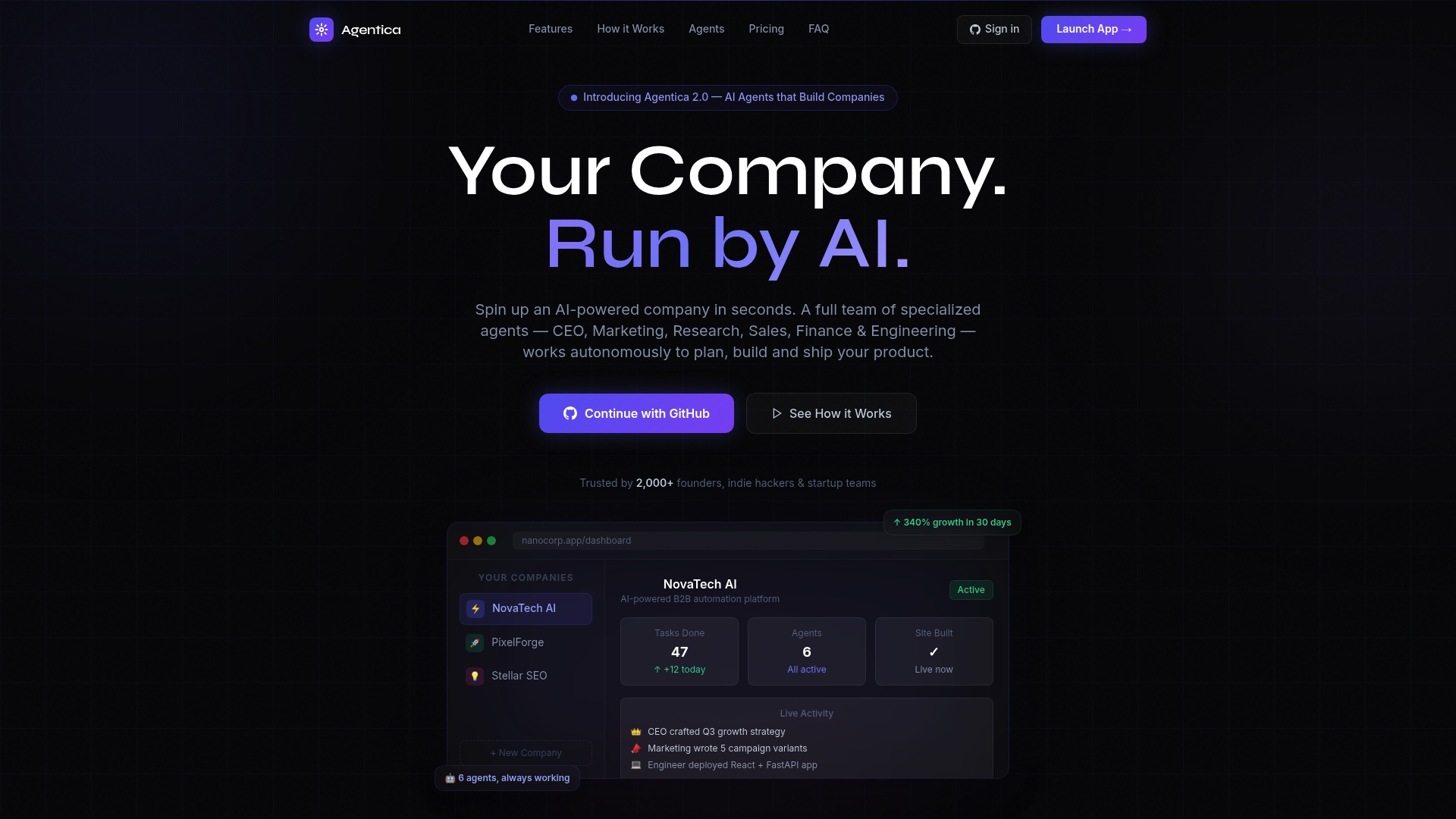
Researchers and analysts using Agentica report the same efficiency gains the data predicts: faster turnaround, lower cost per insight, and the transparency mechanisms that make AI outputs credible to executive stakeholders. If you are building or upgrading your market research capability, Astarlabshub is the starting point worth evaluating.
FAQ
What is AI-driven market research in simple terms?
AI-driven market research uses machine learning, large language models, and automation to collect, process, and analyze market data faster and at lower cost than traditional manual methods. It compresses research timelines from weeks to days while maintaining analytical rigor.
How accurate are AI-generated consumer insights?
Accuracy depends heavily on the use case and data quality. Synthetic panels reach 92% accuracy for pricing and concept testing when trained on relevant historical data, but perform less reliably for radically new products with no behavioral precedent.
What is the biggest risk of using AI in market research?
The primary risk is the trust deficit: stakeholders distrust AI outputs they cannot interrogate. Transparency about data sources, methodology, and confidence levels is the most effective way to build organizational confidence in AI-generated insights.
Can AI replace human market researchers?
AI automates roughly 80% of manual, repetitive research tasks, but human researchers remain necessary for problem definition, qualitative interpretation, and strategic application of findings. The hybrid model consistently outperforms full automation.
How does AI-driven market research reduce costs?
AI reduces costs by automating data collection, cleaning, coding, and analysis tasks that previously required significant human labor. Platforms like Cashew Research report prices 60 to 80% lower than traditional research firms, with turnaround times cut by 5 to 6 weeks.