
Operational support AI agents are specialized systems that execute business workflows autonomously or semi-autonomously, handling classification, data extraction, research, decision support, orchestration, and human collaboration. The industry recognizes six core functional patterns shipped in production in 2026: Triage, Extraction, Research, Copilots, Multi-agent Orchestrators, and Human-in-the-Loop Review Queues. Understanding these operational support AI agent types is the first step toward choosing the right tool for your business. Unlike chatbots, which handle reactive Q&A with minimal tool use, true AI agents reason, plan, and execute across connected systems.
1. What are the main operational support AI agent types?
The six functional patterns represent the clearest taxonomy for categorizing AI agents in operations. Each type solves a distinct problem, and most production systems combine two or more of them. Entrepreneurs who treat these categories as modular building blocks make better deployment decisions than those chasing all-in-one promises.
A capability-based taxonomy further organizes agents into five tiers ranging from simple chatbots to complex multi-agent systems. Tiers differ by memory, planning capability, tool count, time horizon, and failure isolation difficulty. Without this structure, comparing agents across vendors is genuinely misleading.

2. Triage agents: classifying and routing inbound work
Triage agents classify inbound operational items and route them to the correct channel or workflow. They apply classification models and light tool calls to decide routing, which reduces manual triage effort across support tickets, emails, and system alerts. The business impact is direct: fewer humans spending time on sorting, more time spent on resolution.
A triage agent watching a shared inbox can read an incoming email, identify it as a billing dispute, tag it with the correct priority level, and push it to the finance queue without human input. That same agent handles hundreds of items per hour at consistent accuracy. No human team matches that throughput on repetitive classification work.
- Routes support tickets by category, urgency, and team
- Filters and labels inbound emails before they reach a human
- Triages system alerts by severity in IT operations
- Assigns leads to sales reps based on deal size or geography
Pro Tip: Match your triage agent to the volume and variety of your inbound data. High-volume, low-variety streams need fast classifiers. High-variety streams need agents with broader context windows and more tool connections.
3. Extraction agents: turning unstructured data into structured records
Extraction agents convert unstructured documents, such as contracts, receipts, and emails, into structured data that downstream systems can use. They decide whether to flag uncertain fields for human review, which keeps accuracy high without requiring humans to process every document manually. This makes them the backbone of invoice processing, contract management, and compliance workflows.
A practical example: an extraction agent reads a supplier invoice in PDF format, pulls out the vendor name, line items, amounts, and due date, then writes those fields directly into your accounting system. If a field is ambiguous, the agent queues it for a human to confirm rather than guessing. That combination of speed and accuracy is what separates extraction agents from simple OCR tools.
- Extracts line items from invoices and purchase orders
- Pulls key clauses from legal contracts for review
- Converts handwritten or scanned forms into database entries
- Parses email threads to capture action items and deadlines
Pro Tip: Extraction agents perform best when you define a clear schema upfront. Know exactly which fields you need before deployment, and the agent will fill them reliably.
4. How research and operator copilot agents support decisions
Research agents perform multi-hop retrieval and evidence synthesis, querying multiple sources iteratively until they reach a complete answer. This enables complex decision-making support that would take a human analyst hours to complete. A research agent can pull competitor pricing data, cross-reference it with your own margins, and produce a summary in minutes.
Operator copilots work differently. They act as in-app assistants that provide real-time decision support and draft outputs while the human finalizes the action. The key distinction is interaction depth: research agents work in the background and return a finished product, while copilots stay in the loop with the human throughout the task.
- Research agents: market analysis, due diligence, competitive intelligence
- Copilots: drafting customer responses, suggesting next steps in a CRM, summarizing meeting notes live
Combining both types gives you a powerful decision layer. The research agent gathers evidence; the copilot presents it in context and helps the operator act on it without switching tools.
Pro Tip: Use a research agent for tasks with a clear end state (a report, a recommendation). Use a copilot for tasks where the human needs to stay in control of each step.
5. Multi-agent orchestrators and human-in-the-loop review agents
Multi-agent orchestrators coordinate multiple specialist agents across long-running workflows, managing retries, progress reporting, and state persistence. They are critical for complex tasks that require parallelism, such as onboarding a new enterprise client where legal, finance, IT, and sales agents all work simultaneously. The orchestrator tracks which agents have completed their tasks and handles failures without losing workflow state.
Human-in-the-loop review agents insert a human approval step before finalizing high-risk or irreversible actions. These review queues allow humans to approve, edit, or reject agent proposals, which reduces costly errors in finance, compliance, and logistics. Governance frameworks with policy-as-code are the standard method for restricting which actions an agent can take autonomously.
| Feature | Multi-agent orchestrator | Human-in-the-loop review |
|---|---|---|
| Complexity | High | Medium |
| Autonomy level | High | Low to medium |
| Risk profile | Medium to high | Low |
| Best use case | Long-running parallel workflows | High-stakes approval chains |
| Failure management | Automated retries and state recovery | Human correction at review gate |
The two types work best together. An orchestrator runs the workflow; a human-in-the-loop agent pauses it at defined checkpoints for approval before proceeding to irreversible steps.
6. Capability tiers: matching agent sophistication to your business
A five-tier taxonomy organizes AI agents from least to most capable. Tier 1 covers reactive chatbots with no memory and one or two tool connections. Tier 5 covers full multi-agent systems with long-term memory, autonomous planning, and 50 or more connected systems. Each tier up adds capability but also cost, complexity, and harder failure isolation.
| Tier | Type | Memory | Tools | Best use case |
|---|---|---|---|---|
| 1 | Reactive chatbot | None | 0–1 | FAQ answering, basic routing |
| 2 | Tool-augmented agent | Short-term | 2–5 | Form filling, simple lookups |
| 3 | Autonomous agent | Medium-term | 5–15 | Research, extraction, triage |
| 4 | Orchestrated agent | Long-term | 15–50 | Multi-step workflows, approvals |
| 5 | Multi-agent system | Persistent | 50+ | Full business process automation |
Most entrepreneurs start at Tier 3 and scale to Tier 4 as their workflows mature. Jumping straight to Tier 5 without operational experience in lower tiers creates failure modes that are genuinely hard to debug. The specialized roles and functions of each tier map directly to the functional patterns described earlier.
Pro Tip: Many agents marketed as autonomous are actually pre-defined workflow orchestrators. Ask vendors specifically about state persistence and failure recovery before committing to a Tier 4 or 5 deployment.
7. How to select and integrate AI agents for operational efficiency
Selecting the right AI agent starts with identifying your sharpest operational pain point, not with picking the most advanced technology available. A business drowning in unread support tickets needs a triage agent, not a multi-agent orchestrator. Match the agent type to the problem, and you will see results faster with less risk.
Defining clear ownership over AI agent behavior and workflows is the factor most teams ignore. Someone on your team must own the agent's policy, its escalation rules, and its failure modes. Without that ownership, agents drift from their intended purpose and create operational liabilities rather than solving them.
The best practice is for AI agents to draft SOPs and workflow maps that humans review and approve, rather than replacing human knowledge creation entirely. This keeps your team in control while the agent handles the repetitive execution. It also makes the agent's behavior auditable and improvable over time.
- Map your highest-volume, lowest-value tasks first
- Start with one agent type and measure its output for 30 days
- Define escalation rules before deployment, not after a failure
- Build human review checkpoints into any workflow touching money or compliance
- Track accuracy, throughput, and error rate as your core success metrics
The role of AI in daily business tasks continues to expand, but the operators who succeed are those who treat agents as managed systems, not magic boxes.
Key takeaways
Operational support AI agents deliver the most value when matched to specific functional roles and deployed within a clear governance structure that includes human oversight at high-risk decision points.
| Point | Details |
|---|---|
| Six functional patterns define the field | Triage, Extraction, Research, Copilots, Orchestrators, and Human-in-the-Loop are the core types in production. |
| Capability tiers guide adoption decisions | Five tiers from chatbot to multi-agent system differ by memory, tools, and failure complexity. |
| Governance prevents costly failures | Policy-as-code and defined ownership reduce risk when agents act autonomously. |
| Start simple, then scale | Most businesses succeed by starting at Tier 3 and adding complexity only after measuring results. |
| Human oversight remains non-negotiable | Human-in-the-loop review agents protect against irreversible errors in finance and compliance workflows. |
Why I think most operators are choosing the wrong agent first
The most common mistake I see is operators reaching for orchestrators before they have mastered extraction. They read about multi-agent systems and want to skip straight to the impressive version. The result is a complex, expensive deployment that fails in ways nobody predicted, and the team loses confidence in AI agents entirely.
My honest view: triage and extraction agents are where the real money is for most businesses. They are unglamorous, but they eliminate the highest-volume manual work with the lowest deployment risk. A well-tuned extraction agent processing invoices pays for itself in weeks. A poorly scoped orchestrator can cost months of engineering time to stabilize.
The other thing I have learned is that AI agents replace fragmented dashboards, not people. The operators who frame it that way to their teams get much smoother adoption. Nobody feels threatened by a system that consolidates five tools into one workflow. Everybody feels threatened by a system described as "replacing the ops team."
Start with one agent. Measure it honestly. Let the results make the case for the next one. That approach is slower than the hype suggests, but it is the one that actually works.
— Carlos
Agentica by Astarlabshub: autonomous agents built for operators
Astarlabshub built Agentica 2.0 specifically for entrepreneurs who want to run AI-powered operations without a large engineering team. The platform deploys specialized agents covering roles like CEO, Marketing, and Engineer, and they work together to execute tasks, build products, and ship applications.
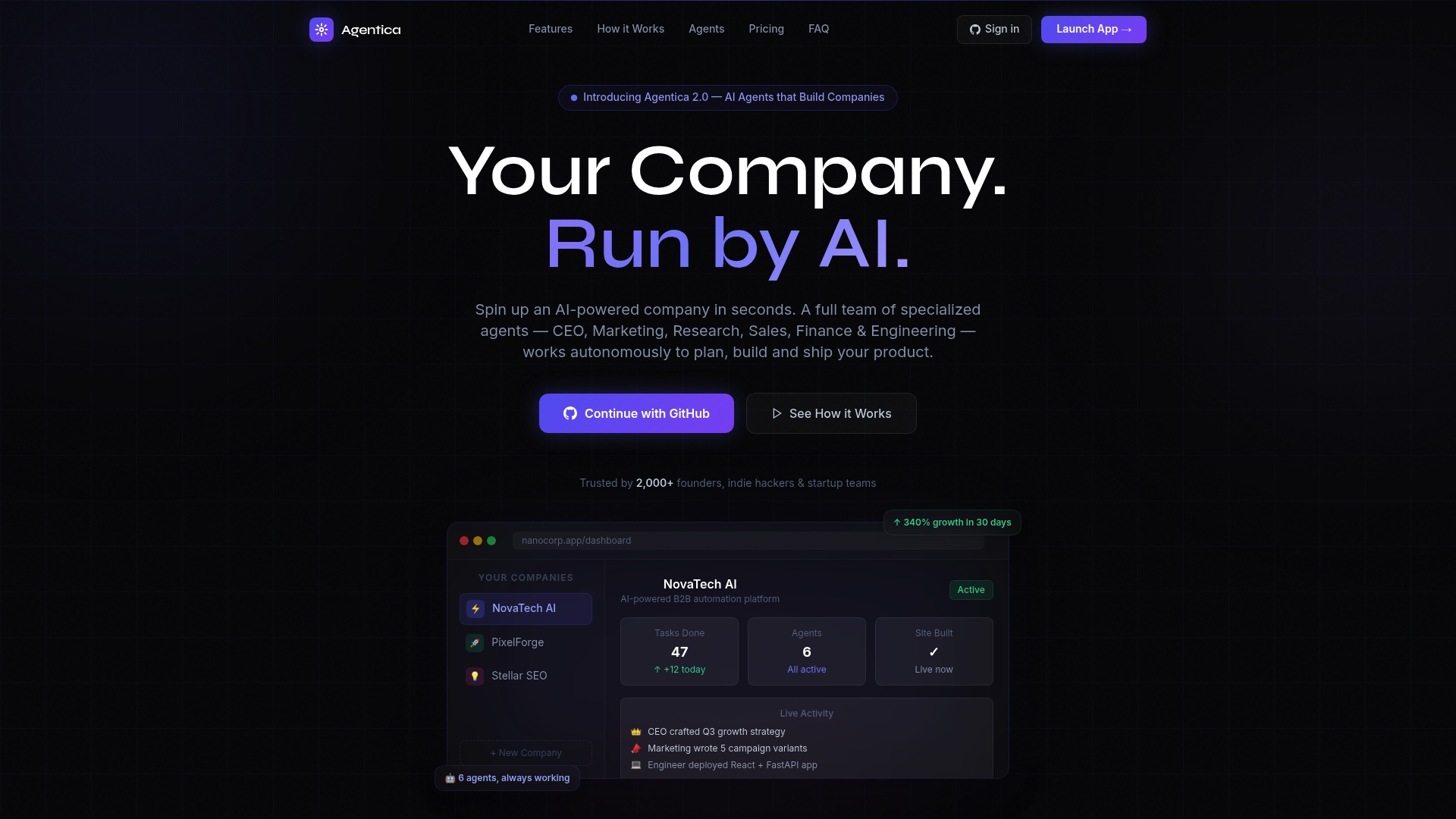
Agentica's autonomous agent platform includes human-in-the-loop controls, real-time monitoring, and transparent reporting so you always know what your agents are doing. Non-technical founders can focus on vision while the agents handle strategy, coding, and deployment. Astarlabshub reports 340% growth for clients within 30 days of deployment. Explore how Agentica works and see which agent roles fit your current operational gaps.
FAQ
What are the six operational support AI agent types?
The six types are Triage, Extraction, Research, Copilots, Multi-agent Orchestrators, and Human-in-the-Loop Review agents. Each handles a distinct operational function, from classifying inbound work to coordinating complex multi-step workflows.
How do AI agents differ from chatbots?
AI agents differ from chatbots by their autonomy, reasoning depth, and ability to execute actions across connected systems. Chatbots handle reactive Q&A with minimal tool use, while advanced AI agents manage 10–50 or more connected systems autonomously.
What is a human-in-the-loop AI agent?
A human-in-the-loop agent inserts a human approval step before an AI finalizes a high-risk or irreversible action. Humans can approve, edit, or reject the agent's proposal, which keeps sensitive workflows safe and auditable.
Which AI agent type should a small business start with?
Most small businesses benefit most from starting with a triage or extraction agent, since these handle high-volume, repetitive tasks with low deployment risk. Scaling to orchestrators or multi-agent systems makes sense only after simpler agents are running reliably.
What is a multi-agent orchestrator?
A multi-agent orchestrator is a supervisory agent that coordinates multiple specialist agents across a long-running workflow, managing retries, state persistence, and progress reporting. It is best suited for complex processes like enterprise onboarding or compliance workflows that require parallel execution.