
Autonomous coding agents are AI systems that take a goal, generate a plan, edit code across multiple files, run tests, and self-correct iteratively without direct human input. This capability rests on three core technologies: large language models (LLMs) as reasoning engines, orchestration layers that coordinate tool use and state, and sandboxed runtime environments that execute code safely. The shift from passive AI assistants to autonomous programming agents that act independently marks one of the most significant changes in software development today. Astarlabshub's Agentica platform represents this new class of systems, where specialized AI agents handle coding, deployment, and business operations end to end.
How autonomous coding agents work: core architecture
The LLM is only the reasoning engine. The full agent system is the entire orchestration stack, including tools, state management, and the execution environment. Treating the LLM as the agent is the most common misconception developers carry into their first agent project.
A production coding agent has five distinct layers working together:
- LLM reasoning engine. The model reads the current context, decides what to do next, and emits a structured instruction. It never touches files directly.
- Tool registry. A predefined set of functions the agent can call: file reads and writes, terminal commands, code search, and test runners. Each tool has a typed schema the LLM must follow.
- Orchestrator and control loop. The coordinator that sends prompts to the LLM, receives tool call instructions, executes them through the harness, and feeds results back into the next prompt cycle.
- Context manager. The component responsible for assembling what the LLM sees on each call, including conversation history, retrieved code snippets, and tool outputs.
- Sandboxed runtime. An isolated environment where the agent runs shell commands, compiles code, and executes tests without risking the host system.
Pro Tip: Build your tool registry before you tune your model. The quality of your tool schemas determines how reliably the LLM can express intent. Vague schemas produce vague tool calls.
Robust orchestration layers handling shell errors, tool validation, prompt caching, and memory management matter more than raw model quality. Teams that focus on harness engineering consistently outperform teams that chase model upgrades.

How does the ReAct loop drive autonomous coding?
The ReAct (Reason + Act) loop is the engine behind every autonomous coding session. The agent alternates between thinking and doing in tight cycles until the task is complete or a stopping condition is met.
A typical task follows this sequence:
- Receive goal. The orchestrator assembles the initial prompt with the task description, relevant code context, and available tool definitions.
- Reason. The LLM produces a chain-of-thought analysis and decides which tool to call next.
- Emit tool call. The model outputs a structured JSON instruction specifying the tool name and parameters. Agents never edit files directly; the harness validates and executes the command.
- Observe. The harness runs the tool and returns the output: file contents, terminal output, test results, or error messages.
- Repeat. The orchestrator appends the observation to the context and sends the updated prompt back to the LLM.
- Validate. The agent runs linters and test suites as part of the loop, catching integration issues before any human reviews the output.
A simple task like adding retry logic to an API client may require 3–6 LLM API calls before the agent produces a passing test suite. Each call refines the solution based on what the previous tool execution revealed.
The JSON tool call format is not a convenience. It is a safety mechanism. Structured output forces the LLM to express intent precisely, which the harness can validate against a schema before execution. Freeform text output would require the harness to parse natural language, introducing ambiguity and errors.
How is context and memory managed in stateless LLMs?
Every API call to an LLM is stateless. The model has no memory of previous calls. The illusion of session memory is maintained entirely by the orchestration layer, which rebuilds the full context on every call.
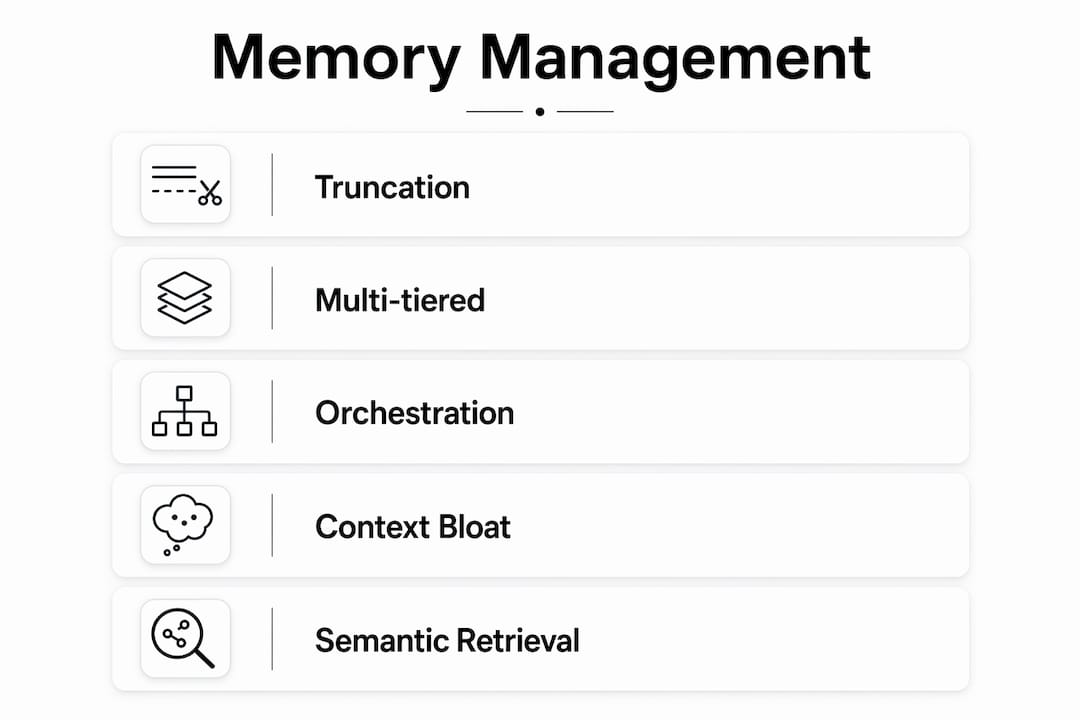
This creates a fundamental engineering challenge. As a task grows longer, the accumulated history of tool calls and observations can exceed the model's context window. Agents use four strategies to manage this:
| Strategy | Mechanism | Best for |
|---|---|---|
| Truncation | Drop oldest messages first | Short tasks with linear history |
| Summarization | Compress prior turns into a digest | Medium tasks with repetitive steps |
| Priority eviction | Remove low-relevance messages by score | Tasks with mixed-importance history |
| Semantic retrieval (RAG) | Fetch relevant code chunks from a vector store | Large codebases with sparse relevance |
Multi-tiered memory architecture addresses the problem more completely. Ephemeral in-context memory holds the current turn. Short-term caches, often built on Redis, store recent tool outputs for fast retrieval. Long-term vector stores hold indexed code, documentation, and prior session summaries that the agent can query by semantic similarity.
The orchestrator assembles stateful context using summarization and semantic retrieval to manage token limits and maintain session coherence. Getting this assembly right is the key engineering challenge in building reliable agents. A poorly assembled context produces hallucinations; a well-assembled one produces accurate, targeted edits.
Context bloat is a real production problem. Agents that accumulate every tool output verbatim hit token limits quickly and degrade in quality. The solution is aggressive summarization at defined checkpoints, combined with retrieval for anything the agent needs to reference again.
What advanced techniques improve agent reliability?
Production agents use several techniques beyond the basic ReAct loop to improve cost efficiency, safety, and scalability.
- Multi-model routing. Enterprise agents switch between models based on task complexity: local models for free or trivial tasks, cheaper cloud models for standard work, and frontier models for complex reasoning. This approach balances cost and performance without sacrificing accuracy on hard problems.
- Subagent delegation. Subagents with constrained context handle specific subtasks in parallel, preventing the main orchestration loop from accumulating context bloat. A primary agent might delegate test generation to one subagent and documentation updates to another, then merge results.
- Audit logging with SHA-256 hash chaining. Every tool call is recorded with immutable hash-chaining and 7-factor risk scoring. This guarantees auditability and prevents tampering with the action log, which matters in regulated environments.
- Guardrails and validation ladders. The harness applies schema validation, output filtering, and sandboxing before any tool call reaches the runtime. This prevents the agent from executing malformed or dangerous commands.
- Async background agents. Modern workflows let developers assign tasks asynchronously, freeing them to focus on other work until the agent finishes and delivers a pull request. This pattern is transforming how engineering teams structure their days.
Pro Tip: Start with a single-agent setup and add subagents only when you hit context limits or need true parallelism. Premature multi-agent architectures add coordination overhead that slows simple tasks.
The async pattern deserves special attention. Developers who treat agents as background workers rather than interactive assistants report the largest productivity gains. The mental model shift from "chat with AI" to "delegate to AI and check back" is what unlocks the real benefit.
How are coding agents applied in real software workflows?
Autonomous coding tools are already embedded in production engineering workflows across teams of every size. The practical applications fall into several categories:
- Multi-file editing. The agent reads a feature spec, identifies all affected files, makes coordinated edits, and opens a pull request. No developer touches the keyboard until review.
- Bug triage and resolution. The agent reads an error report, traces the stack, locates the root cause, applies a fix, and runs the test suite to confirm resolution.
- Automated test generation. Automated test generation and high-signal code review reduce manual effort and improve software quality. Agents write unit tests for new functions as part of the same task that writes the function.
- IDE and terminal integration. Agents run inside VS Code extensions, terminal sessions, and cloud-based development environments, meeting developers where they already work.
- Continuous feedback loops. Agents monitor CI/CD pipelines, catch failing tests, and submit fixes without waiting for a human to notice the failure.
The business impact is concrete. Teams using autonomous coding tools report significant reductions in manual coding time, freeing developers to focus on architecture decisions and product direction rather than repetitive implementation. Astarlabshub's Agentica platform applies this same model at the business level, where AI agents handle coding and deployment tasks end to end for startup teams.
The ecosystem around coding agents is maturing fast. Custom agent libraries, enterprise access controls, and continuous feedback loops are now standard requirements for any serious deployment. Teams that treat agent adoption as a one-time setup rather than an ongoing engineering practice consistently underperform.
Key Takeaways
Autonomous coding agents work because the orchestration layer, not the LLM alone, manages state, tools, and execution to close the feedback loop between reasoning and action.
| Point | Details |
|---|---|
| LLM is not the agent | The full agent includes the orchestrator, tool registry, context manager, and runtime environment. |
| ReAct loop drives execution | Agents alternate reasoning and tool calls, requiring 3–6 LLM calls even for simple tasks. |
| Memory is fabricated per call | Orchestrators rebuild context on every API call using summarization, caching, and vector retrieval. |
| Subagents prevent context bloat | Delegating subtasks to bounded subagents enables parallelism and keeps the main loop clean. |
| Async delegation multiplies productivity | Assigning tasks to background agents and reviewing pull requests later is the highest-leverage workflow pattern. |
Why orchestration beats model quality every time
I've watched teams spend months chasing the latest frontier model while their agent harness remained a brittle mess of string concatenation and hope. The results were predictable: impressive demos, unreliable production behavior.
The uncomfortable truth about autonomous coding agents is that the model is the easiest part to swap. Orchestration is where the real engineering lives. Prompt stability, context assembly, tool schema design, error recovery, and memory management determine whether your agent completes tasks reliably or halts on the third tool call with a malformed JSON output.
The async background agent pattern is the most underrated shift in developer workflow I've seen in years. Developers who stop treating agents as chat interfaces and start treating them as delegatable workers report the biggest productivity gains. You assign the task, you go do something else, you review the pull request. That mental model change matters more than any model upgrade.
My advice for teams adopting autonomous coding solutions today: build your harness first, instrument everything with audit logs, and start with the narrowest possible tool registry. Expand tool access only when the agent demonstrates reliable behavior with what it already has. Complexity added too early produces agents that are hard to debug and impossible to trust.
— Carlos
Astarlabshub's Agentica platform for autonomous agent teams
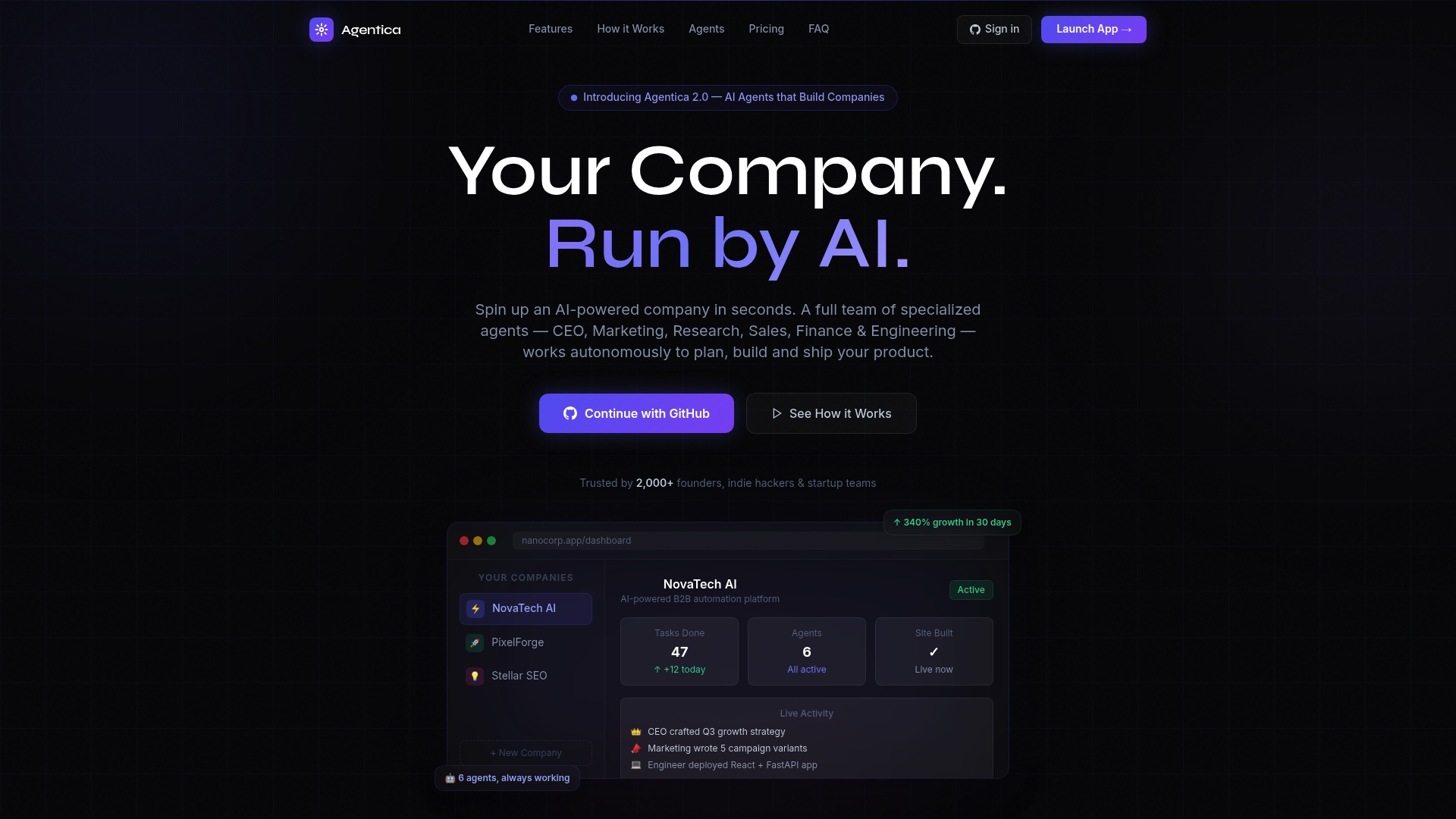
Astarlabshub built Agentica 2.0 for teams that want the full benefit of autonomous agents without building the orchestration stack from scratch. The platform deploys specialized AI agents covering engineering, marketing, and business operations, all coordinated through a single orchestration layer with real-time monitoring and full transparency into every agent action. Non-technical founders get a working product without writing a line of code. Engineering teams get autonomous agent workflows that handle coding, testing, and deployment end to end. Astarlabshub clients have reported 340% growth in 30 days using Agentica's autonomous mode. If your team is ready to delegate beyond individual tasks, explore Agentica's features and see what a full agent-powered operation looks like.
FAQ
What are autonomous coding agents?
Autonomous coding agents are AI systems that plan, write, test, and iterate on code changes without continuous human input. They combine LLMs, tool registries, and orchestration layers to complete multi-step coding tasks end to end.
How does the ReAct loop work in coding agents?
The ReAct loop alternates between reasoning and tool execution in cycles. The LLM decides what to do, emits a structured tool call, the harness executes it, and the result feeds back into the next reasoning step until the task is complete.
Why do coding agents need memory management?
LLMs are stateless, so every API call starts with no memory of prior calls. The orchestration layer rebuilds context on each call using summarization, caching, and semantic retrieval to maintain session coherence within token limits.
What is multi-model routing in coding agents?
Multi-model routing switches between local, standard cloud, and frontier models based on task complexity. This approach controls cost while preserving accuracy on the tasks that actually require high-capability models.
How do async background agents improve developer productivity?
Async agents let developers assign a coding task, continue other work, and receive a completed pull request when the agent finishes. This delegation pattern removes the need to supervise the agent in real time.