
Business decision automation with AI agents is defined as deploying autonomous intelligent systems that collect data, apply reasoning, and execute decisions without waiting for human input at every step. Production-ready AI decisioning systems achieve 92–96% accuracy and process decisions 50–100x faster than manual workflows. That gap between human speed and machine throughput is why entrepreneurs and business leaders are moving fast to automate business decisions with agents across procurement, customer service, and sales approvals. The industry term for this discipline is automated decision management, and understanding it is the first step toward deploying it reliably.
What does it take to automate business decisions with agents?
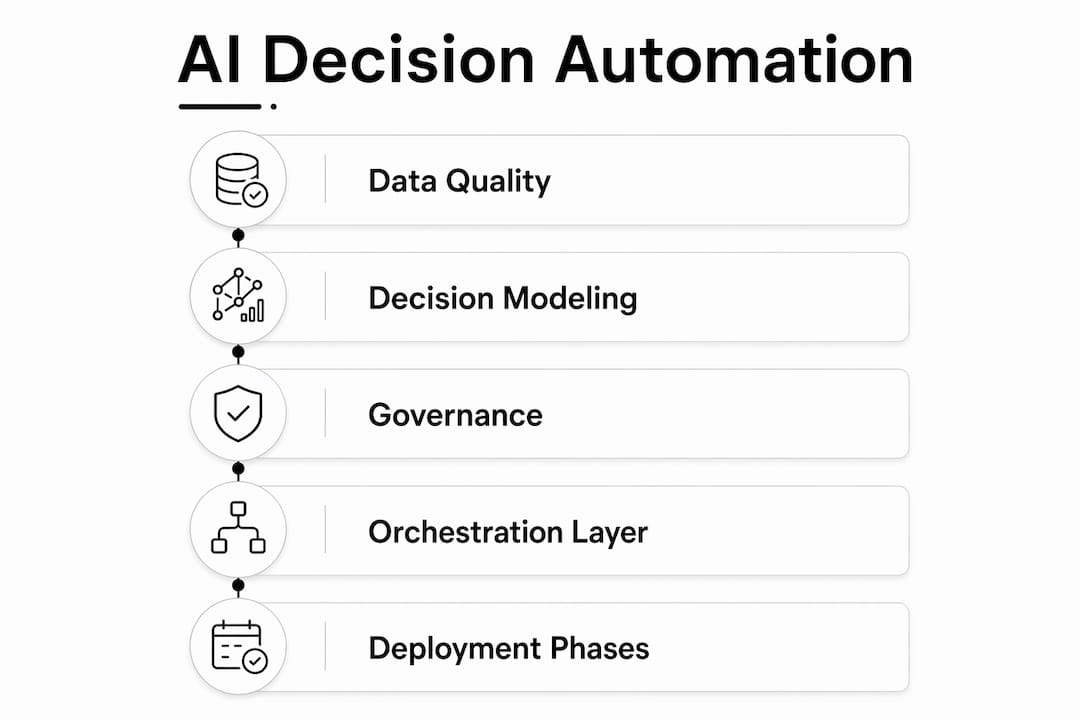
Three foundations determine whether your automation succeeds or stalls: data quality, decision modeling, and governance.
Data quality is non-negotiable. AI decision agents are only as good as the data pipelines feeding them. Clean, integrated, and labeled enterprise data is the raw material every agent depends on. Fragmented data sources produce inconsistent signals, which cause agents to make confident but wrong decisions.

Decision modeling means treating each decision as an explicit, manageable asset rather than an informal process. Managing decisions as connected, adaptive assets prevents outcome decay and enables continuous learning across your operation. When a decision is modeled explicitly, you can version it, test it, and audit it the same way you audit code.
Governance is where most early deployments fall short. Regulatory standards like ECOA and GDPR require human-readable decisions and fairness monitoring at every confidence threshold. A practical governance framework includes:
- Accountability ownership: one named person or team owns each automated decision domain.
- Audit trails: every input, model version, and output must be logged and immutable.
- Bias monitoring: agents must be tested against protected class variables on a scheduled basis.
- Confidence thresholds: decisions above 95% confidence automate directly; lower confidence routes to human review.
- Escalation paths: every agent needs a defined handoff point when uncertainty exceeds tolerance.
Pro Tip: Build your governance framework before you write a single line of agent code. Retrofitting compliance controls after deployment costs three to five times more than designing them in from the start.
The technology stack itself requires an orchestration layer that connects agents, workflows, and data pipelines. Types of autonomous business agents vary widely, from single-purpose rule executors to multi-agent teams with specialized roles. Choosing the right architecture depends on the complexity and volume of the decisions you want to automate.
How to implement AI agents step by step
A phased approach reduces risk and builds organizational confidence before you scale.
- Identify target decisions. Select high-volume, rules-heavy decisions first. Credit approvals, inventory reorder triggers, and customer tier assignments are strong starting points. Avoid decisions that require nuanced ethical judgment in the first phase.
- Audit data readiness. Map every data source the decision currently uses. Identify gaps, inconsistencies, and latency issues. A decision agent built on incomplete data will automate bad outcomes at scale.
- Select your platform. Choose a Decision Execution Platform (DEP) that integrates data ingestion, AI modeling, execution, and outcome measurement on a governed platform. Entry-level platforms handle single-domain decisions; enterprise platforms support multi-agent orchestration across business units.
- Prototype in shadow mode. Run the agent in parallel with your existing process. The agent makes decisions, but humans still execute them. Compare outcomes for four to six weeks before switching authority to the agent.
- Measure KPIs. Track decision speed, accuracy rate, human override rate, and downstream business impact. AI agents reduce manual research time by 98% in production environments. Use your shadow-mode data to verify you are approaching that benchmark before going live.
- Scale and calibrate continuously. Expand to adjacent decision domains only after the first agent is stable. Treat calibration as an ongoing operational task, not a one-time setup.
Pro Tip: Shadow mode is the single most underused tool in AI deployment. Leaders who skip it typically face a painful rollback within 90 days.
The table below shows how KPIs shift across deployment phases:
| Phase | Primary KPI | Target Benchmark |
|---|---|---|
| Shadow mode | Override rate | Below 20% |
| Initial live | Decision accuracy | 92% or higher |
| Scaled deployment | Throughput vs. manual | 50x or higher |
| Continuous operation | Drift detection rate | Zero undetected drift |
What challenges and mistakes should you avoid?
The most expensive mistake in business decision automation is building a monolithic super-agent that handles everything. Specialized modular agent roles such as Analyst, Strategist, and Governance agents collaborating as a team prevent single-point failures and enforce safety at each layer. A single agent that breaks takes your entire decision pipeline with it. A modular team degrades gracefully.
Decision drift is the second major risk. Agents trained on historical data gradually misalign with current market conditions, customer behavior, or regulatory requirements. Continuous calibration using adversarial inputs and periodic AI-Free human validation catches drift before it compounds into a compliance problem.
Immutable audit trails that capture the full chain of data inputs, reasoning steps, decisions, and human overrides are not optional. They are the foundation of trust, troubleshooting, and regulatory defense. Every automated decision must be reconstructable from first principles.
Over-automation is a real and underappreciated risk. Leaders sometimes automate decisions that carry legal or reputational weight beyond what current confidence thresholds can support. The role of AI in daily business tasks is to handle structured, repeatable reasoning at volume. Decisions involving significant human impact, such as employment or credit denial, require human review regardless of agent confidence scores.
Common pitfalls to watch for:
- Skipping data readiness audits and discovering gaps after deployment.
- Neglecting governance documentation until a regulator or auditor requests it.
- Automating decisions that exceed the agent's tested confidence range.
- Failing to define clear escalation paths, leaving agents to fail silently.
- Treating the initial deployment as finished rather than as the start of a calibration cycle.
How do workflows and AI agents work together?
Workflows and AI agents solve different problems, and combining them produces results neither can achieve alone. Workflows provide structure and auditability while agents handle dynamic reasoning and judgment-based steps. The practical question is not which one to use but how to connect them.
Two deployment patterns dominate production environments:
Workflows invoking agents. A structured procurement workflow reaches a vendor risk assessment step and calls a specialized AI agent to evaluate the vendor's financial data, news signals, and contract history. The agent returns a risk score and recommendation. The workflow resumes with that output and routes accordingly. This pattern keeps the overall process auditable while inserting AI judgment exactly where it adds value.
Agents invoking workflows. A customer service agent detects a billing dispute that meets defined criteria and triggers a structured refund workflow. The workflow executes the refund, logs the transaction, and notifies the customer. The agent handles the reasoning; the workflow handles the execution. This pattern prevents agents from taking freeform actions in high-stakes areas.
| Capability | Structured workflows | AI decision agents |
|---|---|---|
| Consistency | High | Moderate |
| Adaptability | Low | High |
| Auditability | High | Requires design |
| Judgment handling | None | Core strength |
| Best use case | Repeatable subprocess execution | Dynamic, data-driven decisions |
Human-in-the-loop designs improve overall scalability by having AI handle structured reasoning while humans manage exceptions. That division of labor is what makes the combined model work at enterprise scale. Neither pure workflow automation nor pure agent autonomy delivers the same reliability.
Pro Tip: Map your decision process on paper before choosing between a workflow-first or agent-first architecture. Decisions with clear rules and fixed steps belong in workflows. Decisions that require reading context belong with agents.
Key Takeaways
Automating business decisions with AI agents requires clean data, explicit decision modeling, modular agent design, and continuous governance to deliver reliable, scalable outcomes.
| Point | Details |
|---|---|
| Start with governance | Define audit trails, confidence thresholds, and escalation paths before building any agent. |
| Use shadow mode first | Run agents in parallel with human processes for four to six weeks before granting live authority. |
| Choose modular agent teams | Specialized roles like Analyst and Governance agents prevent single-point failures at scale. |
| Combine workflows and agents | Use workflows for repeatable execution and agents for judgment-based steps within the same process. |
| Treat calibration as ongoing | Adversarial testing and AI-Free human validation prevent drift and maintain compliance over time. |
Why I think most teams are automating decisions in the wrong order
Most entrepreneurs I talk to want to start with the most complex, high-value decisions they face. That instinct is understandable and almost always wrong. The decisions that feel most important are usually the ones with the most ambiguity, the most regulatory exposure, and the least structured data behind them. Starting there is how you build an agent that confidently produces wrong answers at scale.
The teams that get this right start with decisions that are boring and high volume. Inventory reorder thresholds. Customer tier assignments. Routing logic for support tickets. These decisions have clear rules, clean data, and measurable outcomes. They are also the decisions eating the most human hours per week. Automating them first builds organizational trust in the technology, surfaces data quality problems early, and generates real ROI before you tackle anything sensitive.
The second thing I see teams get wrong is treating the first deployment as a finished product. AI decision automation programs succeed when leaders treat them as continuous calibration cycles, not projects with end dates. The market changes. Customer behavior shifts. Regulations update. An agent that was accurate in january can drift into unreliability by july without anyone noticing until something breaks. Build the monitoring before you build the agent.
The future of this space belongs to modular, governed, continuously calibrated agent teams. Not to monolithic systems that promise to do everything. The AI agency automation leaders who win will be the ones who treat their agents the way great companies treat their best employees: with clear roles, regular feedback, and accountability.
— Carlos
Astarlabshub's Agentica platform for AI-powered companies
Entrepreneurs who are ready to move from theory to production need a platform built for the full lifecycle of an AI-powered business, not just a single automation task.
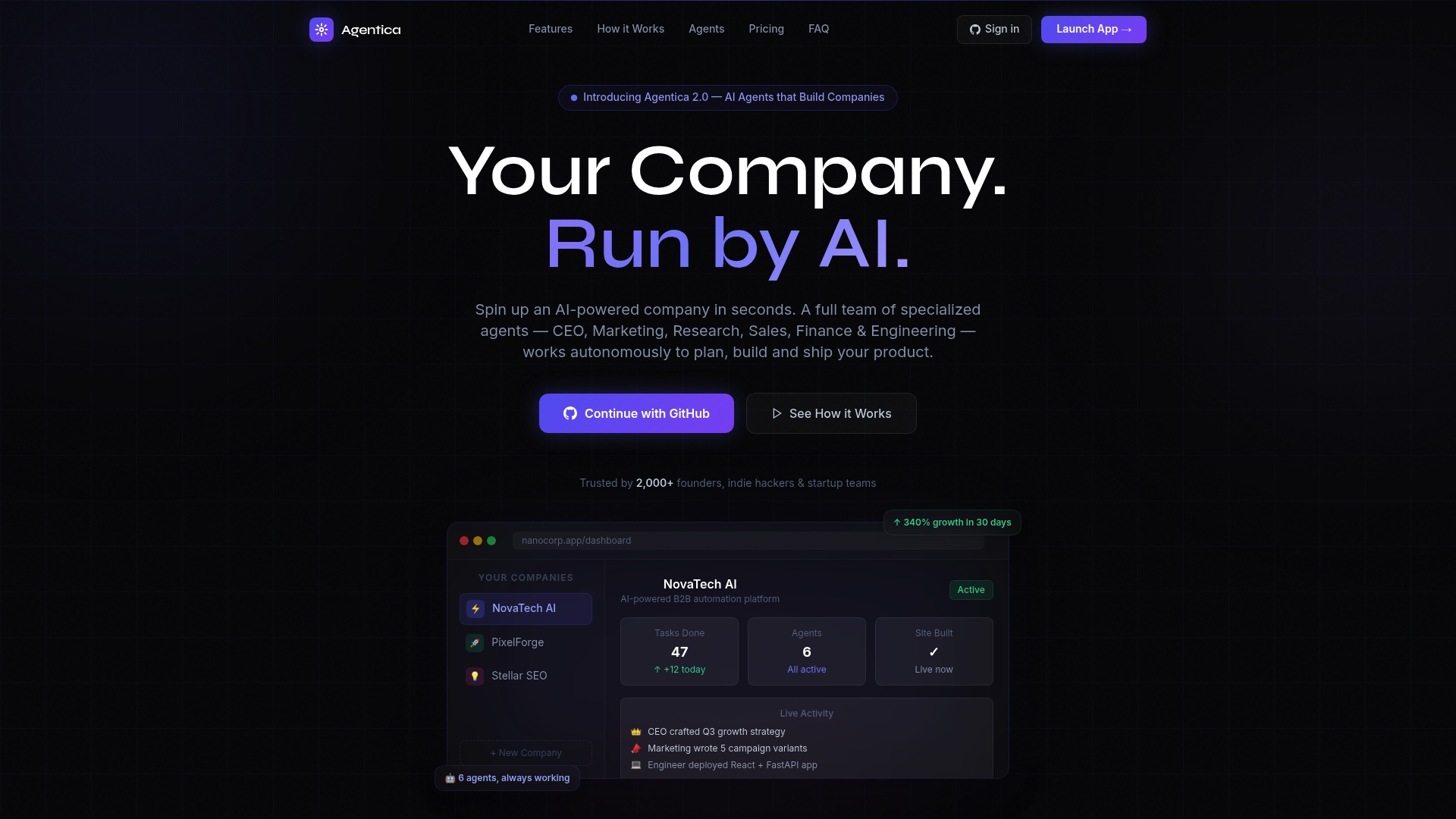
Astarlabshub's Agentica 2.0 deploys a coordinated team of autonomous AI agents covering roles like CEO, Marketing, and Engineer to manage strategy, product development, and deployment end to end. Non-technical founders can focus on vision while the agent team handles execution. Astarlabshub reports 340% growth for clients within 30 days, with real-time monitoring giving leaders full visibility into every agent action. If you are building a company that needs to make hundreds of decisions per day without a hundred-person operations team, Agentica's full feature set is worth a close look.
FAQ
What is business decision automation with AI agents?
Business decision automation with AI agents is the practice of deploying autonomous systems that collect data, apply reasoning models, and execute decisions without manual input at each step. Production systems achieve 92–96% accuracy and process decisions 50–100x faster than human-only workflows.
How many decisions can an AI agent handle at once?
AI agents reduce manual research time by 98% and can handle decision volumes that would require large human teams to match. The practical ceiling depends on data pipeline capacity and the orchestration architecture, not the agent itself.
What governance rules apply to automated decisions?
Regulatory standards like ECOA and GDPR require human-readable decision explanations and fairness monitoring. Any decision above a 95% confidence threshold can automate directly; lower-confidence decisions must route to human review under most compliance frameworks.
What is the difference between a workflow and an AI decision agent?
Workflows execute structured, repeatable processes with high consistency and auditability. AI decision agents handle dynamic, context-dependent reasoning that workflows cannot perform. Combining both produces more reliable automation than either approach alone.
How do you prevent AI decision agents from drifting over time?
Continuous calibration using adversarial test inputs and scheduled AI-Free human validation catches drift before it affects outcomes. Immutable audit trails that log every input, reasoning step, and decision make drift detectable and correctable.