
Finding an autonomous agent platform that launches company workflows quickly without complex setup or enterprise pricing remains difficult for most founders and teams. Many platforms target large enterprises with opaque pricing, required technical skills, or long setup times that lock out small teams and founders. This comparison matches automation, integration coverage, and deployment speed across five platforms so founders and teams can pick the best fit for their budget and workflow needs.
Table of Contents
- Agentica
- Relevance AI
- Kore.ai Agent Platform { Artemis }
- Bellagent
- Exova AI
- Comparison of alternatives
Agentica
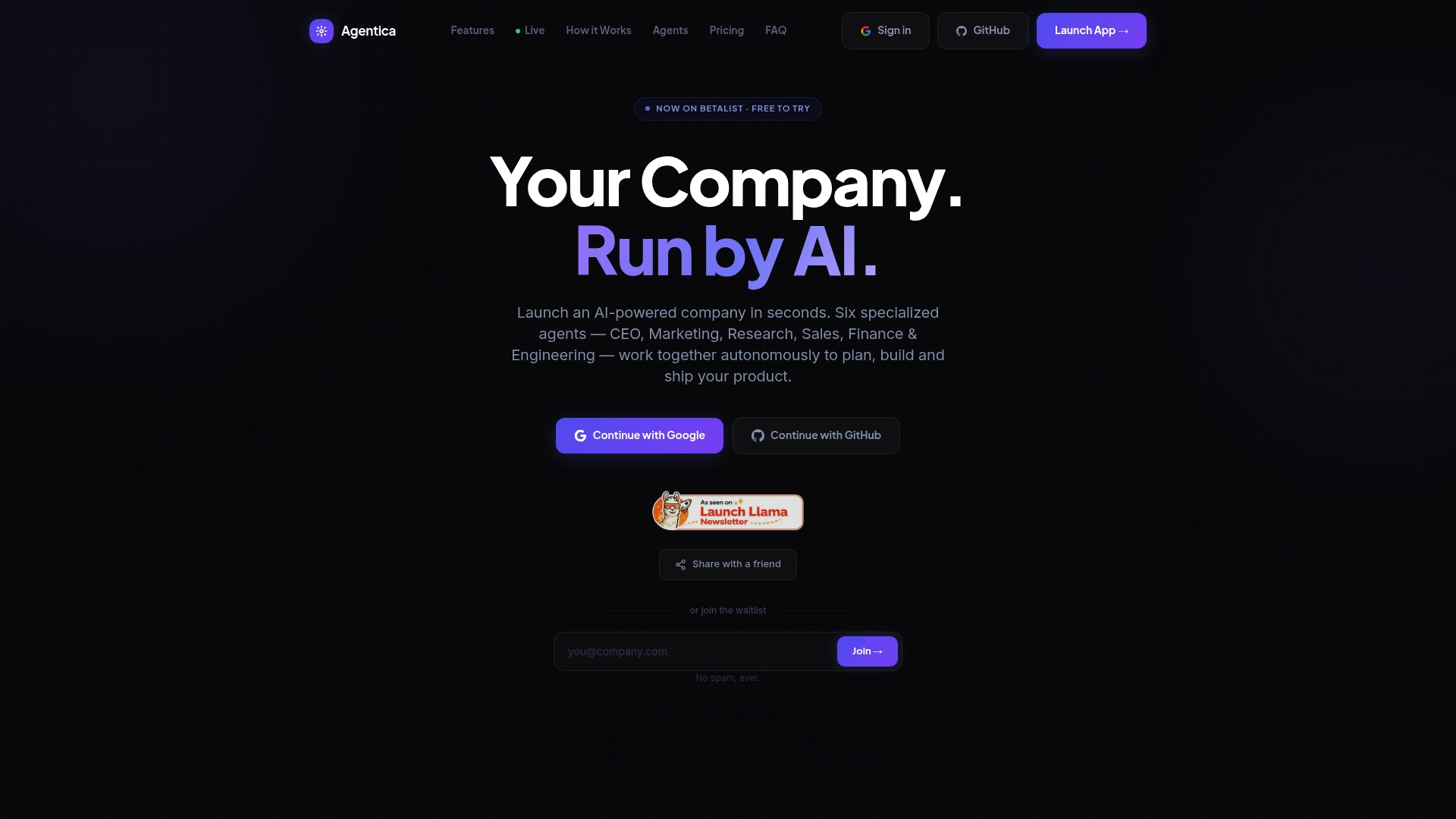
At a Glance
The vendor advertises 340% growth for clients in 30 days. Agentica runs a coordinated set of AI agents that plan, build, and operate companies. Non technical founders can launch products while watching agent reasoning in real time.
Core Features
A coordinated Multi-agent team covers CEO, Marketing, Research, Sales, Finance, and Engineering roles to execute tasks end to end. The platform includes a Full-stack application generator that outputs React and FastAPI code and a landing page creator tuned for marketing. Agentica also offers an Autonomous mode plus real time streaming of agent processes and reasoning logs for visibility.
Key Differentiator
The autonomous multi agent team plans, builds, and ships companies without manual intervention. Those agents handle strategy, coding, deployment, and marketing from a single interface. Real time logs let you audit agent decisions as they run.
Pros
Non technical founders can launch and manage AI driven companies because agents handle strategy, code, and deployment. Automation reduces the need to coordinate separate contractors for product, marketing, and operations. Open source and a self hostable option let technical teams move code on premises and keep control. The growth claim above is vendor reported and suggests fast impact for teams that match Agentica s assumptions.
Cons
- Limited third party integrations and ecosystem support compared with established toolchains
Who It's For
Founders and small teams who want to move from idea to live product without hiring full time developers. Entrepreneurs who accept some loss of manual control in exchange for faster delivery will get the most value. Early stage startups testing multiple concepts will find the platform useful for rapid experiments.
Unique Value Proposition
The full stack generator produces deployable React and FastAPI apps plus optimized landing pages while agents manage marketing and deployment. That setup reduces developer overhead and shortens time to a usable prototype. For non technical founders this converts strategy into running services with fewer external contractors.
Real World Use Case
A founder uses Agentica to spin up a SaaS prototype, have the Marketing agent create landing content, and let the Engineering agent deploy the app. The team watches logs as the system handles onboarding workflows and collects telemetry. That workflow cuts coordination overhead and speeds initial customer tests.
Pricing
Plans start at $29/month for the Starter plan and a free plan is available with no credit card required. Higher tiers add more company slots, credits, and advanced features for teams. Self hosting and enterprise options may affect total cost for larger deployments.
Website: https://astarlabshub.com
Relevance AI
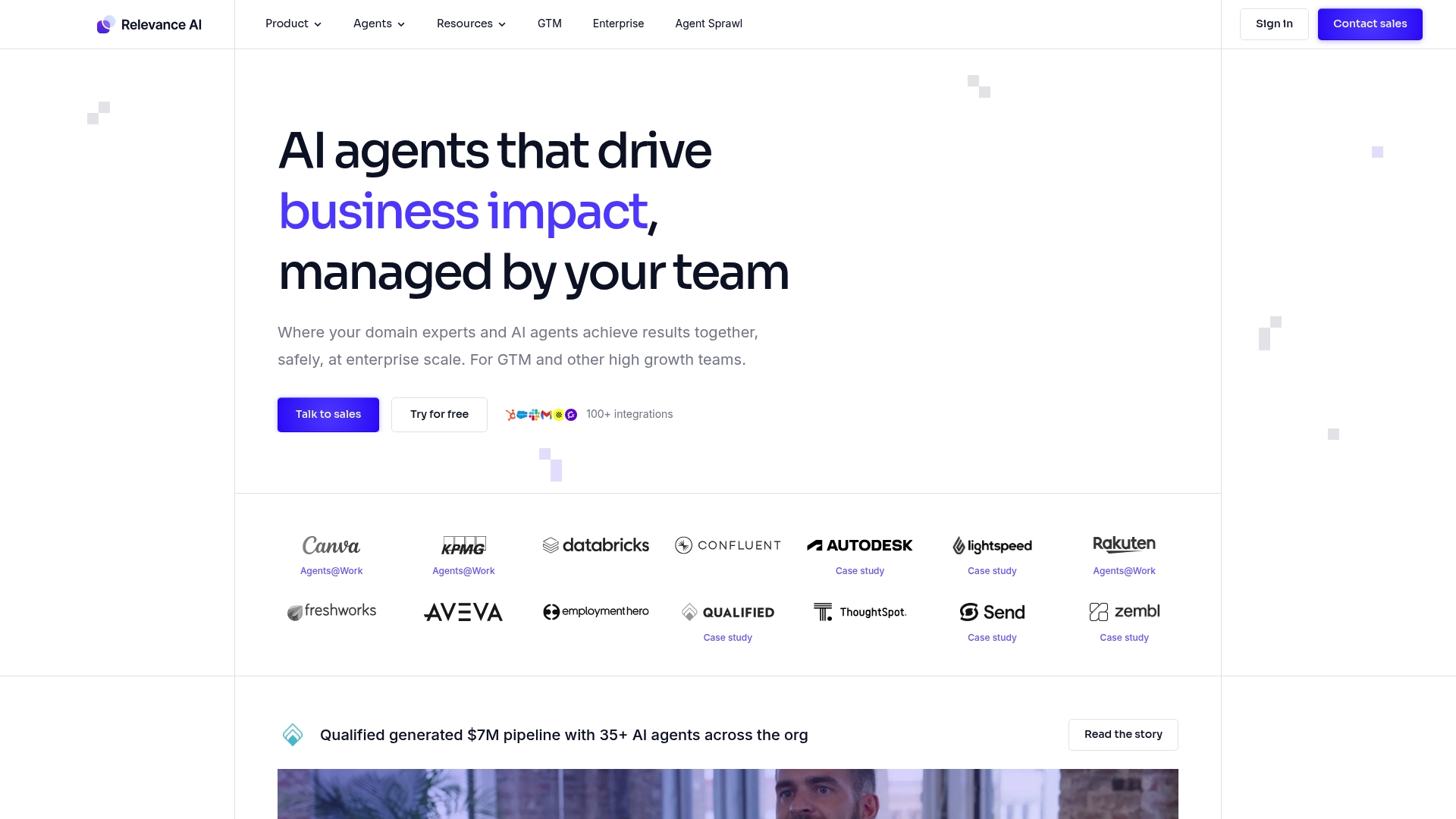
At a Glance
Relevance AI reports over 2,000 integrations, a striking figure for teams that must connect many existing systems. The platform targets enterprise deployments with features for governance, security, and compliance. It frames agent operation, so domain experts can own workflows without constant engineering involvement.
Core Features
Custom agent creation lets you describe desired behavior and deploy agents without hand coding. The platform captures metadata automatically from agent tasks and supports scheduling, approvals, and version control for safe operational changes. Collaboration features include chat embed and voice, while monitoring gives real time analytics across agents and operations.
Key Differentiator
The platform focuses on full autonomy under strong governance, pairing policy controls with broad tool compatibility. Relevance AI supports model agnostic deployments so you can switch or combine LLMs. That approach aims to let enterprise teams balance cost and capability while retaining operational oversight.
Pros
Relevance AI gives teams deep control over agent behavior, with governance and approval flows that match enterprise compliance needs. The product supports multiple LLMs and, as noted above, claims a very large integrations catalog; that figure helps reduce custom connector work. Domain experts can manage, version, and monitor agents directly, which reduces day to day engineering dependency. Real time monitoring and metadata capture make it easier to audit agent actions and measure business impact.
Cons
- Complex setup and operational governance may require dedicated staff and training.
- Pricing is not published and appears enterprise oriented, which may be costly for smaller teams.
- Potentially steep learning curve for teams without prior AI operations experience.
- The platform may be overpowered for single function automation or low volume workflows.
When It May Not Fit
If your team lacks staff for governance and change control, this platform will likely demand more operational effort than lighter tools. Small or medium size companies with limited budgets may find the enterprise pricing model difficult to justify. If you need a single point solution for one workflow, a focused automation tool may be cheaper and faster to deploy.
Notable Integrations
Salesforce, HubSpot, Gmail, Slack, Gong, Notion, Google Sheets, Azure DevOps provide common enterprise touch points you can connect to agents. These integrations support outreach, ticket workflows, analytics, and developer pipelines without building custom adapters.
Who It's For
Large enterprise teams and domain experts who must automate sales, marketing, support, or operations workflows under governance rules. You should have at least one person or team assigned to run AI operations and review agent outputs. The platform fits organizations that must support multiple LLMs and many third party systems.
Real World Use Case
According to the company, Qualified used Relevance AI to generate a $7M pipeline with 35+ agents in six months. That example shows multi agent outreach and qualification at scale, while another customer reported saving 40 hours per week by centralizing global AI operations. Those cases illustrate how broad deployments can both create revenue and cut manual workload.
Pricing
Pricing is not explicitly listed and appears to follow enterprise custom models. Expect negotiated contracts rather than a fixed public tier. Small teams should budget for setup, governance, and potential integration costs when evaluating total spend.
Website: https://relevanceai.com
Kore.ai Agent Platform { Artemis }

At a Glance
Kore.ai uses a structured language called ABL to define agent behavior and guardrails. The platform exposes a marketplace of templates and accelerators for faster development. Enterprises pick this product when they need observable, production ready AI agents for regulated workflows.
Core Features
Kore.ai supports AI agent building and scaling in production with modules focused on service and work. The platform includes prebuilt AI applications for banking, healthcare, retail, HR, IT, and recruiting and a Marketplace for templates, agents, and integrations. Developers author behavior and guardrails using ABL, while teams use the Enterprise modules to add governance and monitoring.
Key Differentiator
The vendor designed the system from the ground up with AI at its core, prioritizing observability and operational certainties for large deployments. That design yields tools for logging, monitoring, and controlled updates that map to enterprise compliance needs. Teams that must run high volume, regulated workflows will notice the emphasis on operational control rather than point product chat features.
Pros
Kore.ai reports hundreds of enterprise clients, which indicates the platform has seen real world scale. The product supports complex workflows and regulatory constraints and includes modules tailored to service and work that reduce integration gaps. The prebuilt applications for banking and healthcare cut initial development time, while the marketplace supplies reusable agents and templates. Built in observability and governance tools let operations teams track agent behavior and tune outcomes continuously.
Cons
-
The company does not publish detailed pricing, so smaller teams cannot quickly estimate total cost. This lack of transparency complicates vendor comparisons.
-
The platform is complex and presumes enterprise level AI or integration skills. Smaller organizations may need outside help to deploy advanced use cases.
-
There are no third party review summaries provided in the product material, which limits independent validation for buyers.
When It May Not Fit
Omitted
Who It's For
Large enterprises that must deploy AI agents across regulated processes and multiple channels will find this platform suitable. Teams that have integration specialists or enterprise AI expertise will extract the most value. Organizations seeking a turn key chatbot for a single campaign are unlikely to get cost-efficient results.
Real World Use Case
Global financial and healthcare firms use Kore.ai to automate customer service workflows, back office operations, and employee support. These deployments link agents to core systems, apply governance rules, and run with active monitoring. Deployments show the platform handles multi channel requests and strict compliance controls.
Pricing
Pricing is not publicly disclosed. Kore.ai follows an enterprise licensing model and likely prices by scope, modules, and deployment scale. Prospective buyers should request a custom quote from the vendor to get accurate figures.
Website: https://kore.ai
Bellagent
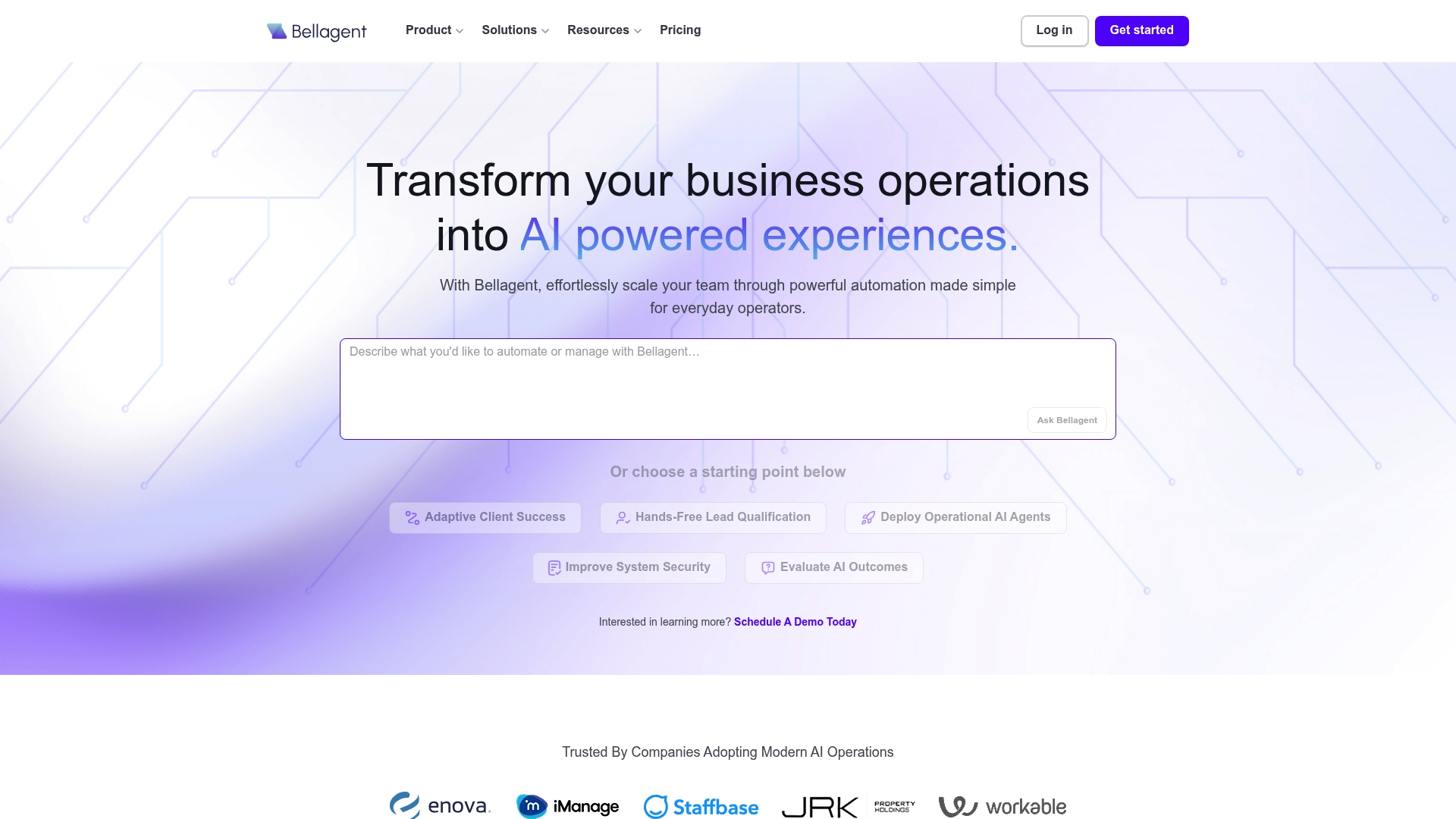
At a Glance
Bellagent's marketing materials state zero touch integrations with thousands of apps and instant deployment of ready to run AI agents. The product targets high velocity teams that need quick automation for lead qualification and follow-ups. Control features and real time performance tracking aim to give managers visibility into agent behavior and ROI.
Core Features
Bellagent provides prebuilt frameworks for common industry workflows, plus instant deployment of agents that handle routine tasks. The platform advertises zero touch integrations to connect data and systems without manual wiring, and it includes a control center for security and operational visibility. Teams can use real-time performance tracking to watch agent actions and measure return on investment.
Key Differentiator
The clearest distinction is the emphasis on ready to run AI agents that you can deploy immediately to live workflows. That focus prioritizes speed of launch over heavy customization. For teams that want working automation the same day, Bellagent positions deployment speed as its primary selling point.
Pros
Rapid deployment reduces setup time and lets teams try automation without long engineering cycles. High reliability and scalability are core claims, and the control center centralizes permissions, monitoring, and management for operators. Deep connectivity to external apps is another strength, and that claim supports passing data between systems without new middleware. These elements suit teams that need dependable automation and visible, auditable agent activity.
Cons
- Pricing details and tier structure are not publicly listed, which makes budgeting and comparison difficult.
- Independent third party reviews are not available to confirm the vendor claims about reliability and integrations.
- The product may not handle highly specialized or unusual workflows without vendor customization support.
Who It's For
Bellagent fits business teams that run high velocity sales, marketing, or support operations and that need quick automation of repetitive tasks. It matches groups that prioritize time to value over deep product customization. Nontechnical founders who want production automation without long engineering work will find the approach friendly.
Real World Use Case
A sales team installs Bellagent agents to qualify incoming leads and send follow up sequences. Agents handle initial qualification questions and route warm leads to reps, which lowers manual triage. Managers use the control center to monitor agent throughput and adjust qualification rules.
Pricing
Pricing is not publicly listed. Prospective buyers must contact Bellagent for pricing, deployment options, and any customization fees.
Website: https://bellagent.ai
Exova AI
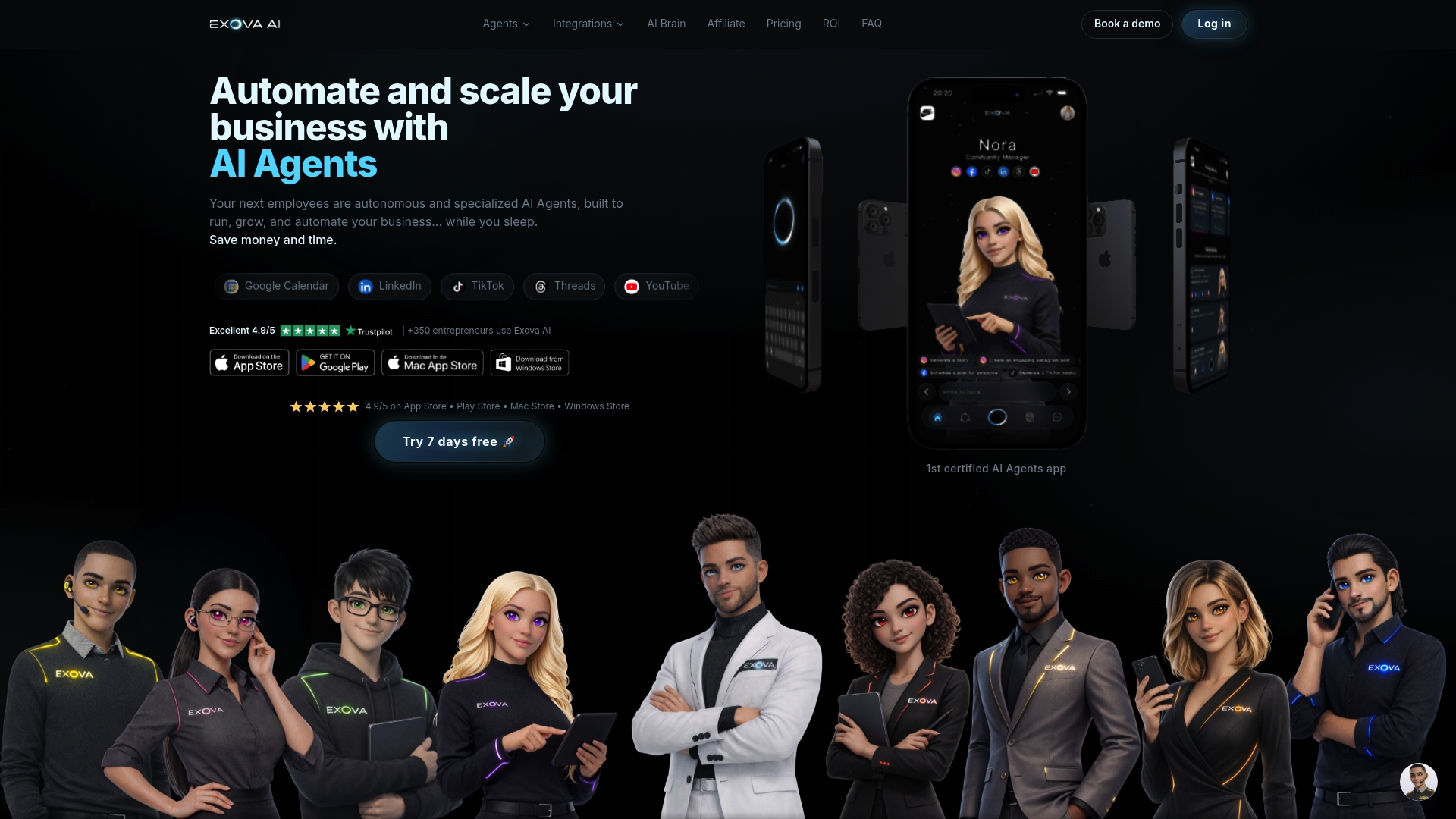
At a Glance
Claiming the first certified AI Agents app for coordinating multiple automation tasks, Exova AI centralizes agent control across social, support, and workflow agents. Exova AI reports a 4.9/5 rating on major app stores. The vendor advertises a 7-day free trial and emphasizes secure data handling and centralized agent orchestration.
Core Features
Exova AI automates content creation and scheduling for social platforms while offering AI chatbots for customer support. It also manages email and calendars through agents and coordinates tasks and workflows from a single interface. The platform supports secure integrations with social, communication, and e-commerce systems.
Key Differentiator
The primary differentiator is its claim to be the first certified AI Agents app capable of coordinating multiple business automation tasks from a single platform. That focus on central agent coordination makes it easier for nontechnical founders to delegate distinct operational roles to separate agents.
Pros
That 4.9/5 rating suggests strong user approval on app stores. The product supports a wide selection of external services, letting agents post, reply, or trigger workflows across social and communication channels. The platform groups specialized agents for social media, support, email, and calendar work, and it offers a 7-day trial so teams can test coordination and integrations before committing.
Cons
- Depends on stable integrations and internet connectivity for reliable agent operation, which can affect uptime for external channels.
- New users may find coordinating multiple agents complex while they tune permissions, prompts, and triggers.
- Specific implementation limits and advanced configuration details are not publicly listed, which makes procurement planning harder.
Notable Integrations
Exova AI connects to mainstream communication and social platforms including WhatsApp, Gmail, and Google Calendar, plus Instagram, Facebook, LinkedIn, TikTok, and Threads (Meta). Those integrations let agents publish posts, read messages, and sync schedules across channels.
Who It's For
Small to medium-sized businesses and entrepreneurs that need hands-off management of social posting, customer support, and internal workflows will find this useful. Nontechnical founders who prefer a single control surface for multiple automation agents will benefit most. Teams that require tight on-premise control or offline workflows may not gain full value.
Real World Use Case
A marketing firm used Exova AI agents to write campaign drafts, schedule posts across Instagram and LinkedIn, and handle initial client queries via chatbots. The agents also synced campaign milestones to the team calendar and routed support tickets to human staff when escalation was needed. That setup reduced manual scheduling and early-stage client triage.
Pricing
Exova AI offers a 7-day free trial. Beyond the trial, pricing details are not specified publicly, so you must contact the vendor for tiering, seat counts, or enterprise options.
Website: https://exova.ai
Comparison of alternatives
Choosing the ideal platform for implementing autonomous agents depends on understanding which solution aligns with operational needs and resource capacity. Each platform offers unique strengths tailored for different applications.
Deployment simplicity vs. capability depth
Astarlabshub.com offers a turnkey system where multi-agent teams autonomously handle business tasks including marketing, product development, and deployment, suited for founders and smaller teams desiring rapid setup. By contrast, Relevance AI excels in integration breadth, with over 2000 native connections facilitating deployment in highly interconnected enterprise environments. Bellagent emphasizes rapid, "zero-touch" deployment, targeting teams seeking to automate repetitive workflows without extensive customization efforts.
Governance and operational oversight
For organizations prioritizing compliance and governed operations, Kore.ai and Relevance AI stand out. Kore.ai employs a dedicated architecture emphasizing regulatory adherence and observability, positioning itself as a suitable choice for industries requiring strict process control. Similarly, Relevance AI implements governance-first workflows to ensure thorough oversight while maintaining flexibility with LLM model integration. These attributes may outweigh other feature sets for teams emphasizing operational integrity.
Best fit
- Astarlabshub.com supports startups and creators seeking to rapidly prototype and launch solutions with minimal manual oversight due to its autonomous end-to-end multi-agent capabilities.
- Relevance AI suits enterprises with a need for system interoperability and governance models, aligning with scaling complex, interconnected operations effectively.
- Bellagent is advantageous for teams requiring immediate automation of routine tasks without complex professional configuration efforts.
- Exova AI provides a consolidated control interface adept at managing specific operational workflows like social media and customer support for small to medium enterprises.
- Kore.ai is notable for enterprises managing compliance-sensitive workflows in regulated sectors, enhanced by its detailed logging and monitoring framework.
Our pick
Astarlabshub.com represents the most solution for nontechnical founders intending to actualize their business models into live, automated realizations, offering ease-of-use for independent creators. For high-governance projects or extensive integrations, alternatives such as Relevance AI or Kore.ai merit serious consideration.
The comparison highlights platforms tailored to autonomous agent workflows, with differentiation based on deployment flexibility, target audience fit, and pricing details.
| Product | Core Feature | Best For | Pricing | Limitation |
|---|---|---|---|---|
| Astarlabshub | AI agents for business functions | Nontechnical founders | $29/month onwards | Limited third-party integration ecosystem |
| Relevance AI | Advanced governance and integration | Large enterprises | Price not published | Complex setup requires dedicated staff and training |
| Kore.ai Agent Platform | Regulated workflow management | Enterprises handling compliance | Price not published | Presumes AI expertise, making smaller teams dependent on support |
| Bellagent | Instant deployment of agents | High-velocity sales and marketing | Price not published | Limited suitability for highly specialized workflows |
| Exova AI | Multi-agent orchestration | Small to medium-sized businesses | 7-day free trial, contact for pricing | Relies on stable integrations for dependable operation |
Choosing the Right Solution Among Futurehabits.tech Alternatives
Many founders and small teams struggle with turning ideas into launched products quickly without hiring full-time developers. The challenge often lies in coordinating strategy, coding, marketing, and deployment all at once. Agentica 2.0 from Astarlabshub offers a unique solution by using specialized AI agents that work together autonomously to handle these tasks, helping nontechnical founders achieve rapid growth—340% in just 30 days.
Astarlabshub's Agentica 2.0 stands out by giving you clear real-time monitoring and letting agents manage the full process while you focus on your vision. This reduces overhead and speeds delivery so your startup can test concepts and attract customers faster. Visit Astarlabshub to learn how Agentica can help small teams launch live products with less friction and increased control.
Agentica Landing Page
FAQ
How does Astarlabshub support non-technical founders in launching AI-driven companies?
Astarlabshub allows non-technical founders to launch and manage AI-driven companies effortlessly. The platform features a coordinated Multi-agent team that covers roles such as CEO, Marketing, and Engineering, making it accessible even without programming skills. Founders can start building their businesses while observing agent reasoning in real time.
What is the difference between Bellagent and Astarlabshub in terms of deployment speed?
Bellagent emphasizes rapid deployment, providing agents that can be instantly deployed to live workflows. Astarlabshub, while still efficient, focuses on a complete autonomous multi-agent workforce that manages strategy, coding, and marketing from a single interface, making it a better fit for comprehensive project management.
What specific integrations does Relevance AI offer that Astarlabshub does not?
Relevance AI boasts over 2,000 integrations, which enables users to connect existing systems seamlessly. While Astarlabshub allows the management of various operational tasks via its agent system, it has limited third-party integrations compared to Relevance AI's expansive ecosystem.
Can small teams effectively utilize Astarlabshub for testing multiple concepts rapidly?
Yes, small teams will find value in using Astarlabshub for rapid testing of multiple concepts. The platform is tailored for early-stage startups, allowing users to experiment quickly with prototypes while the multi-agent team executes tasks autonomously.
What unique feature does Kore.ai provide for enterprises that Astarlabshub lacks?
Kore.ai offers a structured language called ABL to define agent behavior and guardrails, focusing on operational control and observability for large-scale deployments. Astarlabshub, while efficient for launching products, does not offer such specialized language features aimed at enterprise compliance.